
Interview / Andrew Hemmert
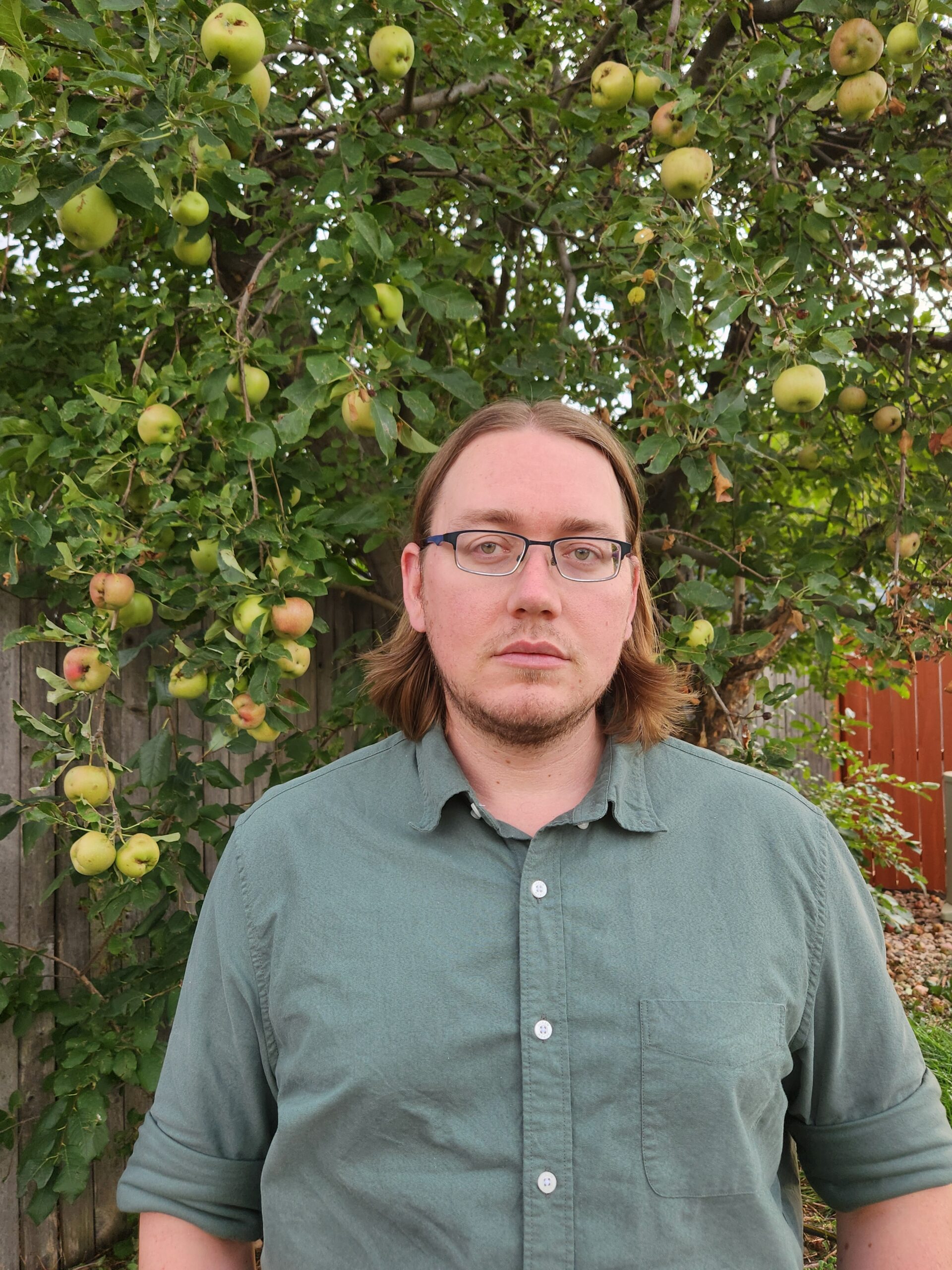
Andrew Hemmert
Editor: Brooke Harries: Andrew Hemmert’s No Longer at This Address is a collection of clear-voiced poems that focus on natural, technological, and personal history. Abounding in couplets, moving from past to future then past again, with tense shifts that reflect quiet hesitancy and wistful skepticism, these poems invite us to obliquely engage with the modern catastrophe of interferences to nature. They remind me of Emily Dickinson’s order to “Tell all the truth but tell it slant.” Imagery, rooted in realism, shows a way of seeing; “outdated phones” and remnants of natural history (“in a thick displace case,” / “the skull of a saber tooth tiger”) are both decidedly not thriving. Yet delightfully, Hemmert undercuts journalistic seriousness with punny images, such as an umbilical cord (in a poem featuring phones), and a voice that is as wry as it is vulnerable: “I no longer / have a cord, though once it was / the only way I ate.”
In our interview, Hemmert shared about choosing diction, the beauty of the world in ruins, and the natural consequence of attempting to write on landscape.
I was drawn to “Like Stars, Like Small-Town Churches.” In couplets that spread across three pages, it tells a story of driving to Denver to inspect a house. Nature is blended with the human domain, and the human-made world is anthropomorphized; an interstate, “overcommitted,” is reminiscent of the language of a time-constrained young professional. Hawks “like traffic cameras, or like stars / above the cheap nativity scenes / of small-town churches” drive home the point that humans have tampered with nature—perhaps at their spiritual peril. The final lines refer to churches “we pass on the way home,” and they present a haunting meditation on options pondered, of course, in hindsight. The possibly fate-changing turns in life, like choosing a new home or geographical region, are troubled by the interrelationships of nature and humanity.
There is a sparse loneliness in all the poems in the collection, yet they feel full, and for me, oddly comforting. Perhaps the pacing, how long one image is drawn out, is what causes the stillness, makes scenes evocative.
What are your considerations, in pacing, when you’re writing and revising poems? What are the voices in your head saying when you’re deciding things?
The first voice in my head is always music, so to speak. I’m writing descriptively, but I’m also writing in such a way that the sounds in the words are connecting to each other. There’s a phrase that Judy Jordan taught me called a sonic ladder, and by that she meant using sounds that you’ve already implemented in a prior line to help determine what words will appear in the following line. You’re going further into the draft on the “rungs” of echoing musicality, so to speak. You arrive at some fun and surprising images doing this, focusing on matching assonance and consonance as opposed to choosing dead-on diction.
As for pacing, I really don’t think about it during the initial composition. I’m just trying to chase interesting music and surprising images. In revision, however, I vary syntax for dynamism by changing sentence length and changing the placement of prepositional phrases in sentences. This is a great way to impart a given momentum in your poem.
In the titular and final poem, “No Longer at This Address,” the lines “In the face of destruction / it’s useful to keep a running list / of all the good things” offer a positive practical tip for readers, something a CBT therapist might suggest for summoning hope in challenging times. How do you balance the negative feelings that arise when writing about our dangerous time and the signs of damage to nature with something like wonder or hope?
I don’t balance it well! It’s psychological whiplash, but that’s just a natural condition of being aware of your surroundings, aware of the world and what we’re doing to it. I’m constantly bowled over by the beauty of the world, and constantly bereft at the ways in which we’ve ruined it, are still ruining it.
Just this last week, I was driving through Christmas FL on the way to the East Coast. We’d be in deep cool shade in heavy trees, oaks hanging low over the road and thick walls of pines on either side. And then harsh light would come through, and we’d be passing another new housing development. It’s scorched earth, the cleared brush and trees in smoldering piles. The stark scaffolds of new fast houses. It works like that. I’m driving along and I’m seeing beautiful things and I’m seeing the destruction of beautiful things in rapid succession. I’m mostly chasing that feeling in my poems. And there’s no therapizing that feeling away.
The hope comes in the idea that one’s depiction of the world might cause someone else to reconsider the flippant way they’ve engaged with the world. It also helps, I’ve found, to pick an environmental action group and send them money! I’d recommend the Florida Wildlife Corridor Foundation.
In a 2022 interview with Thomas Whyte, you identified recurring themes and obsessions: “climate change, work, what it feels like to belong to a place, how distance changes belonging.” Have these evolved, or have you added any new considerations?
That’s still the gist of it! Since that interview, I’ve added a few more places to my expanding poetic picture of home: Santa Fe, the Rocky Mountains, Cape Canaveral. I think there’s always going to be the question of place versus home in the constellation of belonging in my work. And our environmental situation hasn’t gotten any better since 2022, so that’s unfortunately going to continue to be a factor as long as I’m keyed in on place as a subject. I’ve been writing a little more lately about mental illness, though that’s probably been in the work all along. The new work just touches on depression and ADHD more explicitly.
An overarching theme in The Account Magazine is the act of offering “an account”—of bearing witness, or carrying and offering testimony. How do you see the poems in No Longer at This Address interrogating these ideas?
I appreciate that y’all give your writers an opportunity to provide an account with their work. It’s nice to have a little space to provide context or an addendum. The natural consequence of trying to write one place or landscape in full is being honest re: the factors at play in the degradation of said place or landscape.
In No Longer at This Address, I couldn’t write honestly about the grasslands and the mountains that encompass my new home without looking at those things that threaten my home. That means writing about the worsening wildfire threat, the disappearance of native flora and fauna, and the billionaires building rockets to escape the world they’ve wounded. My testimony would be incomplete without that, and that’s why those things appear in No Longer at This Address.
Andrew Hemmert is the author of No Longer at This Address (University of Pittsburgh Press), Blessing the Exoskeleton(University of Pittsburgh Press), and Sawgrass Sky (Texas Review Press). His poems have appeared in various magazines including Copper Nickel, The Kenyon Review, The Missouri Review, New Ohio Review, and The Southern Review. He lives in Thornton, Colorado.