Here’s Your Terrifying Cat

Nonfiction / Brenden Layte

:: Here’s Your Terrifying Cat ::

I’m sit­ting in a rent­ed car in a park­ing lot, and I’m con­vinced that my cat is dying. I breathe and try to talk myself down and think I remem­ber there being a word like hypochon­dri­ac but for some­one wor­ried about some­thing oth­er than them­selves. If I take my phone out to look it up, I’ll end up search­ing his symp­toms for ten min­utes and for­get what I took it out for, so I don’t. Maybe the word I’m look­ing for is just anx­i­ety.  

An abridged list of my recent inter­net search­es: cat fast breath­ing, cat heavy breath­ing, cat heavy and fast breath­ing, cat pant­i­ng, cat pant­i­ng for no rea­son, cat pant­i­ng no exer­cise, cat flared nos­trils, cat pant­i­ng and cough­ing, cat not able to jump, cat heavy fast breath­ing and pant­i­ng, cat sleep­ing in dif­fer­ent places, cat trou­ble get­ting up, cat smells dif­fer­ent.  

Maybe it’s not a case of me hav­ing what­ev­er the word I’m try­ing to remem­ber is, or the fact that he is sick, but the real­i­ty that he’s not the ani­mal he was a year, or even a few months ago, and had been in one way or anoth­er for nine years before that. And between his age and how sick­ness has a way of aging us even more, there’s a real­iza­tion that he might nev­er be the ani­mal he was again. I reach over to his car­ri­er on the pas­sen­ger seat and awk­ward­ly angle my hand through a hole to touch him. He licks my fin­gers until my hand begins to hurt from the carrier’s plas­tic and I pull it away.  

I fid­get in my seat, try­ing to com­fort both myself and the scared ani­mal next to me, and I think maybe I should just try to find that word to dis­tract myself, but then my phone vibrates and it’s a num­ber I don’t know, which I know means it’s the vet. I answer and they’re ready to see him. I get out and go around the car to open the door and grab the pet car­ri­er, then wait awk­ward­ly by the door before putting him down on a gur­ney when it rolls out­side. The car­ri­er was cov­ered in cau­tion tape the last time I left this ani­mal hos­pi­tal with him four years ago. 

I apol­o­gize to the vet tech in advance for the chaos they’re going to deal with when they open the car­ri­er, then walk back to the car and start rolling a cig­a­rette. I won­der how far away I’m sup­posed to go from the entrance to smoke here. Next to the car, I’m about 15 feet from the tents they’ve put out for peo­ple to sit under because there’s a pan­dem­ic and we can’t wait inside. That doesn’t seem far enough. I know there are rules at human hos­pi­tals, and I try to remem­ber what they are.  

I start walk­ing and end up at the far end of the park­ing lot hud­dled on a small tri­an­gle of lawn, smil­ing at the few peo­ple who pass by to use the near­by dog park. Their glances linger and I feel a tinge of embar­rass­ment and the urge to tell them that I smoke like five cig­a­rettes a month and only when I’m real­ly anx­ious and it’s bet­ter than the alter­na­tives. Instead, I look toward the build­ing and think that my being out here instead of inside with the cat is not going to go well for them. Depend­ing on how long things take, it’s prob­a­bly not going to be great for me either. 

~ 

The Hal­loween week­end before the pan­dem­ic, my friend leaned toward me at a bar, telling me about the time she was called into an exam room for a real pain in the ass of a cat at the ani­mal hos­pi­tal she used to work at. Since it was Hal­loween week­end, a band duti­ful­ly wore skele­ton cos­tumes and played a Mis­fits cov­er behind her. My friend said that when she entered the exam room, she saw a gray and white cat half-cov­ered by a pile of tow­els in the mid­dle of the floor hiss­ing and attack­ing any­one that came close. It wasn’t just show­ing the fear­ful defense pos­ture that all ani­mals have when they’re scared, but was ini­ti­at­ing attacks with the pri­mal anger that crea­tures save for those they’re sure mean to destroy them. The kind of anger that says, “I’ll destroy you first.” The vet techs already in the room were hid­ing or pressed into cor­ners. At one point, she said, one of them screamed, “He’s already been tranq’ed three times!” In the com­mo­tion, she didn’t rec­og­nize him as a cat she’d met many times before. She told me that my cat calmed down after the fourth shot. 

~ 

When my cat does tricks and gets pieces of food as a reward, he picks each up with his paw and brings it up to his face and some­times he drops it. If cats could be exas­per­at­ed, I’d swear he is in those moments, but instead of tak­ing the short cut and just reach­ing his mouth down, he grabs the food with his paw and brings it up to his mouth again. My cat responds to come, sit, high five, lay down, and roll-over, all of which are about what you’d think except roll-over, which has the embell­ish­ment of a protest meow about halfway through. And final­ly, there’s jump, which involves him jump­ing through a hoop made from card­board and duct tape and meow­ing at the peak of the jump, this time with more pride than protes­ta­tion. It’s a good thing to show peo­ple to prove that he’s actu­al­ly good when they were just attacked and maybe have blood on their legs because we were out­side and they came in with­out me to use the bathroom. 

When I’m get­ting the cat to do tricks, he often decides that he’s had enough and just stops in the mid­dle of roll-over and lays on his back, tail wag­ging side-to-side like one of those art deco nov­el­ty cat clocks. It’s not that he lays in a stu­pid posi­tion, or at least it’s not just that. It’s that he looks to me and seems to be try­ing to find a com­pro­mise, meow­ing up impa­tient­ly while he’s halfway through this thing that has become part of his social con­tract. Wait­ing for me to tell him that it’s okay to be tired or just not feel like it any­more and stop.  

~ 

Some­times I joke, or some­body else jokes, about how dam­aged my cat would be if he were a human and then I feel awful because most of the peo­ple I care about are dam­aged and it’s actu­al­ly not that fun­ny of a thing to joke about. My cat’s name is Pablo. He’s named after the poet and also a pen­guin from a car­toon I’ve nev­er seen that a per­son I don’t talk to any­more watched. I did have a friend who had a ger­bil named after the drug king­pin if that’s what you were think­ing, though. I don’t talk to him any­more either. 

~ 

Because of the attack­ing peo­ple and the four tran­quil­iz­ers need­ed the last time he was at the ani­mal hos­pi­tal, it took hours for them to get a diag­no­sis and tell me that Pablo had a uri­nary obstruc­tion and need­ed to be catheter­ized for a few days. It took less time than that for them to learn that his cage had to be cov­ered with a blan­ket at all times because oth­er­wise he would slam him­self into the sides of it and try to fight his way through the met­al to get to any­one that walked by.   

When he got home a few days lat­er, the usu­al­ly vocal cat had laryn­gi­tis from hiss­ing and growl­ing and doing the cat ver­sion of mani­a­cal­ly scream­ing the entire time he was in the hos­pi­tal. His mouth still con­stant­ly opened, but noth­ing came out. He stub­born­ly kept doing it, either try­ing to will noise from his bat­tered throat, or maybe he knew that I knew what the noise would have sound­ed like if it were there, and he was fine with let­ting me fill in the silence.  

~ 

Pablo was adopt­ed and brought back a cou­ple times before I end­ed up with him and when I tell peo­ple this, they nod know­ing­ly before real­iz­ing what they’re doing and being polite and stop­ping. When I first saw him, he was just under a year old and play­ing with anoth­er kit­ten through a glass win­dow at the shel­ter. The game was him run­ning around the lit­tle room he was in, bound­ing through a cat tree, and stop­ping hard at the glass and then the kit­ten, no more than a cou­ple months old, would stum­ble and wave his paws in the air and then Pablo would rub the glass and start anoth­er lap. When they stopped and Pablo laid in the lit­tle bed they had in his room, I asked the woman work­ing at the shel­ter to see him. She opened the door and I reached in and our first phys­i­cal con­tact was him grab­bing my hand with a paw, bring­ing it to his face, lick­ing it, and start­ing to purr. It wasn’t until after this that I saw his paper­work and found out he liked to hide around cor­ners and pounce at peo­ple, and some­times got real­ly upset for no good rea­son, and also that he real­ly didn’t like guests. By the time I found all that out, it didn’t mat­ter. He was com­ing home with me. 

Maybe it’s because of how he is, at least to peo­ple he doesn’t know, but maybe not being good enough for peo­ple who are sup­posed to love you and take care of you can make crea­tures a lit­tle dif­fi­cult and prone to emo­tion­al out­bursts. Peo­ple don’t believe me when I tell them that Pablo often waits for me at the bot­tom of the stairs to my door when I go out and if I’m gone too long, he cries until my down­stairs neigh­bor sticks his fin­gers under the door to com­fort him and give him food. When I get home, he climbs me and des­per­ate­ly rubs his face into me, some­times until he drools, and meows until I cra­dle him so that he can lick me until he gets over­whelmed and cud­dles into my arms to doze off, limp oth­er than the vibra­tions of his purring. Some­times peo­ple don’t get the whole sto­ry because they don’t know how we act when we feel safe. 

~ 

Before he got sick, while we were trapped inside for the pan­dem­ic, I’d real­ly got­ten to know Pablo’s dai­ly rhythms and needs in a dif­fer­ent way than I had before. I knew what would keep his com­plaints under con­trol before they even came. What each lit­tle noise meant: a sur­prised, soft trill; a two-part meow that falls in the mid­dle before com­ing back up and fill­ing the room; a purr that seems to push the lim­its of the hap­pi­ness a crea­ture can expe­ri­ence. I was famil­iar with them before, but I began to antic­i­pate his needs and have some­thing resem­bling two-way com­mu­ni­ca­tion. I learned what each tail swish and head tilt meant, what sleep­ing spots were for short- and long-term stays, what toys he liked at what time of day. With this, he began to stay clos­er for longer peri­ods of time. The love and affec­tion from him used to be aggres­sive, but often brief. Now, he sought pets and begged to be picked up. Now he came close and cud­dled up more often, even going so far as to begin meow­ing at a cer­tain pil­low every night so that I’d lay it next to me for him to sleep on, his paws draped over my arm. At ease; con­tent even. 

~ 

I’m not in the park­ing lot much longer after the cig­a­rette before I get a call and find out that they can’t real­ly exam­ine Pablo because he’s attack­ing every­one, and I have to come back next week and give him some stuff before­hand that will sup­pos­ed­ly relax him. The good news is that there were no obvi­ous heart mur­murs through the mul­ti­ple tow­els they were hold­ing him down with. I guess no obvi­ous heart mur­murs is bet­ter than obvi­ous even through tow­els heart murmurs. 

~ 

Anoth­er week of Pablo’s chest heav­ing, and his body curled up next to the sooth­ing cool­ness of the toi­let or the sink. He has trou­ble mov­ing or get­ting up. When he tries to, his front paws strain to get enough of his body up to com­mit to the act. And when he tries to play or exert him­self, his eyes widen before long and he freezes and lays down right where he is, even if it’s not a spot he likes. He used to jump on top of the refrig­er­a­tor from the floor, now he needs a chair just to occa­sion­al­ly vis­it me on the counter where I work. When he tries to get into the bath­room sink, a favorite sleep­ing spot that he’s climbed into a thou­sand times, he comes up short and has to pull him­self up, or he comes up real­ly short, slides down the cab­i­net, and just lies where he falls. He sleeps all day, his only move­ment the rest­less­ness of try­ing to find comfort. 

~  

After a week, I get up at 6:00 a.m. and give Pablo his sec­ond dose of the med­i­cine that the vet gave me that will sup­pos­ed­ly make him eas­i­er to deal with, and he does seem more docile than usu­al. I think about how easy it is for me to give the med­i­cine to him, and then think about how I can clip all of his toe­nails in a minute or two with him purring the entire time, hap­py for the close­ness and atten­tion. Most peo­ple that know him wouldn’t believe these things, but to me they’re just who he is. 

I walk to get the Zip­car I rent­ed; it’s ear­ly July and it’s the ear­li­est I’ve been out­side since the win­ter. We’ve been in a months-long series of heat waves, swel­ter­ing air crash­ing over and engulf­ing every­thing and then giv­ing us just a day or two to wring every­thing out before crash­ing down again. This morn­ing is cool. I dri­ve back home and pick Pablo up and drop him off to wait for news all day. 

I half­heart­ed­ly try to work when I get home. The lack of his pres­ence makes the apart­ment seem like a dif­fer­ent place. Final­ly, the vet calls. Pablo has asth­ma and seri­ous hyper­thy­roidism. It only took three tran­quil­iz­ers to exam­ine him this time. 

~ 

I’m back in the park­ing lot, wait­ing to pick Pablo up and wrestling with the pros and cons of treat­ment options. It sounds like he should be okay for a while but might slow down per­ma­nent­ly. Despite this, I can’t shake the thoughts about his death. They’ve been there a lot late­ly, not just these last two vis­its, but for months now. Part of me thinks it’s because death is such a nat­ur­al thing to fix­ate on right now, but it’s more than that. I had cats as a child, but their deaths nev­er occurred to me as a pos­si­bil­i­ty until they actu­al­ly hap­pened and the mourn­ing set in. When a creature’s well­be­ing is in your hands, it’s dif­fer­ent. There’s a sense of dread when some­thing goes wrong. A sense that when things change, it’s always for the worse and that it’s your fault and in the best-case sce­nario, you have to learn to care in a dif­fer­ent way, and in the worst, you might not have any­thing to care about anymore. 

But then I remem­ber how Pablo still jumped up on the counter to sleep next to me while I worked from home, even when he was sick. One day he was right up against me, upside down with a paw over his snor­ing face, con­tent until I made the wrong move and he nipped me and then vault­ed over a chair to the floor and dart­ed out of the room. And how one day he strung togeth­er a series of this noise he makes that I’d nev­er heard before I heard him make it—a meow that he holds as it gets high­er in pitch, then dives back into his throat and right back up again—and it sound­ed like he was hap­pi­ly ser­e­nad­ing me as I got home. Or that he some­how man­aged to rip off a huge piece of a spi­der plant that’s five feet off the ground when he could bare­ly move ear­li­er that day.   

I also think about the fact that although I’ve been treat­ed as ten­der­ly as he treats me by so few, ani­mal or human, I also know that he’d be damned if he’d let any­one or any­thing else do any­thing that made him uncom­fort­able for even a sec­ond with­out reper­cus­sions. One time my friend was too drunk to go home, and I woke up to him being attacked and yelling, “I am a per­son, you are a cat,” over and over again and either Pablo wasn’t into dis­cussing meta­physics at 6 a.m. or he’d had enough of the strange per­son on his couch and sim­ply didn’t care and wasn’t going to let a per­ceived pow­er imbal­ance stop him from fight­ing. And I start think­ing that atti­tude prob­a­bly applies even if the fight is between his will and his body. 

Maybe this will be what kills him even­tu­al­ly, and maybe his age is final­ly catch­ing up to him and it’s not pos­si­ble to run so hard or so with­out fear for­ev­er. And maybe that’s okay. Maybe hav­ing a favorite pil­low to set­tle into next to some­one you love instead of run­ning around all night is okay. Maybe slow­ing down a lit­tle is some­thing we earn, not some­thing we lose.  

It’s this that I’m think­ing as the vet tech approach­es me, hands me Pablo’s case, and says, “Here’s your ter­ri­fy­ing cat.” 


From the writer

:: Account ::

The first notes that would become this piece were writ­ten dur­ing what we now know were still the ear­ly months of the COVID pan­dem­ic. Watch­ing the unimag­in­able suf­fer­ing of so many, it felt strange to be wor­ry­ing so much about the health of an ani­mal that, part­ly through the nature of pets and part­ly through his par­tic­u­lar atti­tude toward most humans, only real­ly mat­tered to me. At least in any kind of seri­ous way. The idea that my remain­ing time with him could be lim­it­ed, or even end­ing soon, real­ly shook me. I’ve always had pets and loved a few of them a great deal, but Pablo is the first one I’ve been mature enough to love in a way that isn’t self­ish. I care about him not as a play­thing or a dis­trac­tion, but as a crea­ture wor­thy of a cer­tain lev­el of dig­ni­ty, and there was a feel­ing of help­less­ness in not being able to pro­vide that while he was sick. The core of this sto­ry is just that—what it’s like to watch some­thing you care about grow old, but I also want­ed part of the piece to be about the ways that I’d also changed since I’d adopt­ed him, and how steady and com­fort­ing of a pres­ence he has been over those years. 


Bren­den Layte is an edi­tor of edu­ca­tion­al mate­ri­als, a lin­guist, and a writer. His work has pre­vi­ous­ly appeared in places like Entropy, Ellip­sis Zine, and Pit­head Chapel. He lives in Jamaica Plain, Mass­a­chu­setts, with his girl­friend, some gold­fish, and Pablo, the ter­ri­fy­ing cat at the cen­ter of this piece. 


The Chino Center for Oral and Facial Surgery

Nonfiction / Silas Jones

:: The Chino Center for Oral and Facial Surgery ::

Today, my dad got his tooth pulled. He had an abscess. Now, he’s lying down. It’s so fuck­ing hot here. Here equals Ari­zona. All day, I’m wait­ing for the Ari­zona air to cool off and try­ing to decide what to put in the card­board box I’m mail­ing home to my apart­ment in New York. A wig from col­lege, my CD col­lec­tion in two fat black leather binders, a cou­ple half-full jour­nals. My flight home is on Sun­day and I don’t want to check a bag. All week­end, I’m wait­ing to leave. 

How to get to The Chi­no Cen­ter for Oral and Facial Surgery (It’s way out on 89): Pass the church that used to be a movie the­atre. Take the exit after Glass­ford Hill, the one that swoops you around to face Ante­lope Val­ley. Notice for the first time since being back at dad’s that Ante­lope Val­ley is fill­ing up with hous­es, iden­ti­cal, unfin­ished, with tem­po­rary blue tarp roofs weighed down with black stacks of shingles. 

Behind the hous­es, there’s Min­gus Moun­tain, and behind that, there’s the Verde Val­ley. My sense of direc­tion is like those children’s books with acetate over­lays that can be peeled away one by one to reveal: the hold of a pirate ship, the inner work­ings of an oil rig, the anato­my of the human body. 

Peel back Ante­lope Val­ley, peel back Min­gus Moun­tain, peel back Verde Val­ley and see a 1000-year-old stone vil­lage beside a 50-year-old heap of grey tail­ings from the cop­per mine up the hill. Peel back the Mogol­lon Rim and see the woods on top of it, see the San Fran­cis­co Peaks. Peel back the San Fran­cis­co Peaks and see a wilder­ness of pur­ple cin­der cones with Pon­derosa pines grow­ing straight from their peb­bled, vol­canic flanks. Behind them, the Paint­ed Desert and Black Moun­tain and then the Ver­mil­lion Cliffs, their feet buried in umber bad­lands. Peel back the Glen Canyon Dam and see Escalante and the white sand­stone piled in mile-high drifts out along State Route 12. 

On the car ride home, my dad speaks to me through a wad of bloody gauze. 

Wait, flip back five or six lay­ers and return to the Mogol­lon Rim; he says he’s con­sid­er­ing mov­ing up there. He’s think­ing about Payson. He’s think­ing about Pine or Straw­ber­ry. Hell, what about Hap­py Jack? Up there, it’s cool­er and the devel­op­ment is under con­trol. It rains still. He’s think­ing of mov­ing to the last intact colo­nial town in Mex­i­co. There’s no air­port; that keeps the riffraff out. We get off 89 and whip around a new traf­fic cir­cle pinned down at its pea-stone cen­ter by a giant, bronze stat­ue of a cowboy. 

The Oral Sur­geon was wear­ing square-toed cow­boy boots and teal scrubs and a wed­ding band made of grey sil­i­cone. I won­der if, after he pulls his hand out of the last mouth of the day, he trades the sil­i­cone ring for a gold one before dri­ving home to Ante­lope Valley. 

“How are you relat­ed to the patient?” he asked me when I came to grab my dad. I look at his cow­boy boots and weigh my options. I’ve made enough mod­i­fi­ca­tions to my body that I look, I think, approx­i­mate to boy; my ID says Sophie. 

“I’m his, uh, daugh­ter,” I said, trot­ting after him to a small room where my dad was reclined, fuck­ing with his IV. The oral sur­geon stands with his hands on his hips and looks at me. Behind him, there’s a framed por­trait of his fam­i­ly: a blonde wife and three small brunette daugh­ters posed in East­er dress­es beside Gran­ite Creek. In the building’s front office, less than an hour ear­li­er, my dad looked up from paper­work to point to an iden­ti­cal pic­ture and said too loud­ly, “Are they scoops or what?” Scoops is what my dad calls Mor­mons. Scoops miss­ing from their brains. 

The scoop sur­geon was wear­ing a mask and so was I, but my dad wasn’t. He looked acti­vat­ed some­how. I adjust­ed my eye­brows to express calm obliv­i­ous­ness to any embar­rass­ing resid­ual dis­ori­en­ta­tion he might be expe­ri­enc­ing. I smiled behind my mask and tried to look like a daughter. 

“When your father was going under, we noticed some irreg­u­lar­i­ties with his heart­beat,” the sur­geon said. I reori­ent­ed my eye­brows to show an appro­pri­ate amount of con­cern plus casu­al dis­re­gard, for my dad’s sake. “Your dad says he exer­cis­es all the time and that he’s a healthy guy,” the sur­geon said. 

“He is,” I said. 

“I am,” my dad said. 

“Well, it’s some­thing he should fol­low up with his pri­ma­ry care physi­cian about,” said the sur­geon (the scoop). He held his hand in a fist; “the heart is like any mus­cle.” He opened and closed his fin­gers, squeak­ing his sil­i­cone band; “it tires, it gets spas­my.” I made a hum­ming sound. 

“Okay,” I said. 

A nurse showed my dad and then me how to irri­gate the hole where his tooth used to be. I won­der what they’ve done with it. She loaded my dad into a wheel­chair and I held the door for her, all daugh­ter­ly. My dad slid into the pas­sen­ger seat of my Sub­aru, told the nurse that he can han­dle his drugs, thank you very much, and then we drove away. 

“The devel­op­ment out here is just out of con­trol,” he says sev­er­al times between the Surgery Cen­ter and home. There’s blood dry­ing on his lips. 

Yes­ter­day, my dad and me went for a bike ride through the raw pink gran­ite boul­ders beyond Glass­ford Hill. The rocks emerge glit­ter­ing from the erod­ing slope in a tum­ble, like mud squeezed in drips from a toddler’s tight lit­tle fist and left to dry in pil­lars and blobs. There are miles and miles of them. The trail is long, wide, and flat; it used to be a rail­road for the mine. We ped­al past four pairs of dads and daugh­ters. The daugh­ters are learn­ing how to ride bikes, or how to enjoy it. Bik­ing care­ful­ly behind my dad, I feel like the old­est mem­ber of a club. 

At the end of the trail, you can see out across Ante­lope Val­ley. To the west, you can see almost out to King­man, out to Bagh­dad and Search­light. Cow­boy towns. Peel them back and see the Mojave; see Cal­i­for­nia (on fire), see the Pacific. 

The land beyond the trail has been cleared and lev­eled and mea­sured out in squares. In the thin strip of shade cast by the near­est gran­ite spire, some kind of bad-look­ing machin­ery is parked. I can hear the beep­ing of some­thing back­ing up. It’s been rainy this sum­mer, and Glass­ford Hill is like Ire­land: green and empty. 

After I get him home from the Surgery Cen­ter, I make my dad a man­go smooth­ie. With it, he takes two Tylenol and three ibupro­fen because the scoop won’t give him opi­ates. Then, he goes to sleep. I dri­ve to CVS and buy ice packs and navy blue liq­uid eye­lin­er that I spend all after­noon try­ing to put on right. When I am not yelling down the stairs to ask my dad if he wants any­thing, I am as qui­et as pos­si­ble. He’s read­ing a huge book called Nixon­land, or maybe he’s sleep­ing. I avoid him because it feels like the kind thing to do; I don’t want him to see me see him in pain. I wor­ry I’m being inattentive. 

I used to date a boy with an ill­ness that required him to sit on an IV drip once every six weeks. He was real­ly sick, but he was also real­ly rich, so the treat­ment was admin­is­tered by a home health aide in the rec room in the base­ment of his par­ents’ brown­stone. The home health aide was an old­er black man in navy blue scrubs and match­ing crocs named Wil­son. The needle’s fold­ed plas­tic sheath looked like a but­ter­fly alight­ed on my boyfriend’s arm. It stayed there for hours. I stared at the TV. I was unsure of how much my boyfriend want­ed to be touched, or of how much was appro­pri­ate to touch him. I didn’t ask. Wil­son sat on a plush ottoman and when my boyfriend’s dad appeared with an arm­ful of hot sand­wich­es drip­ping oil, Wil­son chose turkey. 

Last time I saw my ex-boyfriend, we wan­dered end­less­ly around Fort Greene instead of sit­ting down for a beer like we’d planned because he was in so much pain he said he couldn’t stop mov­ing. He fin­ished a pack of Marl­boros; he start­ed anoth­er. We bought a six pack at a bode­ga and split it, and then we split anoth­er one. When the side­walk was busy, I fell into step behind him so I could watch him walk with a beer in one hand and his aching bel­ly flat beneath the oth­er. I real­ized I’d missed my chance to take good care of him. I put my hand on his back and steered him through a crowd gath­ered around a bad bike accident. 

I used to think he was a girl because when he gets drunk (relaxed) he is floun­cy and inse­cure. When he was sick in the rec room, he was too qui­et and still, sat on the couch with his sand­wich unwrapped and untouched in his lap. That’s how I knew he was a boy for sure. 

My dad keeps the win­dows of his house open all day and all night. Indoors, it is cool. Except today, it’s not. When the sun final­ly pass­es over­head, I escape onto the shad­ed porch. Behind the house, the Brad­shaw Peaks sling black shad­ows over the whole neigh­bor­hood. Hid­den in their wood­ed slopes are shal­low pits cleared by pio­neers a hun­dred years ago. Peo­ple call them mines, but they’re just hand-dug holes grad­u­al­ly refill­ing them­selves with pine nee­dles and crum­bling gran­ite and lit­ter. In front of the house, across 89, there’s a huge machine smash­ing bedrock into lev­el dust; they are build­ing a hotel. This neigh­bor­hood is a fire trap. 

I hear my dad come upstairs and I go back inside to ask him again if he wants soup, a milk­shake, an edi­ble from the unmarked jar in the fridge. There is sweat show­ing through his t‑shirt. He’s stand­ing per­fect­ly still over the kitchen trash can with his foot on the ped­al so the lid is stuck open, like a mouth. His jaw is slack and his eyes are trained on the wall. 

“Dad?” I say, “dad?” and he doesn’t answer, just moves his lips like he’s talk­ing. It dawns on me; I am in one of those moments. In this moment, I am stand­ing half on the porch and star­ing at my dad who is star­ing at the wall. I am real­iz­ing that some­thing is real­ly, seri­ous­ly wrong. I am in the moment of every­thing get­ting fucked up. I am in the moment before every­thing changes. 

I’ve been in these moments before; see­ing my ex-boyfriend stag­ger back when he stood up too fast from tying his shoes; watch­ing my sister’s lumi­nous face grow small­er and green­er the deep­er she sank into the pond; leav­ing Andy alone for ten min­utes, ten min­utes I swear, to run to the phar­ma­cy for anti-nau­sea meds. They’d just had top surgery and had been throw­ing up for hours from the opi­ates. I was sup­posed to be tak­ing care of them. 

From those times, I rec­og­nized the sen­sa­tion of a life about to be dif­fer­ent. But those times, every­thing had turned out okay, stayed the same; my boyfriend caught him­self against the ban­is­ter, I grabbed my sis­ter by her wrist, Andy took the med­i­cine, kept some water down. 

Then, my dad straight­ened up. He opened his mouth wide and began to talk around the mov­ing shape of his own tongue. “They pulled the wrong tooth, those fuck­ers,” I stared into the red black space where his molar had been. They had pulled the right tooth. 

“It’s fine, dad” I said, and then I helped him put his ear­ring back in. The scoop sur­geon had made him take the sil­ver hoop out of his ear and put it in a lit­tle dime bag. 

My dad hat­ed my ex-boyfriend, I think, but he won’t tell me for sure. They met once at my col­lege grad­u­a­tion and then a sec­ond time here, when my boyfriend flew out to vis­it and got imme­di­ate­ly sick from the dry air and high ele­va­tion. There was a dis­tance between them, even though I imag­ined they’d read the same selec­tion of non­fic­tion and nov­els that smart, sen­si­tive boys feel oblig­at­ed to: Von­negut and like, what­ev­er else. 

We had already been late for our flight home when my boyfriend slammed his fin­ger in my car door. From the porch, my dad saw it hap­pen and threw down a bag of frozen peas that left smelly, wet spots on my boyfriend’s cor­duroy lap. With­out tak­ing my eyes off 41 to Phoenix, I lift­ed a hand from the steer­ing wheel and rest­ed it on his head. He radi­at­ed heat. 

“Please, don’t touch me right now,” he said. The fin­ger­nail turned grey and fell off and a few months lat­er, he dumped me. 

The oth­er night, perched beside him on a park bench, I asked to see it. His hands were long and bony and the same; his fin­ger­nails were uni­form. We sat for as long as he could han­dle, and then we kept walk­ing. He asked me if top surgery hurt, and I told him yes. 

“You know how I am with doc­tors,” I said, “I’m a mess.” I looked at him to see if he thought I was a mess. He didn’t say anything. 

“I don’t know what I would have done with­out Andy,” I said. I want­ed him to know; Andy is my best friend. Andy had been unafraid of the IVs and hos­pi­tal smells and asked good ques­tions of the nurs­es; they’d brought a pil­low for the Uber ride from the hos­pi­tal and made me a lit­tle snack plate when we got home and had done every dish. 

Andy got top surgery three months before I did, and I had done these things for them too. I want­ed him to know: I had run through the wet snow to get the med­i­cine, Pedi­alyte, and gin­ger ale, stuff I prob­a­bly should have thought to buy ahead of time. For a ter­ri­ble moment when I returned to the apart­ment, I was sure that they’d aspi­rat­ed on their own vomit. 

I didn’t tell him any of that. 

“No one’s ever known how to take such good care of me,” I said. I laid it on thick. 

I thought about him after I cut my tits off, when I was watch­ing TV, high and nau­seous. Even though we hadn’t spo­ken in near­ly a year, I’d con­sid­ered call­ing him the night before, when I was so afraid I could hard­ly speak to the friends I’d invit­ed over. Andy noticed me wig­ging out and asked every­one to leave soon after we’d fin­ished the piz­za. I didn’t tell him any of that, either. 

“You seem real­ly hap­py,” my ex-boyfriend said over his shoul­der. “Are you happy?” 

“I am,” I said, scis­sor­ing two fin­gers togeth­er until he passed me a cig­a­rette, already lit and canoe­ing in the breeze off the riv­er. Peel back Fort Green and that big hill and down­town Brook­lyn and the cour­t­house and the Duane Reed. Peel back Jorale­mon street. We had walked all the way to his par­ents’ house; he was spend­ing the night there and meet­ing Wil­son in the morn­ing. We kept walk­ing until we got to the river. 

Once, on the way home from a par­ty at a spa­cious loft that belonged to one of his friends’ par­ents, I’d thrown up right exact­ly here while my boyfriend watched ner­vous­ly from far away. The par­ty had been all boys and their girl­friends. The loft had been all high ceil­ings and pol­ished stain­less-steel sur­faces across which our reflec­tions slipped and slid like an upside-down reflec­tion in a cere­al spoon. 

The win­dow to the fire escape was so large that when I want­ed a smoke, I sim­ply stepped through it like a door instead of hav­ing to clam­ber or crouch. I remem­ber how the wet met­al slats left stripes on my socked feet, the flip­book flash of car head­lights between the truss­es of the bridge. Peel back the bridge and see ??? I was drunk and didn’t yet under­stand how any­thing fit togeth­er or stacked up in the city. I threw up and my vom­it slapped the cob­bled street below, scat­ter­ing tourists tak­ing pho­tographs with Man­hat­tan. My boyfriend walked me back through filmy acetate lay­ers to his par­ents’ house. He washed my coat and my pants while I slept. 

“I always knew you would tran­si­tion,” my ex-boyfriend said, offer­ing me anoth­er cig­a­rette. “Of course,” he added, see­ing my sur­prise in the glow of the riv­er. Peel back the riv­er, peel back the dock where we’d once caught a fer­ry out to the Rock­aways, peel back the finan­cial dis­trict, and Bat­tery Park, and then anoth­er riv­er. Peel back crowd­ed state after crowd­ed state until you get to the one where he and me met, at col­lege. Peel back the woods and wide main­streets and state­ly red brick and then peel back a few more fly-over states and see Ari­zona; see my dad on the porch read­ing Nixon­land, his cat sprawled beside him. 

“At your grad­u­a­tion, when your dad got so drunk?” he said. 

“Yeah?” I said. 

“I was a real­ly good boyfriend then,” he said, “I took good care of you then.” I walked him back to his par­ents’ house. He told me he’d like to see me again, and then I walked home. He has a new girl­friend; they’ve been in love for like, a year. Peel back the fan­ci­est parts of Brook­lyn until you reach the Children’s Muse­um; turn left, and there’s my build­ing. The next morn­ing, I drove to vis­it my dad in Ari­zona. I texted my boyfriend from Penn­syl­va­nia; hi to Wilson. 


From the writer

:: Account ::

I’m very attached to the land­scape of the state where I most­ly grew up. I lis­ten to peo­ple I know from my life in New York talk­ing about dri­ving through Ari­zona on their way from L.A. to White Sands and I get real­ly grumpy. Then, when I end up in the actu­al land­scape, vis­it­ing home, I feel real­ly grumpy too. It’s hard to be there because there’s no water and so much smoke and so many bor­der patrol and the vio­lence feels so present in gen­er­al. I wrote this sto­ry about watch­ing a land­scape change, about see­ing rela­tion­ships change. I also grew up part­ly in Wash­ing­ton state and have always loved the way Carv­er throws around the toponyms I know from child­hood to estab­lish a scene. It reminds me of how my par­ents and uncles—outdoor guides and seri­ous know­ers of the West, hip­pie drug­store cowboys—talk about Ari­zona. I tried to do some­thing sim­i­lar here. 


Silas Jones’s writ­ing has appeared in Hobart and The Wilder Voice, and is forth­com­ing in this Fall’s Foglifter and in Ice Floe Press’s Pan­dem­ic Love anthology.

Names Are Always Changed to Protect the Innocent

Nonfiction / Chanel Earl

:: Names Are Always Changed to Protect the Innocent ::

So when I say that tomor­row my nephews, Peter, James, and John, will be inter­viewed by the police, and that after­ward it will be decid­ed if they will live with one or the oth­er of their par­ents, you know their names have been changed. 

And when I write that my friend Lazarus—who is sev­en years old and spent the last twelve months receiv­ing reg­u­lar injec­tions of chem­i­cal poi­son through a port in his chest—just returned from a trip to Dis­ney World, and decided—after los­ing his leg, his hair, and most of his body weight—to stop chemo, that his name has been changed too. 

So have the names of his par­ents, Phillip and Mary, who have four healthy chil­dren, and will soon have four in the ground. I’ll call the oth­er three—who nev­er took in their first breaths—Bartholomew, Tabitha, and Matthew, and—for my sake, not theirs—imagine a moun­tain of flow­ers on their graves. 

I sit and write in silence, and I know that Anna, Eliz­a­beth, and Thomas are asleep in the next room. Eliz­a­beth has strep throat, which has pro­gressed into scar­let fever. Just a hun­dred years ago I would have been up all night won­der­ing if this was our last, but I have been instruct­ed to relax because she took antibi­otics, and the doc­tor insists she can go to school tomorrow. 

I go to her when she cries. Her fore­head is still cov­ered with bright pink spots, and I place my hands on her face and whis­per, Every­thing will be okay. Our breath­ing aligns. Thomas rolls over. He is hav­ing a dream. And I know we are all going to lose each oth­er some­day, but I can’t believe that mat­ters right now because my name is Martha, and I am going to feel this moment, and the next, and always the next. 


From the writer

:: Account ::

Every­thing in this piece is true. One evening while pro­cess­ing the pain of my sis­ter as she went through a divorce, the pain of my friend whose son was dying of can­cer, and my own wor­ry about my four-year-old daughter’s scar­let fever diag­no­sis, I got real­ly worked up about the inno­cence of the chil­dren and par­ents involved in every one of these sit­u­a­tions. I ate ice cream, and cried, and made lists about what I could do to help. Then this came out. I have tried many times to turn this piece into a poem, adding line breaks and play­ing with the rhythm. Ulti­mate­ly, it is and remains a micro-essay about a moment in my life. A moment of grief, con­fu­sion, and the real­iza­tion of mortality. 


Chanel Earl is a recent MFA grad­u­ate, a moth­er of four, and an aspir­ing gar­den­er. Her work has appeared in print and online. For more infor­ma­tion about her and her writ­ing, vis­it chanelearl.com.

Three Poems

Poetry / Claire Wahmanholm

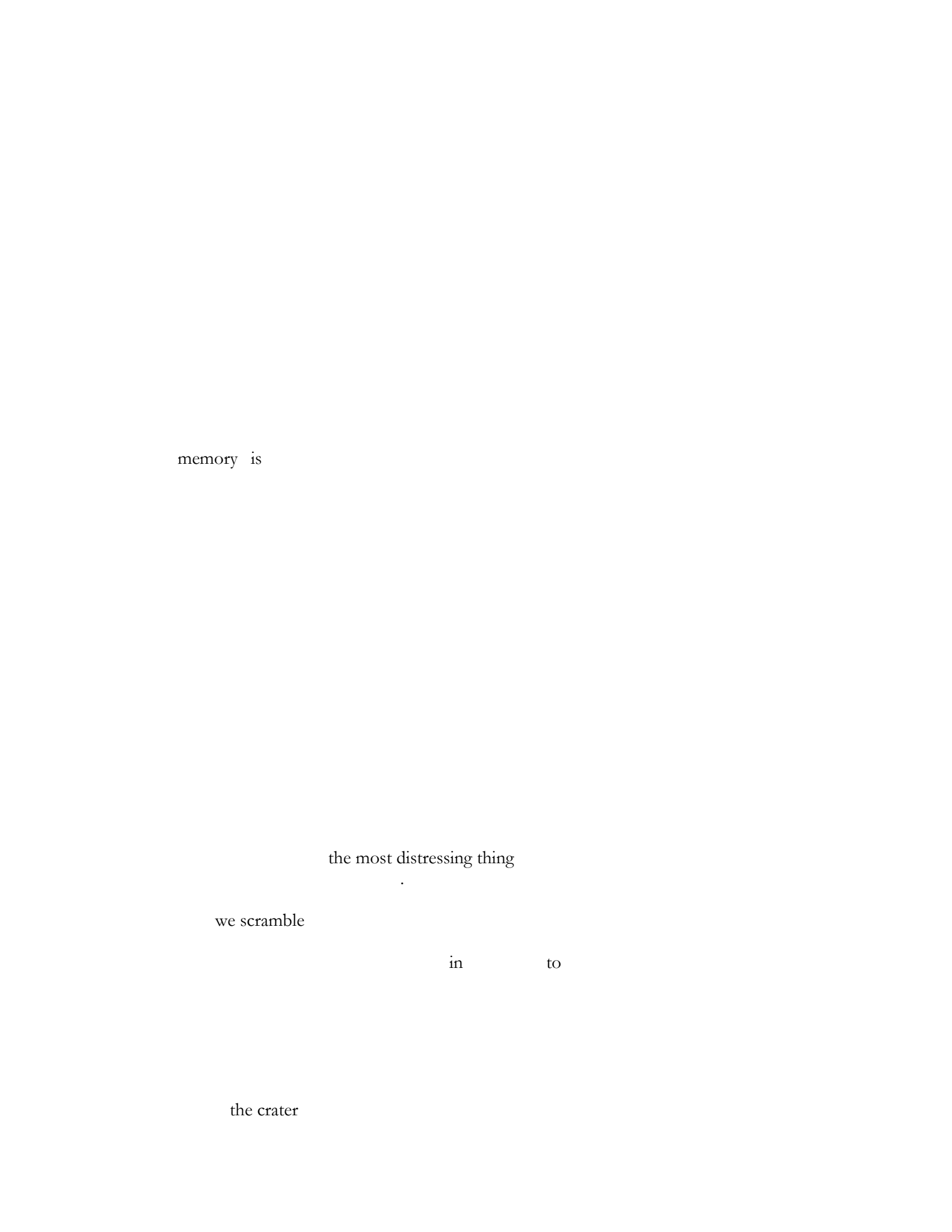
:: Meltwater ::


:: Meltwater ::


:: Meltwater ::


From the writer

:: Account ::

These poems are based on Lacy M. Johnson’s 2019 New York­er arti­cle “How to Mourn a Glac­i­er.” They would usu­al­ly be called “era­sures,” though I’d like to find a dif­fer­ent word for them since the poems—and I—don’t have the rela­tion­ship with the source text that often char­ac­ter­izes era­sure projects. I’m not inter­est­ed in using era­sure as a method of cri­tique or con­fronta­tion; I pre­fer to think of my inter­ac­tions as a kind of close read­ing. I see the era­sures func­tion­ing like any oth­er crit­i­cal essay on a text, except that I’m using only the lan­guage of the orig­i­nal source. 

My inten­tion was that the vis­i­ble words would point up a series of par­al­lel storylines—ones that are some­times more micro, and more macro, than the orig­i­nal. There are only so many things that can be made explicit/conscious at one time, so iso­lat­ing cer­tain words might be a way of untan­gling those threads and mak­ing each more vis­i­ble. In the case of Johnson’s orig­i­nal essay, she’s writ­ing about Okjökull while simul­ta­ne­ous­ly writ­ing about much more than it, and I see the lone­ly words as mak­ing that “more­ness” explicit. 

I am hop­ing that the project also makes a point about the way we read news, and our ten­den­cy to notice nar­ra­tives we’re already invest­ed in. The poems obvi­ous­ly say some­thing about me and my own pen­chant for see­ing grief in every­thing (as well as my impulse to put every­thing with­in the con­text of children). 

I saw the essay’s instruc­tion­al title as mak­ing an invi­ta­to­ry ges­ture to mourn, or to at least con­sid­er how mourn­ing looks for each read­er. I was com­pelled by the fact that my own mourn­ing, maybe, is already embed­ded in the orig­i­nal text, so that the essay is (poet­i­cal­ly) enact­ing the mourn­ing that it (jour­nal­is­ti­cal­ly) describes. I was try­ing to repli­cate on the page what I felt like my body was doing when I read the arti­cle, which was like a slow­ing down of my heart, or an uneven­ness in its beat­ing. Like large chunks of myself were being eat­en away. 

I was inter­est­ed in doing more than one era­sure (and iso­lat­ing dif­fer­ent words every time) to empha­size the cycli­cal nature of mourning—how we make minor adjust­ments with­out any sweep­ing over­haul, how it’s (appar­ent­ly) pos­si­ble to mourn the same things again and again but using dif­fer­ent words. I am hop­ing that the poems high­light the ten­sion between the appar­ent inabil­i­ty to communicate—the way we write arti­cles and arti­cles (and poems and poems), and noth­ing changes—and the impulse to keep try­ing any­way. And by mak­ing the high­light­ed words off-lim­its for the next poem, I was try­ing to show how the pool of words to draw from drains and drains. The way our vocab­u­lary dimin­ish­es and dimin­ish­es, we have few­er and few­er resources avail­able to us as we descend into grief.


Claire Wah­man­holm is the author of Night Vision (New Michi­gan Press 2017), Wilder (Milk­weed Edi­tions 2018), Red­mouth (Tin­der­box Edi­tions 2019), and the forth­com­ing Melt­wa­ter (Milk­weed Edi­tions 2023). Her work has most recent­ly appeared in, or is forth­com­ing from, Cou­plet, Ninth Let­ter, Black­bird, Wash­ing­ton Square Review, Good Riv­er Review, Des­cant, Cop­per Nick­el, and Beloit Poet­ry Jour­nal. She is a 2020–2021 McK­night Fel­low, and lives in the Twin Cities. Find her online at clairewahmanholm.com

Two Visual Poems

Poetry / Nance Van Winckel

:: Clearly ::


:: Auto Pilot ::


From the writer

:: Account ::

I’ve been work­ing on a kind of graph­ic nar­ra­tive about a char­ac­ter I call Admi­ral Dot. He’s full of hubris. He keeps try­ing, and fail­ing, to con­quer the skies. For the pages of his sto­ry, I begin with old pages from children’s books and oth­er pub­lic domain illus­tra­tions. Con­sid­er­ing these pieces my “can­vas­es,” I col­lage onto them and make many alter­ations as I crop and col­orize, etc. The text is my own, and gen­er­al­ly it evolves AS I rework the pages and think about poor old Admi­ral Dot and his world.


Nance Van Winck­el’s ninth poet­ry col­lec­tion, The Many Beds of Martha Wash­ing­ton, will appear in 2021 from the Pacif­ic North­west Poet­ry Series/Lynx House Press. She’s also pub­lished five books of fic­tion, includ­ing Ever Yrs, a nov­el in the form of a scrap­book (Twist­ed Road Pub­li­ca­tions, 2014) and Boneland: Linked Sto­ries (U. of Okla­homa Press, 2013). The recip­i­ent of two NEA poet­ry fel­low­ships, the Wash­ing­ton State Book Award, a Pater­son Fic­tion Prize, Poet­ry Soci­ety of America’s Gor­don Bar­ber Poet­ry Award, a Christo­pher Ish­er­wood Fel­low­ship, and three Push­cart Prizes, Nance teach­es in Ver­mont College’s MFA in Writ­ing Pro­gram, is visu­al poet­ry edi­tor for Poet­ry North­west, and lives in Spokane, Washington.

The Thing About Nature

Poetry / Wendy M. Thompson

:: The Thing About Nature ::

You lie smooth on your back, 
a long pier. 
Each bone is a cliff 
overlooking skin, fatty tissue, 
the best parts around the hooked jaw. 
 
The hairs at the back of your neck, 
small tufts of alumroot,  
were singed by the fire,  
along with feathers, claw,  
and cartilage. 
Smoky with ash, your teeth, and 
an upturned skull in the debris 
were the only evidence they found  
of global warming. 
 
Because there is never a soft way  
to indicate that  
          Man is responsible for the death of earth, 
they extracted the science first: 
a hair pulled from the lab, 
an entire species folded into extinction  
in the back of a  
leather-bound encyclopedia. 
What is science anyway but a wholly  
irrational, irrelevant, omnivorous,  
long-tailed thing? 
 
Instead, it was convenient to lie  
while looking for the 
match that ended the world:  
          an arsonist, white male, about 30,  
          wearing camouflage, holding a beer. 
It’s never the tire marks that  
mar your bed of sage, 
or the eventual highway that  
cuts across the height of your thigh, 
slicing through tendon, 
the fur still warm. 
 
                    New single family homes are being built in this development 
                    New single family homes are being built in this development 
                    New single family homes are being built in this development 
 
The deer that you carried,  
fractured by headlights, 
have migrated further east, onto  
new land  
slated for development. 
 
Every hour,  
the ocean drags you further away  
from  
your mother, 
your children, 
until there is no name  
left in the sand but, always,  
bits of shell and the people  
who come  
to collect them. 
Perhaps one of them will listen  
deeply enough to hear you  
calling for your family. 
 
It isn’t an echo, 
it’s an owl. 
It isn’t an owl, 
it’s a hybrid car backing out of the driveway. 
 
Night constellations map the fibers 
of your many homes: 
a womb,  
a nest,  
a meadow,  
a new three bed / two bath house 
inside of a cul-de-sac 
that was just built in this development. 
The sky is a quilt,  
is a mirror  
through which you look,  
and ask your ancestors,  
          Who’s the fairest of them all: 
          the gophers that dig up my lawn 
          or my right as a tax-paying homeowner to kill them? 
 
Because after all is said and done,  
the wet membrane  
from which you crack, 
the yolk that runs down  
the scruff of your throat when  
you (try to) pick up women  
ten years your junior, 
the savage expression you hide  
behind giant luminescent wings  
when your coworker Eric  
claims full credit and is  
promoted over you, 
the sea cave that rages 
in your throat  
when your father tells you  
he’s getting remarried  
to a brunette your brother’s age, 
the territorial way you mark  
your job title,  
your woman,  
your assets, 
even the blood that fills your mouth  
when you make her 
lie smooth on her back, 
a long pier, 
each bone, a cliff 
overlooking skin, fatty tissue, 
your erect jaw and open teeth 
tearing through her best parts around  
the hooked jaw, 
is anything but fully human. 


From the writer

:: Account ::

I wrote this poem after think­ing about the inter­re­lat­ed rela­tion­ship between Amer­i­can mas­culin­i­ty, pow­er, prop­er­ty own­er­ship, and nature. There’s this way in which the struc­ture of Euro­pean set­tler colo­nial­ism orga­nized all four into a matrix of dom­i­na­tion, pos­ses­sion, and (over)use that con­tin­ues to shape our lives and world today. Through force and vio­lence, the con­quest of native inhab­i­tants, flo­ra, and fau­na led to the aggres­sive amass­ing of land and resources with the ulti­mate intent being max­i­mum extrac­tion and pro­duc­tion for prof­it. Today, dom­i­na­tion, pos­ses­sion, and (over)use reside as core tenets that define a man’s val­ue and worth in soci­ety: his abil­i­ty to dom­i­nate all liv­ing and non­liv­ing things using direct or indi­rect vio­lence, his abil­i­ty to amass great wealth or prop­er­ty at the expense of the nat­ur­al envi­ron­ment, and his abil­i­ty to extract max­i­mum val­ue from what he owns or pos­sess­es. It is an unnat­ur­al way of life that has been made to feel and seem nat­ur­al. It is also the cause of tremen­dous detri­men­tal stress on our nat­ur­al world. 

I begin the poem describ­ing the human body as though exam­in­ing a non­hu­man ani­mal, sit­u­at­ing it in the midst of a land­scape that is per­pet­u­al­ly on fire and marked by human overde­vel­op­ment. Here, I want­ed to link us back to the world we work so hard to dis­tance our­selves from: one con­nect­ed to trees and plants and birds and preda­to­ry mam­mals. I then move to empha­size the way humans have ren­dered our nat­ur­al world unfa­mil­iar, exter­nal, and patho­log­i­cal, an emp­ty excess onto which we can build ever-expand­ing sub­di­vi­sions and cook­ie cut­ter hous­ing devel­op­ments. While we look at nat­ur­al dis­as­ters as vio­lent dis­rup­tions to our idyl­lic lifestyles, we rarely rec­og­nize the vio­lence that is present in our addic­tion to sub­ur­ban sprawl, to widen­ing and con­gest­ed free­ways and express lanes, and to the attack on nature when it shows up in the form of “inva­sive pests” in our back­yards.     

The rest of the poem inter­ro­gates how our man-made sur­round­ings have left us unable to imag­ine or reclaim our link­ages to our ani­mal kin and nat­ur­al world. Wildlife is dis­pos­able when it comes to build­ing new­er town­homes and sub­ur­ban devel­op­ments. And we find our­selves seek­ing out the calm­ing and heal­ing prop­er­ties of nature, dri­ving miles or fly­ing to pre­serves and oth­er wilder­ness sites far away to escape the mun­dane­ness and monot­o­ny of our every­day lives. In writ­ing this poem, I want­ed to stress the fact that we as human ani­mals have a respon­si­bil­i­ty to our nat­ur­al world, that our strained rela­tion­ship to/with nature must be appraised and reme­died, and that our prox­im­i­ty to non­hu­man ani­mals is a lot clos­er than we’d like to believe. 

I end the poem by play­ing with the notion of the “ani­mal,” a pejo­ra­tive term that we apply to humans who we per­ceive as behav­ing in ways that do not adhere to social norms or exhib­it accept­able deco­rum. Here, I cat­a­logue the ways that cer­tain expres­sions of raw human emo­tion, respons­es, and behav­iors are per­ceived as ani­mal­is­tic and can sig­nal our inher­ent wild­ness, chal­leng­ing us to con­sid­er how our instincts sit­u­ate us always close to nature no mat­ter how advanced and civ­il we strive to be. 


Wendy M. Thomp­son is an assis­tant pro­fes­sor of African Amer­i­can Stud­ies at San José State Uni­ver­si­ty. Her cre­ative work has most recent­ly appeared in Palaver, the San­ta Fe Writ­ers Project, Rap­pa­han­nock Review, Jet Fuel Review, and Wac­ca­maw Jour­nal. She is the co-edi­tor of Sparked: George Floyd, Racism, and the Pro­gres­sive Illu­sion (Min­neso­ta His­tor­i­cal Soci­ety Press, 2021). 

Excerpts From Your Baby Book

Poetry / Catherine Theis

:: Excerpts From Your Baby Book ::

You sleep for an hour. 
 
The bird flutters by the window’s screen just as you stir awake. 
 
I feed you again, hoping you will fall back asleep. 
 
You are quiet now. 
 
You are crying now, matter-of-factly. 
 
There is always a touch of the menace in the imagination. 
 
It’s hard to understand. 


The loneliness of the long-distance swimmer is like the loneliness of the mother. 
 
I hear you cry in the film’s soundtrack. 
 
The short film is usually in black and white but your cry is always color. 


Poems, babies, I have milk. 
 
I have loaves of bread, wheels of aged goat cheese 
 
and a bruise you would hardly believe. 
 
I have a small barrel of red wine ready 
 
to be tapped after seven o’clock 
 
and an entire dishwasher of stemware piping hot. 
 
I have an advent calendar with twenty-five tiny doors opening 
 
into a hallway of pure celestial light—


The facts of today: 

I buy a singular persimmon nicked by your teeth. 

I bring permission to myself to begin again. 

I whip heavy cream for a dessert custard of persimmon. 

The custard so sweet I don’t add any sugar. 

Your bumblebee hat still fits, so. 

The slide at the playground an entirely new experience. Have we officially exhausted the swings? 

I hold onto your tiny torso while simultaneously letting you slide down. You look the part of a young bumblebee. 

We buzz on home under the pink toxic skies of Los Angeles. 

I buy a second persimmon from Bob’s Market. 

You get to work immediately, scoring its smooth orange skin with your luminous front tooth, a surprising ferocity. 

Your fist smaller than the globe of fruit.


Closer and closer you inch toward 

the spinning center of creation. 

Your preferred method of transport 

the whirling, lurching see-saw of swing. 

Your clothes grow tighter. Two colds, 

one with one cough. We wash blackberry 

stains from your booties every night. 

Birthday celebration? Champagne, 

oysters, blackberries?


From the writer

:: Account ::

I decide to write again out of the nothing. 

The appro­pri­ate amount of time has passed. I have griev­ed enough for my body. The world glows in spring­time green. I almost for­get how quick­ly the hem­or­rhage began, how many pints of blood I lost that day or how the doc­tors and nurs­es didn’t even have enough time to warm the trans­fu­sion blood. I’m O pos­i­tive. One of the ancient blood types. Var­i­ous mys­tics and heal­ers have sug­gest­ed to me that it’s ben­e­fi­cial to eat red meat and greens. This doesn’t sur­prise me. I’ve picked my fair share of bit­ter dan­de­lions from the rocky moun­tain­side with the wind blow­ing up my black skirt. I do try to eat a nice steak at least one a week. Just like I try to write at least once a week. Also raw oys­ters. What­ev­er min­er­als I’m miss­ing, I crave the creamy flesh of oys­ters like you wouldn’t believe. 

~ 

I read some­where that the preg­nant woman’s brain shrinks, and that it takes a full six months after the baby is born to regain its orig­i­nal size. 

I have rough­ly two more months to go. 

My sis­ter tells me this is not true. A woman’s brain after hav­ing giv­en birth actu­al­ly grows in size. But we both get some ver­sion of the sto­ry wrong. I final­ly read an arti­cle that describes the loss of gray matter—specifically in the part of the brain that con­trols social interaction—as a process called synap­tic prun­ing. This prun­ing is not a loss of abil­i­ty but rather an indi­ca­tion that the brain is becom­ing more spe­cial­ized. In oth­er words, the gray mat­ter in the mother’s brain changes so that she becomes more attuned to the social cues of her baby and less atten­tive to the cues of those bit­ing flies around her. 

I always keep a fly­swat­ter with­in reach now. One hangs on a hook near the kitchen sink. One hangs in the laun­dry room. I saw anoth­er one on the din­ing room table just the oth­er day. 

“That’s a cal­en­dar with the moon cycles,” I tell the baby, who eats his stuffed fire­fly we have named Blu for no oth­er rea­son than we like the sound of the word—blu. The baby sits upon a tuffet on the counter while I nar­rate the mak­ing of the cof­fee. Eat­ing his curds and whey, eat­ing his curds and whey. 

He moves his lit­tle neck. His eyes fol­low. Then his arms stir. He moves in pieces, in parts. A tiny red porce­lain spoon taps out cof­fee grounds into a red cof­fee pot. I nev­er noticed our fetish with red kitchen appli­ances and uten­sils. I’m let­ting his father sleep in this morn­ing. I can han­dle the first round, I think.


Cather­ine The­is is the author of The Fraud of Good Sleep (Salt Mod­ern Poets, 2011) and  the chap­book The June Cuck­old, a tragedy in verse (Con­vul­sive Edi­tions, 2012). Her recent pub­li­ca­tion is a full-length orig­i­nal play called MEDEA (Plays Inverse Press, 2017). Recent poems have appeared in Pre­lude and Quar­ter­ly West. Forth­com­ing poems in Fir­ma­ment.

Two Poems

Poetry / Jennifer Richter

:: Trending: Seismologist Explains How to Make an Earthquake Early Warning System With Cats ::

Lately I have more cats in my Cloud than kids 
in real life two kids no cats but now no kids at 
home so cats are how we stay in touch if their 
phones ring they huff mom why’re you calling 
but when I text my son a tabby in a taco bowtie 
he texts right back maybe a chonky ginger and 
I know he’s okay that’s a thumbs up for today 
since the kids left I’ve been using cats to predict 
disaster as the seismologist says it’s tricky you’d 
think cats parkouring through kitchens crashing 
trashing everything would mean it’s all falling 
apart you’d think a cat reeling with cheese stuck 
to its face might be a cry for help but when he 
sends those I know my son’s actually laughing 
that day my daughter had a fever and a French 
final I texted you’re the best with a moustached 
munchkin she sent back a show-posed golden 
Persian someone had captioned yo for real this 
cat looks like the grandfather of a croissant how 
is it only 16th best ha I thought okay she’s okay 
when they don’t respond I’m suddenly back 
in a too quiet house with toddlers I worry if 
one sends the same meme two days in a row 
what’s so distracting I worry getting bursts of 
Norwegian forest cats in the snow from my son 
it’s tricky you’d think all those dreamy scenes 
might mean he’d found a little peace this week 
but the last winter he lived at home it vanished 
the neighbor’s cat with ears like that slept only 
on our deck only ever let my son get close then 
one day left no warning just didn’t come back 
that winter my friend left too you never know 
seismologists agree meanwhile we chase hints 
of what and when like red laser dots we won’t 
ever pin down a guy online actually analyzed 
a thousand cookie fortunes found very few use 
predictive language mostly they offer random 
observations about you like my daughter when 
I visit her wow mom at my outfit means either 
the heart-eyed cat emoji or the crying one now 
my son texts kittens spilled from a takeout box 
rice like snow on their noses my friend’s hands 
on my body used to shake with jolts that rose 
he said from deep beneath his feet okay you’ll 
be okay he said anyone can heal anyone then 
pointed to a shadowed corner sighing oh look 
at all their wings so I squinted like I do at my 
phone now at one of the sticky snarling kittens 
chewing a fortune you are surrounded by angels 
it says wow mom they’d say if my kids saw me 
always staring at my dark screen like that corner 
look I’d say I’m okay every day you light it up


:: Message in a Bottle: Dear Future ::

Stunned to still be here 
after emergency brain 
surgery my friend kept 
weeping kept palming 
her chest to feel the rise 
of her actual breath oh 
future maybe by now 
your earth is fissured 
as a cortex maybe your 
west coast has become 
a sedated brain wiped 
clean by waves oh dear 
future if like my friend 
you wake in a shaken 
state may you recover 
like her surrounded by 
beloveds repeating the 
word fine and experts 
nodding at the word 
stable may it be still 
too soon to say what’s 
been irretrievably lost 
may your memories 
resurface like hers 
just the sunny ones 
floating back so far 
dear future how are 
you I seriously think 
about you all the time


From the writer


:: Account ::

In the win­dow­less depths of the Cal­tech Archives, I read this ques­tion in hand­writ­ten fan mail to Charles F. Richter, inven­tor of the earth­quake mag­ni­tude scale, and knew I’d found the spark of my next col­lec­tion: “I was won­der­ing how you feel about your name being asso­ci­at­ed with a disaster.”

I grew up in the flood-prone, tor­na­do-swept, wind-chilled Mid­west; it wasn’t until I moved to the Pacif­ic North­west twen­ty years ago that I began hear­ing the term “Richter scale” thread­ed through pub­lic broad­casts and pri­vate con­ver­sa­tions with increas­ing fre­quen­cy and urgency. These two poems come from that new man­u­script, The Real­ly Big One, which has become a con­sid­er­a­tion of the ways we—as indi­vid­u­als, as fam­i­lies, as communities—cycle through peri­ods of shat­ter­ing and heal­ing. In both of these poems, the lan­guage and imagery of seis­mol­o­gy helped me approach the entwined sub­jects of fam­i­ly, fear, and the future; at the heart of each poem is the beau­ti­ful and brave leap of faith we take each day, trust­ing that every­thing will be okay.


Jen­nifer Richter’s first col­lec­tion, Thresh­old (2010), was cho­sen by Natasha Trethewey as a win­ner in the Crab Orchard Series in Poet­ry; her sec­ond col­lec­tion, No Acute Dis­tress (2016), was a Crab Orchard Series Editor’s Selec­tion, and both books were named Ore­gon Book Award Final­ists. Her new work has been fea­tured in ZYZZYVA, The Los Ange­les Review, The Mis­souri Review, and The Mass­a­chu­setts Review. Richter teach­es in Ore­gon State University’s MFA pro­gram. https://jenniferrichterpoet.com

Two Poems

Poetry / Susan Rich

:: Salt Crystals in Cape Town ::

Always it was the men involved in such minutia— 
  
which prayer to recite first: table salt or kosher, 
 
while the women chopped carrots for the cholent, 
 
added tomato paste and kidney beans that would begin 
 
to simmer and flake before sundown— 
 
indestructible slop dating back to the second temple. 
 
 
In Cape Town I met my only orthodox boyfriend  
 
whose lovemaking leaned towards devout. Please your woman  
 
in bed on the Sabbath, the Torah reads—my favorite  
 
part of the teaching—a religious obligation to pleasure  
 
the woman solely for pleasure’s sake, Exodus 21:10. 
 
Regularly, if he is a husband of means, or once a month 
 
 
for camel drivers and long-haul truckers. We made love 
 
under orange scented trees and above mountain tops. 
 
We salted our lips with each other’s sweat, and still 
 
he hid his grapes fermenting in their improvised machine.  
 
The dozen wine bottles uncorked and sequestered 
 
in the hall closet among suit jackets and ties  


because I wrote on Saturdays, flicked light switches, 
 
loved shrimp. My body would remake his wine  
 
into something impure. So many rituals, so little time— 
 
prayers for a healthy shit, another one for the car keys before 
 
they magically reappear. When my mother died, we covered  
 
the mirrors, thought to tear our clothes. No easy listening,  
 
 
no rock & roll, no show tunes for a year he ordered. 
 
But listening to the Red Sox on the radio? Allowed.  
 
I wonder if God cares for team sports or salt crystals—if  
 
a woman’s pleasure in the Scriptures is a directive slipped  
 
in from some lost holy book? Is there a verse there for fair  
 
wages? Equitable lives? When the orthodox scholar left 
 
 
me he said he said he wanted to make love to everyone 
 
else. His own kabbalistic interpretation of tikkun olam. 
 
He assured me it was kosher because Jewish women  
 
aren’t allowed to create law. Is there a prayer to tell  
 
ex-lovers to fuck off? A prayer to regain belief  
 
in orange groves—for transforming what we are told? 


:: Kerchiefs of Yellow Linen ::

 
     During World War II, 91–95% of Lithuania’s Jewish population were killed—  
     the highest casualty rate of Jews in any nation in the Holocaust.
 
Somewhere in Lithuania, my grandmother’s  
sisters, parents, cousins, aunties, in-laws, and everyone else  
 
die during the Holocaust and before that, in pogroms. 
I wonder if the women tracked the soldiers’ path 
 
from the hills, watched them with binoculars as they 
frog-marched through fields of pomegranate and rye. 
 
Did the women foretell danger, the cold wave  
 
cresting on the edge of their skin, their skin 
intuiting door to door searches, ditches, death? 
 
Scientists say our bodies remember  
trauma like footsteps from one generation 
 
into another. The pathogen of the physical  
fear planted in infancy 
 
that festers and expands—not like wild mint 
 
but more like a grove of stinging nettles  
that surrounds my sleep. The house 
 
where I grew up—I’m there alone and then 
—you’d think they were delivering flowers  
 
the hard knock, followed by the doorbell,  
such politeness—until the door breaks open— 
 
and I exile myself from myself— 
 
watch as the militia takes over, helmets  
to boots readied for an ever-present war.  
 
Recently, the scenario reconfigured 
with tech execs and hedge fund  
 
entrepreneurs with slick hair.  
The men drone on: foreclosures and stock ops.                               
 
Do they occupy my body, my land?  
 
I wake on high alert 
bathed in the breath of terror, 
 
a haunting that thrives across  
continents, and further. 
 
What happened to my women— 
the Jews of Lithuania— 
 
raped, taken, tossed  
 
into the deep unknowing  
until perhaps now— 
 
when maybe if I learn to listen, they’ll speak. 


From the writer

:: Account ::

For many years I avoid­ed writ­ing about fam­i­ly— not because it seemed too dif­fi­cult, but because it seemed too ordi­nary to me. I grew up at the far edge of the post-Holo­caust gen­er­a­tion with rel­a­tives who had hid­den in garbage cans to sur­vive and escaped rape by being ban­daged to pass as lep­ers. The old-coun­try sto­ries always end­ed with the same piece of implied advice: Don’t trust any­one that isn’t Jew­ish. I reject­ed this whole­heart­ed­ly and spent sev­er­al years in Niger, West Africa, per­haps the only Jew­ish per­son in the coun­try. (At least I nev­er met anoth­er.) There­fore, it was a strange sur­prise to me when, a cou­ple of years ago, I wrote a poem where my Jew­ish­ness took front and cen­ter. Since then, more poems of oth­er­ness, pogroms, Holo­caust sur­vivors, and racism have appeared. My per­spec­tive, I believe, is more irrev­er­ent and sur­re­al than what one thinks of when they think of Jew­ish poet­ry, if they think of it at all. These poems are irrev­er­ent, sur­re­al, and most def­i­nite­ly in the lin­eage of Jew­ish writ­ing. There is no one way to be Jew­ish just as there is no one way to be a poet. 


Susan Rich is an award win­ning poet, edi­tor and essay­ist. She is the author of four poet­ry col­lec­tions, includ­ing, most recent­ly, Cloud Phar­ma­cy (White Pine Press, 2014) and The Alchemist’s Kitchen (White Pine Press, 2010), and co-edi­tor of the anthol­o­gy The Strangest of The­atres, pub­lished by the Poet­ry Foun­da­tion. Rich has received awards from PEN USA and the Ful­bright Foun­da­tion. Recent poems have appeared in the Har­vard Review, New Eng­land Review, Poet­ry Ire­land, and World Lit­er­a­ture Today. Her 5th col­lec­tion, Gallery of Post­cards and Maps: New and Col­lect­ed Poems is forth­com­ing from Salmon Poet­ry, Ire­land, in 2022; Blue Atlas is forth­com­ing from Red Hen Press, 2024. Susan is on fac­ul­ty at High­line Col­lege out­side of Seat­tle, WA. 

Two Poems

Poetry / Suphil Lee Park

:: Present Tense Complex ::

Not I love you 
but the cuckoo 
clock moves me 
to tears. Poor 
thing. 
Have seconds, fast 
I will 
seconds to fast. 
Spare us a second. 
Light at gunpoint. 
Whose lung 
brims with bullets 
already 
ruts snowed- 
in, mind tucked in 
skin. What will 
heal, what not. 
There’s no sobbing in this world 
there’s no sobbing 
          in this world 
          there’s No 
sobbing in this world. 


Poetry / Suphil Lee Park

:: Route, Root ::

Volcanic winter, the cold 
is in color, sheltered. 
The canon balls in place 
of your eye balls 
I’m sure are the dead 
ends of your brain—god, 
should I drop my torch.


From the writer

:: Account ::

I’ve always found it hard to agree with many who like to say the most impor­tant qual­i­ties of a poem are essen­tial­ly son­ic. I believe I feel this way because I’m Kore­an AND a bilin­gual writer. I have that hard-head­ed bias as a native read­er and writer of the Kore­an lan­guage that has evolved from cen­turies of such com­pli­cat­ed his­to­ry; unlike the Japan­ese who have ful­ly inte­grat­ed Chi­nese char­ac­ters into their own lan­guage, we invent­ed our own unique alpha­bet while still car­ry­ing over most of the words that con­sist of Chi­nese char­ac­ters from the last cen­tu­ry. For exam­ple, the sun in Kore­an is 해. Oth­er words in Kore­an, such as “year” and “harm,” even some phras­es like “will do,” “do this,” “should I do this?” spell and sound exact­ly the same (except some sub­tle dif­fer­ences in into­na­tion when it’s used as a phrase); the mean­ing of the word, there­fore, depends entire­ly on the con­text. But we also have anoth­er word for the sun in Kore­an, 태양, which con­sists of Chi­nese char­ac­ters “​太” (big) and “陽​” (yang); and each of these Chi­nese char­ac­ters also has mul­ti­ple dif­fer­ent def­i­n­i­tions. While 해 is an exact equiv­a­lent for 태양 when it means the sun, a skill­ful Kore­an read­er will be first sprint­ing through a web of lin­guis­tic pos­si­bil­i­ties and con­no­ta­tions at their  recog­ni­tion of this sim­ple word. In oth­er words, I was born into a lan­guage that neces­si­tates lis­ten­ing not to the words them­selves but for the his­to­ry and poten­tial of each word and how words come togeth­er to form a wild­ly com­plex rela­tion­ship. So my obses­sion with words lies not in how they sound (the son­ic ele­ments are notes and beats that pro­vide pre­req­ui­site back­ground music) but in the chem­istry they spark up on the page. 

This lin­guis­tic incli­na­tion of mine matured into an impor­tant aes­thet­ic lat­er when I start­ed writ­ing in Eng­lish. At first, my very Kore­an brain approached the Eng­lish lan­guage pri­mar­i­ly as text, not as sound that I often had a hard time mak­ing out. While spo­ken Eng­lish was slip­pery and hard to grasp at the time, the lan­guage on the page felt to me some­thing like clay, espe­cial­ly in poetry—malleable, volatile, and tac­tile, as the words put and close the dis­tance that we call lines between them. Depend­ing on that dis­tance, they could become entire­ly dis­parate things, con­tained in the exact same word. In that sense, writ­ing in this lan­guage has been like paint­ing to me. A sim­ple jux­ta­po­si­tion can bring out an unex­pect­ed hue in a sim­ple red; some shapes, you can only dis­cern in hind­sight, at a dis­tance. A poached “egg” dif­fers dras­ti­cal­ly from a woman’s “egg.” I’ve always loved the idea of every word as an attempt and fail­ure to con­tain the uncon­tain­able, and how that only expands the hori­zon of each poem, with every word, even a rudi­men­ta­ry one like “egg,” adding lay­ers and nuances when put in a dif­fer­ent con­text, and depend­ing on which line it’s placed in. In that sense, I almost feel every poem is to be a brief jour­ney for its words to align them­selves. This is why many of my poems make use of antana­cla­sis and explore the con­tex­tu­al and tex­tu­al rela­tion­ship of words.


Suphil Lee Park (수필 리 박 / 秀筆 李 朴) is the author of the poet­ry col­lec­tion, Present Tense Com­plex, win­ner of the Marysti­na Santi­este­van Prize (Con­duit Books & Ephemera 2021) and has recent­ly won the 2021 Indi­ana Review Fic­tion Prize. Born and raised in South Korea before find­ing home in the States, she holds a BA in Eng­lish from NYU and an MFA in Poet­ry from the Uni­ver­si­ty of Texas at Austin. You can find more about her at: https://suphil-lee-park.com/

Eye to Eye

Poetry / Carol Moldaw

:: Eye to Eye ::

When I see my mom and H__ stare into each other’s eyes, inch­es away from each oth­er, my moth­er on her sag­gy flo­ral coach, H__ bend­ing to her lev­el, lean­ing in, with her obsid­i­an eyes and limpid smile, the deep­ness and unbro­ken length of their gaze stuns me. Had my moth­er ever held her wild­flower blue eyes that steady for any­one, for that long? In old pho­tos, she looks straight into the cam­era, shin­ing, intent—until the flash pops. With us, her regard was tran­si­to­ry, less than a gaze but more than a glance. H, one hand on the couch’s arm, close to my mother’s rest­ing arm but not touch­ing it, is firm and insis­tent as she cajoles and appeals to my mother’s bet­ter nature. And no mat­ter how unin­ter­est­ed or stub­born­ly oppo­si­tion­al my moth­er is, H, in this way, man­ages to per­suade her time after time to do what she wants her to. To rise from the lily-print­ed couch, to eat, go to the bath­room, change from one fleece or print­ed poly­blend zip-up caf­tan to anoth­er, fresh­er one. I arrange not to be there to wit­ness the get­ting out of bed, the teeth clean­ing, the bathing, the trans­ac­tions from one room, one chair, to anoth­er. For the moment, H__, the firm but lov­ing moth­er my moth­er nev­er had, has her entranced.


From the writer

:: Account ::

In describ­ing aspects of the rela­tion­ship between my moth­er and H__, her caregiver–H__’s patience and lov­ing kind­ness, my mother’s unchar­ac­ter­is­ti­cal­ly pli­ant response to it–I want­ed to con­vey how deeply the rela­tion­ship reach­es into my mother’s psy­che, how heal­ing it appears to be for her. Of course, I can’t–and the poem doesn’t–presume to know what place, if any, in H__’s psy­che the rela­tion­ship has; the poem can only char­ac­ter­ize the way she treats my moth­er. Prose, straight­for­ward and obser­va­tion­al, seemed to bet­ter con­vey the cadence of their inter­ac­tion and my own role, as a bystander. Only in describ­ing each set of eyes did I feel the neces­si­ty to use imagery. 


Car­ol Moldaw is the author of Beau­ty Refract­ed (Four Way Books, 2018) as well as well as five oth­er books of poet­ry, includ­ing The Light­ning Field, which won the FIELD Poet­ry Prize (Ober­lin Col­lege Press, 2002) and a nov­el, The Widen­ing (Etr­uscan Press, 2008). Her work has been pub­lished wide­ly in jour­nals, includ­ing The New York Review of Books, Poem-A-Day, AGNI, Den­ver Quar­ter­ly, FIELD, Har­vard Review, The New York­er, The Yale Review, Plume and On the Sea­wall, which also pub­lished Tyler Mills’s inter­view with her in 2020. She lives in San­ta Fe, NM.

Manufacturing Resilience In Tifton, GA

Poetry / Drew Krewer

:: Manufacturing Resilience In Tifton, GA ::

When we talk about dog 
years, we are discussing trajectories 
of death. Instead, let’s discuss 
a lawnmower that doesn’t shear 
but recreates wildlife in its wake. 
Mow down the world in an elaborate frenzy 
against the extinction 
of grass. Buried treasure crazed 
the neighborhood, taught children 
the art of extraction, of taking profit 
from the earth. Sometimes, I find myself 
inside empty supermarkets, with no aisles. 
I am small, sissy, pre-industrial; convenience 
has abandoned me––the tabloids, the candy— 
all of it, not here, not necessary. 
Everything echoing the emptiness 
of the year––the stroke of an impressionist 
leaving me with a suggestion 
of a face and conversations with decorative 
whispers. The portrait––don't remember me this way. 
Remember me as pixels, as wildflowers, 
as chihuahua. What is your earliest 
memory of a natural disaster? 
Was it close or far away? 
While the water is still here and clear, 
I want to wade through and dissolve 
like a vivid watercolor. Tell the dwarfed, 
frightened fish that the diatom has arrived, 
that it is durable and can handle 
this region of pain. We can only 
dive so many times to the beginning, 
where we correct the heart from hateful thresholds 
and not every tree takes in the same amount of light.


From the writer

:: Account ::

This poem comes from a fin­ished man­u­script I start­ed writ­ing in ear­ly 2015 just before elec­tion sea­son kicked into full force. As our coun­try unfold­ed in both star­tling and per­haps expect­ed ways, I found myself unable to iden­ti­fy and char­ac­ter­ize what I was feel­ing in my mind and body; how­ev­er, I knew I want­ed to find a way to access and explore these laten­cies. On Insta­gram, I found myself fol­low­ing sev­er­al dig­i­tal artists, and I real­ized the art was so com­pelling to me because it was pro­vid­ing an avenue to access what my body was try­ing to tell me. Soon there­after, I cre­at­ed a sec­ondary Insta­gram account, curat­ing a list of 100 dig­i­tal artists that some­how felt aligned with my vision. Explor­ing and cycling through mas­sive amounts of imagery from these accounts (over the course of four years) is what ulti­mate­ly cre­at­ed the fab­ric of these poems.


Drew Krew­er is author of the chap­book Ars Warholi­ca (Spork Press, 2010). His work has appeared or is forth­com­ing in Trou­bling the Line: Trans and Gen­derqueer Poet­ry and Poet­ics, Dia­gram, LIT, and Dream Pop, among oth­er pub­li­ca­tions. He holds an MFA in Poet­ry from the Uni­ver­si­ty of Ari­zona and lives in the desert. 

Three Poems

Poetry / David Kirby


:: Stanza ::

It means room in Italian, but room itself  
means both enclosed area and open space,  
means confinement and as well as freedom.  
Let the poem say what it will, and let it go  
silent and speak again when it decides to.  
Let its words live under pressure: “in the very  
essence of poetry there is something indecent,” 
says Milosz, for “a thing is brought forth  
which we didn’t know we had in us,”  
and we jump back “as if a tiger had sprung  
out / and stood in the light, lashing his tail.”  
Poets, listen to your poem! It will tell you  
what sort of stanzas it wants to be whittled into:  
long, short, regular, random, or one alone,  
a stanza like a waterfall toward which  
the reader floats unknowing. First there is  
the river, tree-lined and tranquil, then  
the boulders that churn the water and whiten  
it with rage, then the precipice itself,  
and after that, the long flight through a mist  
that hides a future of which you know nothing,  
not a thing, only that it’s waiting for you,  
and you land in the still waters of the pool  
and sink to the bottom, and your feet touch  
everything that came before: ancient cities,  
shipwrecks, the armies of the dead. You rise,  
and the world is more silent than it will  
ever be again, and suddenly there’s sunlight 
and birdsong, and now you know everything.

:: I Should Have It to You by Noon ::

I’d like to write a love poem for you but I’m not sure you’d believe me seeing as how man is 
              ice to truth and fire to falsehood, according to Jean de La Fontaine, though where I come 
              from, we say that a lie can go around the world twice before the truth gets its socks on.  
 
Why? Because the more gaps and fissures in your poem or song or story or press release or 
              conspiracy theory or good or bad dream or academic or personal essay, the more room 
              for your audience to let their imaginations slither in.  
 
And who’d know that better than Jean de La Fontaine, as the most celebrated of his fables, “The 
              Grasshopper and the Ant,” can be read in two completely different ways?  
 
The first has the improvident grasshopper playing his fiddle and dancing while the industrious 
              ant piles up food for the coming winter. When winter arrives, the starving grasshopper 
              begs the ant for something to eat. But the ant says no, and in this way are we told that we 
              should plan for hard times. 
 
However there’s another reading in which the grasshopper is a merry fellow filling the air with 
              music and joy and the ant is a cruel old meanie unable to feel the least bit of compassion 
              for his fellow insect. 
 
“We laymen have always been intensely curious to know… from what sources that strange 
              creature, the creative writer, draws his material,” says Freud, “and how he manages to 
              make such an impression on us with it and to arouse in us emotions of which, perhaps, 
              we had not even thought ourselves capable.” 
 
Jean de La Fontaine answered Freud’s question two hundred years before Freud asked it. If 
              you’re that strange creature the creative writer, you do it this way: you set up a situation 
              and let it play out and refrain from commenting on it, because that’s the beholder’s job. 
              In the eye of the beholder, every entendre is double. 

❧

This is why pornography will never be art. Erica Jong said that when you watch a porno, for the first 
              twenty minutes, you want to go home and have sex, and after that, you never want to 
              have sex again.  
 
John Waters says watching porn is like watching open-heart surgery. 
 

❧

Sam Phillips, who recorded Elvis, Jerry Lee Lewis, and Johnny Cash at Sun Records studio in 
              Memphis, had a knack for steering his artists back to the growls and mumbles that not 
              only made them seem more neighborly to their blue collar audience but also allowed 
              listeners to enter into the music’s sense of playfulness.  
 
All those guys wanted to do was get away from farming and truck driving and become regional 
              stars who could play in small-town movie houses and high school gyms in the south, but 
              Phillips insisted they stay in touch with the parts of themselves that didn’t take so well to 
              upward mobility. 
 
When Carl Perkins of “Blue Suede Shoes” fame complained that a particular recording session 
              had been “one big original mistake,” Sam Phillips replied, “That’s what Sun Records is.” 
 
An interviewer asked Jerry Garcia why the Grateful Dead was so popular since the individual 
              band members never started or ended a song at the same time or played in the same key 
              and often forgot the lyrics, and Garcia said, “Well, you can’t please everybody all the 
              time.” 
 
I should have that poem to you by three p.m. 
 

❧

I do know two things about writing a love poem or any poem, for that matter. The first is that 
              you can’t try too hard, and the second is don’t fake it. 
 
Tom Waits says, “Writing songs is like capturing birds without killing them.” 
 
Alastair Reid once said that he read a master’s thesis someone had written on his poems, and the 
              thesis said that most of Reid’s poems were about rain. What a terrible epiphany! If you 
              know most of your poems are about one thing,  you might be tempted to make them 
              about something else, and think of all the awful poems that would ensue. 
 
A poet friend of mine who lives in another country wrote that “I am still baffled by America. . . . 
              I cannot understand why there is such a love affair in the country with a joyless 
              obfuscatory poetry that wears out its welcome, for most of us, ultra-rapidly.” 
 
If you like to write about rain and you’re good at it, write about rain. 
 
Something else about trying too hard is that you might be successful, and then where would you 
              be? When Erik Satie was asked about the fact that Ravel had turned down the Legion of 
              Honor, he said: “It’s not enough to have refused the Legion d’Honneur. The important 
              thing is not to have deserved it in the first place.” 
 
As far as faking it goes, you’ll just look silly. In Thomas E. Ricks’ novel Fiasco, a colonel 
              compiling a report is described as “pasting feathers together, hoping for a duck.” 
 

❧

Let me tell you about this poem I’m writing for you.  
 
It’s going to be terrific. It’ll be like a Cole Porter musical. It’ll be like the sack of Rome. It’ll be a 
              regular deluge of a poem: there’ll be music, costumes, angels, scenery, food, vivacity, 
              and weekend charades. 
 
It’ll be chockful of the finest images available to any poet anywhere. Every image in it will be as 
              fabulous as the one in Le Chien Andalou where the lover is advancing on the pretty girl 
              who’s ready to swat him with a tennis racket but drops it and just stares at him in 
              amazement when, out of nowhere, he shoulders two ropes and starts dragging two priests 
              across the floor, and the two priests are tied to two pianos, and on the two pianos are two 
              dead horses.  
 
Religion, art, lust, beastliness: the whole movie’s in that one image, including the lover’s 
              inability to do what he came there to do in the first place, which is to woo the pretty girl. 
 
You know, I’m going to feel pretty stupid if I put a lot of time and energy into this poem I’m 
              writing for you only to have you say, “David who?” 
  

❧

As if! Of course you love me. You adore me, in fact. Why, I wouldn’t be surprised to learn that 
              you’re writing a poem for me yourself at this very moment, even though you don’t know 
              how to do it any more than I do. 
 
Let’s try this. Let’s forget that we don’t know what we’re doing. Who does?  
 
Dante didn’t. Dante has spent a sleepless night making his way through the dark forest and is 
              exhausted before his poem even begins.  
 
So he turns back when he encounters three snarling beasts, but Virgil tells him he has to go 
              through the fiery center of the earth and contend with minotaurs and flesh-eating harpies 
              and ice giants and Satan himself before he comes out on the other side and finds Beatrice, 
              if he’s lucky.  
 
Dante is still exhausted and now he’s terrified as well, but off he goes. 
 
Forget the poem. Give me your hand. Take just one step with me, then one more. Let’s be like 
              Dante. Let’s do it. Let’s do it scared. 

:: Low-Effort Thinking ::

Did you know that when mob bosses want somebody killed, they get the one of the victim’s
              friends to do it?  
 
That way, if you go to your friend’s house to kill him and are seen entering by a nosy neighbor  
              or if, after the deed’s done, investigators find your fingerprint or a strand of hair, it can be 
              explained away.  
 
“I was just dropping off some cannoli,” you could say. “He looked okay to me. Said he had to  
              get his taxes in and find a math tutor for his kid, but otherwise, fine. Is there a problem, 
              officer?” 
 
This is what’s called high-effort thinking.  
 
The opposite of high-effort thinking is low-effort thinking, which leads to political conservatism 
              according to the scientists who tested that hypothesis by conducting two experiments, one 
              boring and one not. 
 
The boring experiment consisted of assigning one group of volunteers to react to items on a list 
              of liberal and conservative statements such as “Large fortunes should be taxed heavily” 
              and “A first consideration of any society is property rights.” 
 
Meanwhile, a second group was given the same task but instructed to listen simultaneously to a 
              tape of tones varying in pitch and to count and record the number of tones that preceded 
              each change.  
 
Ha, ha! I’d go batshit, too, wouldn’t you, reader?  
 
Or at least I’d make conservative choices, as everyone in the second group did. 
 

❧

Popcorn movies as well as most bumper stickers and t-shirts tell us that decisive action by one 
              person saves the day, but in reality, usually that gets you jack diddley. 
 
No, no. False starts, trial and error, teamwork: human progress is built on these.  
 
And patience. Wittgenstein said, “Philosophy is like trying to open a safe with a combination 
              lock: each little adjustment of the dials seems to achieve nothing, and only when 
              everything is in place does the door open.” 
 

❧

Case in point: it’s 1967, and Albert King is in the Stax studio, and the recording session for his 
              next album is almost done. Thing is, they need one more song.  
 
Now William Bell is in the studio as well, and Mr. Bell has a verse, a chorus, and the bass line to 
              a new song worked out, and when he tries them out on Albert King, the bluesman likes 
              what he hears and asks for the rest.  
 
Well, there is no rest. So Mr. Bell goes off with Booker T. Jones of Booker T. & the M.G.’s, and  
              they stay up all night and finish the song, which they call “Born Under a Bad Sign.” 
 
The next day, everybody comes back to the studio, and here’s where the story gets good.  
 
“Albert King couldn’t read,” Mr. Bell says in the course of an interview about the incident. 
 
“You mean he couldn’t read music?” says the interviewer. “A lot of musicians can’t read music 
              —Paul McCartney can’t read music.”  
 
“No, I mean he couldn’t read!” says Mr. Bell. “Couldn’t read English. Couldn’t read words. So I 
              stood next to him in the studio and whispered each line to him, and he sang it.”  
 
Amazing, huh? Or maybe not.  
 
If you’re a musician, especially a successful one, almost certainly not. 
 
Good musicians always take their time, and the best musicians listen to others.  
 
As they learned their craft, the Beatles played a stint at a Hamburg club called the Indra which 
              was managed by Bruno Koschmider, described by Beatles’ biographer Bob Spitz as “a 
              florid-faced man with a preposterous wig-like mop of hair.”  
 
Koschmider would yell “Mach schau!” (“Put on a show!”) during the boys’ lackluster 
              performances. 
 
At first the four musicians laughed and staggered around, knocking over mikes as they made fun 
              of the silly German man. But when the audiences went crazy, the boys saw the value of
              “putting on a show” and became the band that changed the world. 
 

❧

And now for the fun experiment.  
 
Mixed-sex groups of experimenters waited outside a bar and asked potential participants if they 
              would complete a short survey on social attitudes and then consent to being tested for 
              blood alcohol levels. 
  
Ha, ha again! Can you imagine how much fun it was for the psychology students to accost a 
              bunch of drunkos and ask them to agree or not with statements like “Production and trade 
              should be free of government interference” and “Ultimately, privately property should be 
              abolished”?  
 
The drunkos didn’t care; they were drunk. 
  
The drunkest among them registered more conservative attitudes because alcohol limits 
              cognitive capacity and disrupts controlled responding while leaving automatic thinking 
              largely intact.  
 

❧

By the way, if you’re wondering if conservatives are all dumb-asses, the answer is “Not quite.”  
 
That’s from principal investigator Scott Eidelman, who devised both the boring experiment and  
              the fun one.  
 
“Our research shows that low-effort thought promotes political conservatism,” says Dr. 
              Eidelman, “not that political conservatives use low-effort thinking.” 
 
Those undergraduates must have had so much fun interviewing those drunkos. 
 
“Excuse me, drunko, would you agree that rich people have the right to shove as much money up 
              their backsides as they like?”  
 
“Huh? Oh, yeah, and guns and cocaine and—BLOOOOORCH! Excuse me. Say, who are you anyways?”  
 
Oh, Jesus. I better not laugh again or I might not be able to stop. 

From the writer


:: Account ::

A few years ago, I noticed that I was get­ting tired of some of my favorite poets and couldn’t fig­ure out why. After all, they were still writ­ing great poems. Then I got it: they were writ­ing the same great poem over and over. To avoid the same­ness that can mire the work of any artist who has been going at it as long as I have, I began to think seri­ous­ly about rein­ven­tion. In 2016, I fell hard for the short, punchy poems of Jack Gilbert. Then two years lat­er, I was swept off my feet for the umpteenth time by Ginsberg’s “Howl” and began knock­ing out poems that one might call cousins to that canon­i­cal work. And last sum­mer, I redis­cov­ered Frank O’Hara while look­ing up some­one else. You’ll find exam­ples of all these poem types here.


David Kir­by teach­es at Flori­da State Uni­ver­si­ty. His col­lec­tion The House on Boule­vard St.: New and Select­ed Poems (LSU Press, 2007) was a final­ist for both the Nation­al Book Award and Canada’s Grif­fin Poet­ry Prize. Kir­by is the author of Lit­tle Richard: The Birth of Rock ‘n’ Roll (Con­tin­u­um, 2009), which the Times Lit­er­ary Sup­ple­ment of Lon­don called “a hymn of praise to the eman­ci­pa­to­ry pow­er of non­sense” and was named one of Book­list’s Top 10 Black His­to­ry Non-Fic­tion Books of 2010. His lat­est books are a poet­ry col­lec­tion, More Than This (LSU Press, 2019), and a text­book mod­est­ly enti­tled The Knowl­edge: Where Poems Come From and How to Write Them (Flip Learn­ing, 2021).

Two Poems

Poetry / Perry Janes

:: I have lived my entire life inside the movies, ::

          —after Diane Seuss 

their orchestras hiding around every corner. Where boom 
mics lurk between building girders, sidewalks uncouple 
from gravity, Cosmo and coffee cups clutter the skyline. 

Yes. I have lived leaping from one moving vehicle to another. 
Often in peril. Often unable to free scarf from steering wheel 
even at cliff edge, ripping clear to jump the gap from Jeep to jet, 

jet to yacht, from yacht to any stable shore. I have lived here 
learning, each day, to strike my most heroic pose. To love 
linearity! There was a road I followed. From gray sidewalks, tinted 

SUVs chasing me down highway clovers, to a countryside of quiet 
settlers. Finally: a silo I could hide inside when the storm came 
looking for me. Storm of rain, sand, men, yes, I have lived 

where every turn is a wrong turn and only bad choices take me 
where I need to go. Where I am strong but never too strong, 
barely enough to best a one-armed shooter, to grip the slick 

sides of the subway as it hurtles past. Where, some nights, 
the thing I love is a ghost, pixelated fingers brushing 
through my hair. Where, some days, the sun rises twice. 

Some days, if you squint, you can see, in the distance, 
that cut-out where one lost extra ran straight through 
the horizon— 

                           theirs is a shape I yearn toward. 
No acetate sunsets catching flame. No cellos 
playing from the cemetery, cymbals clashing 

me awake. You should know: there are others, 
like me, who have slipped the edges of our frame. 
Slipped to where, I’ve seen, another world waits. 

Though the people there sit, watchful, in the dark. 
Though it is dark there and this world is the light 
they see by.

:: Creation Myth ::

          —beginning with line by Joy Harjo

there’s no more imagination 		we’re in it now 
                    reader 		the storm’s light rising as a boy 

in his father’s too-large leather apron bends 
                    above the sheeted workbench 	steel rod 

raised up through the roof for lightning 
                    to enliven his invention 	how clouds cauldron 

and spark    the edges fade 	the flash resolves 
                    and now we see it clearly 	little bones 	little chin 

not yet scarred by acne       a child I guess 
                    except for the flesh-mitten fingers stitched together 

except for the collage of random raccoon and possum 
                    hide patchworking its back 	  there is of course 

the moment of inspection 	the boy pinches the child 
                    that isn’t a child        flesh that isn’t flesh 	can’t be 

flesh 	those wire-like hairs already sprouting between 
                    legs that raise against his touch 	and if I stand here 

with them      if I watch from the corners of the room        corners 
                    the light doesn’t reach        I’m in this for keeps 

after 

                    the boy tucks his shirt 

he steps into the rain 
                    left alone the child-thing rises 

to test its newfound feet       rubs cocoa butter between its joints 
                    to hide the smell of musk 	wet with what it knows 

marks the body as belonging 	      watch       the light 
                    shifts 	   factory lamps dimming as a sun dazzles up 

and reader      you should know there are no bystanders 
                    here 	outside the boy snaps his half-split thumbnail 

against a matchbook’s flint 	I pull my ragged tee 
                    on top my lotioned chest      when I join him 

the storm washes smoke from my hair


From the writer

:: Account ::

These poems explore an uneasy rela­tion­ship between auto­bi­og­ra­phy and per­for­mance. I cur­rent­ly work as a screen­writer in Hol­ly­wood, where the life of a writer requires I pack­age, pitch, and sell my projects to pro­duc­ers, exec­u­tives, and con­sumers. With time, I’ve become keen­ly aware (and deeply sus­pi­cious) of the mytholo­gies I’ve learned to build. I notice how skilled I’ve become at posi­tion­ing myself in a cer­tain light, in manip­u­lat­ing the details of the sto­ry toward hero­ism, sac­ri­fice, bold dec­la­ra­tions of fact.

Notic­ing these ten­den­cies has led to an obses­sion with assem­blage. In the midst of craft­ing the poem, I’m con­front­ed by the impulse to step back; to inter­ro­gate the speak­er; to look close­ly at those moments where rup­ture or arti­fice appears. Who do I become when I shed my per­for­mance of good­ness, right­ness, cer­tain­ty? When I exam­ine the flaws in my own con­struc­tions? How did I learn to posi­tion the prover­bial cam­era? What are the moral impli­ca­tions of such craftsmanship?

Despite these ques­tions, I find I’m unable to aban­don allu­sion, mythol­o­gy, and arche­type. These struc­tures aren’t only familiar—they’re often play­ful. They allow me to dis­charge dif­fi­cult sub­jects with won­der­ment. When writ­ing about child­hood in par­tic­u­lar, they restore a fun­da­men­tal ele­ment of child­like imag­i­na­tion into expe­ri­ences I might oth­er­wise recoil from. Ele­ments of fan­ta­sy, fable, or (more broad­ly speak­ing) enter­tain­ment enable the poem to hold para­dox and con­tra­dic­tion. What does it mean to con­front trau­ma and nos­tal­gia in the same breath? Shame and wist­ful­ness? Vio­lence and tenderness?

Some­where in this ten­sion, these poems emerge.

Per­ry Janes is a writer and film­mak­er from Metro Detroit, Michi­gan. A Push­cart Prize and Hop­wood Award recip­i­ent, his work has appeared in POETRY, Beloit Poet­ry Jour­nal, The Michi­gan Quar­ter­ly Review, Zyzzy­va, Sub­trop­ics, The North Amer­i­can Review, West Branch, The Adroit Jour­nal, and oth­ers. He holds a BA from the Uni­ver­si­ty of Michi­gan, Ann Arbor, and an MFA in Poet­ry from War­ren Wil­son Col­lege. A recip­i­ent of the AMPAS Stu­dent Acad­e­my Award, he cur­rent­ly lives in Los Ange­les, where he works as a screenwriter.

My Fear of Water Came Later

Poetry / Natalie E. Illum

:: My Fear of Water Came Later ::

My family doesn’t like the desert air.   
We prefer low-tide to high altitudes; 
coastal highways to mountain. We don’t ski. 
We charter. We choose our bait with precision.  
We don’t let the lines go slack. We hunt the Mako 
because we can.We don’t relish 
a shoreline. We forget  
we live so close to 
what most would pay dearly for. We aren’t  
moved by the stunning sunsets. My father 
named his boat Bite Me. 
That isn’t a joke. We made fun of  
my mother. Whenever she said I pacifically  
told you not to do that.  
She wasn’t born here, but she is a water sign. Said if 
I’m drowning  
I should 
try to play dead and  
hope the Coast Guard finds me in time and  
face up. We don’t fear the riptide 
we live in. We just  
call our flying dishes fish.  
We imagine all our broken  
glass finds its way 
into the Atlantic  
for some sweet kid to discover; our arguments  
finally smoothed enough  
to call treasure.   
Look how pretty we are  
now. The light hits us  
just right. 


From the writer

:: Account ::

How much of one’s life becomes flu­id over time—mem­o­ry as salt water, paint, fear? These poems are held togeth­er by the car­ti­lage of the past—it weak­ens, bends and some­times heals over time. But there is still a film, scar­ring from any tear. Here is a slide show of stains through­out the body of my house.


Natal­ie E. Illum is a poet, dis­abil­i­ty activist and singer liv­ing in Wash­ing­ton, D.C. She is the recip­i­ent of three Poet­ry Fel­low­ship Grants from the D.C. Arts Com­mis­sion and a for­mer Jen­ny McK­ean Moore Fel­low. She was a found­ing board mem­ber of moth­er­tongue, an LGBTQIA open mic that last­ed 15 years. She com­pet­ed on the Nation­al Poet­ry Slam cir­cuit and was the 2013 Belt­way Grand Slam Cham­pi­on. Her work has appeared in var­i­ous pub­li­ca­tions, and on NPR’s Snap Judge­ment. Natal­ie has an MFA in Cre­ative Writ­ing from Amer­i­can Uni­ver­si­ty and was a Teach­ing Artist for Poet­ry Out Loud. You can find her on Insta­gram and Twit­ter as @poetryrox, and as one half of the band All Her Mus­es, whose debut album is being released this Fall. Natal­ie also enjoys whiskey and giraffes.

In Which I Search Zillow® for My Childhood Home and Discover It’s for Sale

Poetry / Bill Hollands

:: In Which I Search Zillow® for My Childhood Home and Discover It’s for Sale ::

Our modest 1950s rambler  
now mid-century modern, façade  
crisp white. 40 years, 3000  
miles, one click and I’m  
 
in. Everything is white— 
the walls, the fireplace, even  
the living room’s old wood  
paneling. No more murky  
 
fish tank. Faux fir floors glisten,  
wall-to-wall all gone. I grew up  
here? 3D Walkthrough arrows  
show me the way. I stumble 
 
forward, pull up short, lurch  
again, a drunk, a toddler,  
a robot on the fritz. I zip  
down the hallway (wasn’t it  
 
longer?) to my brother’s  
lair, then my room—no more  
shelves for my beer can  
collection. Walls slant  
 
crazily as I careen around  
corners. Why can’t I  
find my parents’ room? How  
do I back up? I stagger 
 
to the kitchen, a movie  
set of stainless steel  
and granite. Through it all  
the staged furniture  
 
poses, Scandinavian blond 
wood, no clutter of records,  
trophies, dog bowls, Sports  
Illustrated. I need 
 
air, so I click Street View  
and pan around the old  
neighborhood, now  
gated McMansions.  
 
Charming family home.  
Move-in ready. Enjoy as is  
or tear down and build  
the home of your dreams! 


From the writer

:: Account ::

Some­thing about the real estate web­site Zil­low cap­tures the zeit­geist of this moment. Or maybe a zeit­geist since I don’t real­ly believe in just one. In any case, wit­ness the recent Sat­ur­day Night Live spoof in which the char­ac­ters browse Zil­low list­ings as a replace­ment for sex. The ulti­mate aspi­ra­tional fan­ta­sy, who doesn’t like to watch? Or, as in the case of this poem, search for one’s child­hood home? I bet I’m not the only one who has done this on a bor­ing Tues­day night. The expe­ri­ence gets even weird­er when you can (vir­tu­al­ly) go inside and match your inevitably dis­tort­ed mem­o­ries to the cold real­i­ties of mar­ket­ing. Mem­o­ry and fan­ta­sy merge with cap­i­tal­ism and the Amer­i­can Dream of home­own­er­ship, all (of course) in iso­la­tion and on a screen. What’s more 2021 than that? 


Bill Hol­lands lives in Seat­tle with his hus­band and their son. His poems have appeared or are forth­com­ing in Rat­tle, North Amer­i­can Review, DIAGRAM, The Amer­i­can Jour­nal of Poet­ry, Hawai’i Pacif­ic Review, The Sum­mer­set Review, and else­where. He was recent­ly named a final­ist for North Amer­i­can Review’s James Hearst Poet­ry Prize and a semi-final­ist for Iron Horse Lit­er­ary Review’s Nation­al Poet­ry Month competition. 

Love Me With the Fierce Horse of Your Heart

Poetry / Gabrielle Grace Hogan

:: Love Me With the Fierce Horse of Your Heart ::

Then again, don’t. I can’t ride it off into any sunset 
so why bother. Mitski says I could stare at your back all day, 
& I do not understand. I go for a walk. 
 
This fast-fading sunfall feels like a threat, a throat flowering. 
I pass that house with the cactus wall. The plumbago bushes 
pushes whispers of wasps into frame. Lusty neighborhood cat 
 
a skipped stone storing heat in its belly 
before the eventual blossom. The tower blossoms orange 
as night pinkly fades in. 
 
Bats make up a quarter of all mammals— 
this is felt most in a Texan dusk, the acoustic coil 
of their clicks, their frantic chittering & blind low swoops, 
 
as the animal of the skyline bursts with bright yellowed teeth. 
I want to love someone enough to buy an island with them— 
now that, that’s the kind of love mountains move for. 
 
The heart is a mountain. Immovable. My geology professor 
was so beautiful in how he loved minerals—that giddy phosphate 
grin. Rock after rock coaxed, coddled wonder. 
 
I’m afraid 
I’ll never be in love again. Out of the corner of my ear, 
I hear the cowboy say we’re more ghosts than people. 
 
The heart is a cowboy. Riding off. I want 
to love someone enough to make them a stone, 
worn smooth by the brush of my thumb. 


From the writer


:: Account ::

I’ve become invest­ed in nego­ti­at­ing lone­li­ness and nos­tal­gia in my poet­ry as of late. Real­ly, I think I’ve been writ­ing about them for awhile; it’s only recent­ly I’ve real­ized this, and there­fore have leaned into it. I write these poems as an avenue to under­stand­ing my own rela­tion­ship with these top­ics. Over the past few years, I have expe­ri­enced two breakups, nei­ther pleas­ant and one with con­sid­er­able dam­age to myself. I have approached roman­tic rela­tion­ships with a much more bit­ter, cyn­i­cal edge, and have been unable to pin­point where lone­li­ness can feel so large when you are shar­ing a bed with some­one. I want to exam­ine the lone­li­ness that comes from feel­ing inca­pable of lov­ing some­one back, rather than inca­pable of being loved. How do you approach your own lone­li­ness when the alternative—to be with someone—is a much more seri­ous and drain­ing endeav­or than the movies make it seem? What does it mean, too, to be “with some­one”? What are our decid­ed-upon def­i­n­i­tions of love, and how are they flawed? Par­tic­u­lar­ly, how does lone­li­ness affect queer peo­ple in a dif­fer­ent way—we are already fight­ing for the “right to love” from those who would oppose us, but we are fight­ing our­selves some­times as well. And when we “fail” to love, to find a rela­tion­ship (par­tic­u­lar­ly one that close­ly resem­bles a het­ero­sex­u­al one), is that a greater fail­ure because we are meant to act as rep­re­sen­ta­tives of our com­mu­ni­ty? In a sim­i­lar vein, I have been strug­gling with the idea of “home”—what, or even who, makes a home? In the past few years I have begun and grad­u­at­ed from under­grad, and start­ed grad school, so I have lived in three places includ­ing my home­town. It’s been a neb­u­lous weav­ing through, where no place feels exact­ly right because pieces of your­self are stretched over dif­fer­ent states, and you’re in such a quick­ly chang­ing time of life—early 20s, where noth­ing is sta­ble, where your sense of self is as hard to define as a word in a lan­guage you don’t speak. How can you make a rela­tion­ship, make a home, when you don’t have a grasp of your­self? This poem doesn’t seek to answer those ques­tions, but does seek to illu­mi­nate them—I’ve tried to posi­tion the speak­er in a phys­i­cal sense of place through descrip­tion, that then flows into more abstract, emo­tion­al ter­ri­to­ry. The pres­ence of the phys­i­cal and the emo­tion­al togeth­er feels nec­es­sary for grasp­ing that feel­ing of being lost in space and lost in self. Some poets I’ve been read­ing who have had influ­ence on my cur­rent man­u­script include Sharon Olds, Joan­na Klink, Dorothea Lasky, and Eileen Myles. 


Gabrielle Grace Hogan is a poet from St. Louis, MO, cur­rent­ly liv­ing in Austin, TX, while pur­su­ing an MFA from the Uni­ver­si­ty of Texas at Austin. Her work has been pub­lished by the Acad­e­my of Amer­i­can Poets, Nashville Review, Kiss­ing Dyna­mite, Pas­sages North, and more. She has worked as the poet­ry edi­tor of Bat City Review and co-edi­tor of You Flower / You Feast, an online anthol­o­gy inspired by the music of Har­ry Styles. Her debut chap­book, Soft Oblit­er­a­tion, is avail­able now from Ghost City Press. Her social media and projects can be found on her web­site, gabriellegracehogan.com. 

Tough and Soft

Poetry / Zakiyyah Dzukogi

:: Tough and Soft ::

I’ll write poetry
afresh
tough and soft
on the toilet sit.
Like every spot on my neck
from the ones mother made,
I found poems,
stretchy like today's wind—
forgive them, read them.
Turn off your lamp,
this is one of my dreams.


From the writer

:: Account ::

This poem is one among my sim­ple, short poems. I gave “Tough and Soft” life on the night of 14 Jan­u­ary, 2021. It came about that night when I had a feel­ing about not writ­ing enough in the lan­guage of God. Writ­ing this poem makes me feel free from any rules attached to writ­ing poet­ry: it is ther­a­peu­tic. Poet­ry has always been. Poet­ry, whether “Tough or Soft,” should at least car­ry flowers.


Zakiyyah Dzuko­gi is a 17-year-old Niger­ian poet. She is the author of Carved (a poet­ry col­lec­tion), win­ner of the 2021 Nige­ria Prize for Teen Authors, a prize she had ear­li­er won the sec­ond-place posi­tion in 2020. She is a win­ner of the 2021 Brigitte Poir­son Poet­ry Prize, as well as the 2019 Splen­dors of Dawn Poet­ry Prize. Her works are pub­lished or forth­com­ing in Mel­bourne Cul­ture Cor­ner, Olney Mag­a­zine, Rig­or­ous, The Account, Mixed­Mag, The Beat­nik Cow­boy, Kala­hari Review, Spill­words, Sledge­ham­mer Lit, and others.

Willow

Poetry / Hannah Donovan

:: Willow ::

Does she bleed anymore? 
I’ll have to look it up. 
 
I keep thinking about the plastic diagram 
of a woman’s anatomy in the science classroom, 
the great hollowed bean where 
the bloomed iris of reproduction sits. 
In a dream, a careless knock sends it 
to scatter on the floor, ovaries rolling 
under desks to collect dust. 
 
Life continues. 
I’m aware of how full a body feels. 
I run thoughts of touch, of climax, and my pelvis swells. 
I run the pavements and my pelvis thuds. 
I can’t imagine such emptiness. 
 
          They scraped her out. 
          A radical hysterectomy. 
          A restructured vagina. 
          Rounds of radiation. 
 
I thought of her the other day 
as I did the dishes, scouring 
the frying pan with steel wool. 
I cried so hard I filled the sink. 
The drain was slow to empty. 
It held everything. 
I hated its ability. 
 
Malpractice shouldn’t 
roll off the tongue like it does. 
It should require spit, a throaty cough, 
a sharp taste. 
 
          We are not martyrs, we are matrons. 
          Please look to our bodies with blades 
          of scrutiny, waves of patience. 
          Please believe us when we say “it hurts here.”


From the writer

:: Account ::

I spend a lot of time think­ing about the fem­i­nine expe­ri­ence. Whether that’s my own expe­ri­ence or the expe­ri­ence of oth­ers, I am at many moments pre­oc­cu­pied with the soci­etal, inter­per­son­al, and phys­i­cal issues that befall those who iden­ti­fy as women. The specifics of the poems I write are always a bit dif­fer­ent, but the themes I con­sis­tent­ly exam­ine are ones that are close­ly tied to wom­an­hood*. My gen­er­al hope and inten­tion in writ­ing is to unearth the unex­ca­vat­ed truths in myself and to also offer com­fort, per­spec­tive, or a mix­ture of the two to those who read my work and can find com­mon threads.

In “Wil­low,” I write to bring light to a fam­i­ly member’s pain, I write to soft­en the blow of the news, I write to under­stand my anger toward sit­u­a­tions in which women are writ­ten off as hys­ter­i­cal or over-dra­mat­ic and suf­fer because of it. The poem is some­what frag­ment­ed, equal parts lost in thought and root­ed in tac­tile dai­ly life. The struc­ture serves to mim­ic how one process­es a heavy expe­ri­ence: piece­meal. Sud­den and sharp. Pen­sive and nos­tal­gic, then, in an instant, sad or enraged.

(*These state­ments are inclu­sive to every­one who iden­ti­fies as a woman, regard­less of sex assigned at birth.)


Han­nah Dono­van is a poet, pho­tog­ra­ph­er, and visu­al artist from North­ern Cal­i­for­nia. Her work has been fea­tured in Hobart, Else Jour­nal, Hill Lily Mag­a­zine, The Artist Essen­tials, and at the Black Box Gallery in Port­land, OR. Her lat­est chap­book, Ice Chips, will be pub­lished by Ethel Zine in 2022. She lives in Maine and has yet to see a moose. Find more from Han­nah at www.hannahdonovanart.com.