Scarce Resources

Poetry / Geetha Iyer

:: Scarce Resources ::

Los indí­ge­nas pre­colom­bi­nos ven­er­a­ban a la rana [dora­da] y tal­laron tal­is­man­es de arcil­la y oro (hua­cas) seme­jantes a éstas. Esta prác­ti­ca con­du­jo al mito mod­er­no de que las ranas doradas se trans­for­man en hua­cas de oro al morir, y cualquier per­sona que ve o posee una rana dora­da viva ten­drá bue­na fortuna.

          I have been thinking about amphibians 
the way others think about fortunes. The cost of storing
 
          sperm in a vat of nitrogen. The cost of lighting, 
casing, ventilation. Labor—the woman who raises a swarm 

          of fruit flies, dusts them in nutritional supplements. 
The value of a toad in a tank that refuses 

          to lay. Maybe she wasn’t feeling it. Maybe, tomorrow,
as that woman who minds the amphibian tanks crunches

          the season’s dry leaves underfoot, she’ll sicken
of her commute. Low pay and stubborn animals. She doesn’t see 

          enough of her children, worries what they haven’t learned
in school. It is for her that guyacán trees burst 

          into bloom. Their amarillo brillante punctures
months of drought like the silk-strung suns

          of orb-weaver webs. Wealthy men, artists, harvested
the labor of Madagascans, made them milk

          gold from such spiders, spin threads and weave a mantle
they draped over the shoulders of a woman

          pale as baby’s breath. My grandmother’s saris were shot 
with gold threads, my mother’s silver, plated, mine

          plastic treated to shine, so scarce are the veins
under earth. I think of the coats some toads wear, signaling 

          fitness, the coming of storms, sex, biohazard 
toxins, prospectors’ fortunes. They’re extinct

          in the wild, those ranas doradas. After the harvest, 
we shall need new myths. A woman returns to her children 

          in the dark, kisses the brown of their foreheads, whispers 
that they must study hard, become economists. 

          But stop, she adds, to praise the brief sunbursts 
of guayacanes before their flowers fall, lest the rains 

          do not follow, lest your hearts compress 
to mere nuggets beneath your lungs.


This poem takes its epi­graph from Zip­pel, K. C. et al. Impli­ca­ciones en la con­ser­vación de las ranas doradas de Panamá, aso­ci­adas con su revisión tax­onómi­ca. Her­petotrop­i­cos 3:1 (2006), 29–39.


From the writer

:: Account ::

We are liv­ing through a bot­tle­neck period—the Anthro­pocene era of mass extinc­tion; the ever-widen­ing gap between wealth and pover­ty; the brink of nuclear war­fare between mega­lo­ma­ni­acs; the insti­tu­tion­al exploita­tion of peo­ple most mar­gin­al­ized by pow­er struc­tures; and the col­lapse of crit­i­cal ecosys­tems under the impacts of cli­mate change, pop­u­la­tion growth, and unchecked resource extrac­tion. Those of us who will make through the oth­er end of this bleak and nar­row­ing tun­nel will be poor­er for all that we have left behind in the wreck­age. We will only have sto­ries of those who died, images and videos of megafau­na and micro­bio­ta that have gone extinct. We will speak less than a cou­ple hun­dred lan­guages. We will have for­got­ten the names of every­one who didn’t have the wealth to erect mon­u­ments in their mem­o­ry. I am haunt­ed by this inevitabil­i­ty. When I write, about peo­ple or about oth­er organ­isms, it is to com­mit some­thing of what is won­der­ful about this world into the abstract realm of mem­o­ry. It’s all I can car­ry with me, cita­tions included.

Scarce Resources” con­cerns itself with extinc­tion on the one hand and eco­nom­ics on the oth­er. I live in Pana­ma, where the gold­en frog, Atelo­pus zete­ki, is an icon for native bio­di­ver­si­ty and con­ser­va­tion. I wrote the first draft of this poem in mid-April, just before the first rains of the sea­son, when Tabebuia guay­a­can trees bloom en masse. Words can­not express their yel­low in full sunlight—their mag­nif­i­cence stops cars short along the road-side so peo­ple can get out to take pho­tos of them. Yel­low-gold is the heart of this poem, giv­en form in ani­mal, min­er­al, and plant form. A Pana­man­ian told me a ver­sion of the sto­ry that appears in the poem’s epi­graph, and since my Span­ish is not as good as it should be, I mis­un­der­stood its mean­ing. I thought the mod­ern myth of the Pana­man­ian gold­en frog (sci­en­tif­i­cal­ly speak­ing, a toad) went like this: that if a man were lucky enough to find and cap­ture one in the wild, upon death, he would turn to gold. In fact, in the sto­ry I was told, it was the frog that would turn to gold. In real­i­ty, A. zete­ki is extinct in the wild, which makes me won­der, if we dug up the earth, would we find their lit­tle bod­ies trans­mo­gri­fied into gold nuggets? And if we found noth­ing, what sto­ries would we tell then? What would we do with­out yel­low so yel­low it glowed?


Geetha Iyer received an MFA in Cre­ative Writ­ing & Envi­ron­ment from Iowa State Uni­ver­si­ty in 2014. Her writ­ing appears or is forth­com­ing in jour­nals includ­ing Ori­on, Gulf Coast, the Mid-Amer­i­can Review, and the Mass­a­chu­setts Review, among oth­ers. Recog­ni­tion for her work includes the O. Hen­ry Award, the James Wright Poet­ry Award, the Calvi­no Prize, and the Gulf Coast Fic­tion Prize. She was a 2016 writer-in-res­i­dence at the Sit­ka Cen­ter for Art and Ecol­o­gy in Ore­gon and a 2017 writer-in-res­i­dence at Estu­dio Nuboso’s Lab de Arte y Cien­cia in Pana­ma. She was born in India, grew up in the Unit­ed Arab Emi­rates, and present­ly lives in Panama.

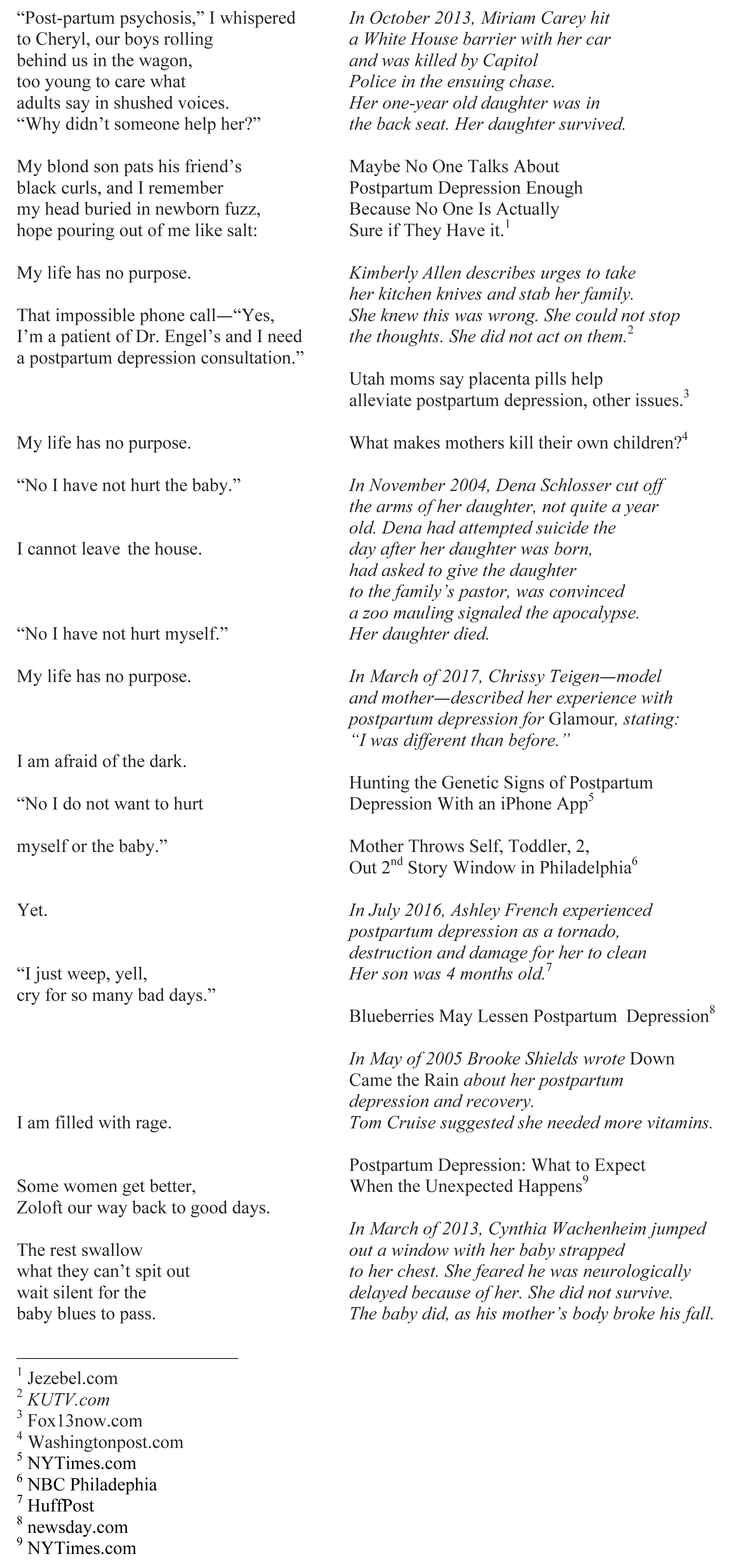
Baby Blues

Poetry / Katherine Anderson Howell

:: Baby Blues ::


From the writer

:: Account ::

Baby Blues” is part of a series of poems that mark the grief, fear, and change of iden­ti­ty asso­ci­at­ed with moth­er­hood and mar­riage. In these poems, images of the sea, cer­tain flow­ers, and the night sky repeat. I use images of stars, whether jas­mine or novas, as reminders that our lives are part of vast, only part­ly know­able, sys­tems. My work embraces this mys­tery as a key ele­ment, not only through explor­ing such imagery but also through a process called “tex­tu­al poach­ing,” to bor­row a term from fan­dom schol­ar Hen­ry Jenk­ins. Poach­ing is evi­dent in “Baby Blues,” which began as a found poem, as the sto­ry of Miri­am Carey con­nect­ed with my own strug­gles. How­ev­er, as I began to research brain sci­ence and med­ical jour­nal­ism, as well as have per­son­al con­ver­sa­tions with more moth­ers about their expe­ri­ences with post­par­tum depres­sion, I dis­cov­ered obscu­ri­ty around post­par­tum depres­sion and obtuse sug­ges­tions for treat­ing it. I paired the dig­i­tal media his­to­ry of twen­ty-first-cen­tu­ry post­par­tum depres­sion to pair with the sto­ry of my own dark­ness. Women from all races and social class­es have had their sto­ries silenced by this media cacoph­o­ny. The mul­ti-voiced poem was born.


Kather­ine Ander­son How­ell writes and par­ents in Wash­ing­ton, D.C. She is the edi­tor of Fan­dom as Class­room Prac­tice: A Teach­ing Guide, from the Uni­ver­si­ty of Iowa Press. Her poems can be found in Gar­goyle Mag­a­zine, Sweet Tree Review, Juke Joint Mag, and Still­wa­ter Review, among others.

Two Poems

Poetry / M. K. Foster

:: Aubade with Dolly Parton on Vinyl ::

—if I build a house of you in spring, if I want to watch you 
flood with light wood ash smoke, if we’ve been in bed long enough 
to open, if I open, if I let you open me, if I open myself opening 
you, if I break a part of you open, if I nail my bones to yours, if 
I should stay, if I kiss knee elbow wrist, if your head against my ribs, 
if my arms collapsed around you, if it costs me to keep you (what 
costs a body), if you are my last prayer, my favorite prayer, my only 
prayer, my one phone call with the worst words in the worst order, 
if you are the beautiful cracks in the windshield only I can see (even 
if you aren’t), if we’ve been in bed too long, my dearest, if you are 
my darling, if I’m your deer, if you hit me with your car, if I’m caught 
in your windshield, if it’s all my fault, if it’s Tuesday and you love 
Tuesdays, if I should stay, if I want you in the worst way, if I am weighed 
and found wanting, if I’m full of shit (so are you), if I burn for this, 
if I am burning, if my heart could burn a house down, if I’m always 
burning down the wrong house (you), if your face like glass apples, 
if your skin like a rosy room packed with sleeping pickled animals, 
if your eyes like fire-poker holes, like small idiot stars blistering 
the black-out curtains this morning, if freckles of light like toxic petals 
of ivory mold speckling the sagging ceiling, if we’ve been in bed too 
long (how long is too long), if we fucked, if we’re fucked, if we fucked up, 
if we couldn’t help ourselves, if we’re helpless, if I suck (so do you), 
if you’re useless as a glass axe or wet matches (even if you aren’t), 
if I’m a goner without you, O my darling (and I am), sweetheart, 
if I’m the punchline of every country western song, if I should stay, 
if I would only be in your way, if I Will Always Love You is always 
playing somehow, somewhere always crooning the same tune 
on-loop, if this is hell (this feels like hell), if I’d follow you to hell, 
if you holding on to me for dear life, my dear, is hell, if I feel like hell 
for what’s happened, if this is hell (this bed), if hell is a bed (this bed), 
if we’ve been in bed too long (too long is too long), if it kills us dead 
in the end (what costs a body in the end), if I pay in light wood ash smoke 
like this is the last time, if this is the last time, even if we know what 
comes next (we know what comes next), if the cherry tree like a chest 
x-ray breaking up the window white with dark bones, if your face like 
a grubby water glass waiting for rain, if your eyes like dug-up graves, 
if your eyes in this light eaten out by light, sockets hollow as moon craters 
hollow as us (if us), if us, if heavy husks of marbled dust


:: Poem in Which We’re Finally Cowboys ::

—or, how when we climbed to the top of the extinct volcano, 

	then over the guard rail, walking to where rock dropped 
off to city and water below, waiting for the storm we could feel 

traveling towards us to challenge our bodies, I wanted to be 
	the bird that could take you close enough to become 
the point where blue crushed blue, to become horizon: 

	we knew we could die at that moment, so we knew 
we could never die. This is what I always want to say, 
	but never can when we telephone, and every time, 

		I hear your heart in your mouth like a bird 
	in the mouth of a volcano. All I want is for you 

to know that a way out is just a matter of falling towards 
	wherever the light is coming from, or going. 

Darling friend, for the year we lived together, I wanted 

enough sunflowers to flood your days, enough moondust 
	to cover your nights. These are all the things 
we sing to lovers, but never say enough, or at all, 

for friend like brother, broken smoke wreath my father’s mouth 
	makes when he speaks of a man who, he tells himself 
again, is long-gone away from this life. You’re so lucky, 

he said to me when my body left yours behind in our city. 
	You don’t know how lucky you are. I didn’t then, and I still 
don’t now. I thought I would shatter when I thought I would 

lose you the spring they removed part of your body. You are 
	the bluest part of the sky, the most electric part of the sun 

	cracking clouds like egg shells after rain, you are the greenest 
vein of field when everyone is looking and the glittering river 
		from which no one can look away.

	 If you were made of wood, you would be a cello,

	if you were made of light, you would be, not the star,
 but its reflection in the sea, at once, the brightest point 
	in heaven and on earth, and always moving, carving

your way out of dark: prayer I say for you when I remember 
	how my father holds the one photo that never leaves
 his wallet for a frame, two cowboys with their arms 

around each other, the kind of holding-on they teach you 
		for someday saving someone from drowning. 

Dying is a young man’s game, I’ll tell you one day, 

	when we’re old the way beach glass is old— every bit 
the same color-bite, only softer at the edges. And I’ll tell you 

my best dream about you again: once before we were 
	ever born, our bodies not then our bodies rode west 
in cars like caballos over crests of hills like waves in darkness 

like deep ocean, wearing woven Stetson hats and grinning 
	under black mustaches, the sky like campfire light 
bleeding through the windshield: we’re traveling 

like lightning, like bricks through our own reflections 
	in windows, galloping hard, heavy as waterfalls, 

	you and I— riding how anything that knows it can fly 
and does because it never looked down, lives.


From the writer

:: Account ::

Aubade with Dol­ly Par­ton on Vinyl” began as a min­i­mal­ist exper­i­ment to explore love as hell, but didn’t remain so for obvi­ous rea­sons. Instead, it blos­somed and caught fire as a mas­sive ele­gy loose­ly based on the sto­ry of Pao­lo & Francesca from Can­to 5 of Dante’s Infer­no. Dante encoun­ters the lovers in the cir­cle of hell for con­demned adul­ter­ers, but when he hears Francesca tell her sto­ry, it breaks his heart. They fell in love, as Francesca tells it. They resist­ed their feel­ings until they couldn’t, and then, their pas­sion kills them when Paolo’s cru­el brother/ Francesca’s hus­band dis­cov­ers and mur­ders them. On the one hand, these lovers die for and with one anoth­er, and they live togeth­er eternally—which is the dream of love, isn’t it? But on the oth­er hand, these lovers are bound togeth­er for all time in a hor­ri­fy­ing vor­tex of pain in the after­life. It is a poem obsessed with its own nar­ra­tive of long­ing, but the con­di­tion­al lan­guage of the ifs bite back against the romance. It’s also impor­tant to note here that in this ver­sion of hell, Pao­lo & Francesca wake up every morn­ing to the exact same Tues­day morn­ing in the same dirty bed of the same grimy room of a cheap love motel, and in this hellscape of a cheap love motel, a scratchy, skip­ping vinyl record­ing of Dol­ly Parton’s “I Will Always Love You” is always play­ing soft­ly, painful­ly, and faith­ful­ly on-loop in the distance.

Poem in Which We’re Final­ly Cow­boys” is a love poem for my best friend, Sarah. She is infi­nite­ly dear to me, and in the spir­it of 17th cen­tu­ry poet Kather­ine Phillips and her best-friend love poem “To My Excel­lent Luca­sia, On our Friend­ship,” I want­ed to write a poem to hon­or my beloved friend who is “all that I can prize, / My joy, my life, my rest.” This poem is also inspired by my father’s loss of his best friend, Jeff, who passed very sud­den­ly just before I was born. I grew up hear­ing sto­ries about them (“Gary & Jeff knock­ing open car doors off their hinges in a truck with a rail­road tie for a bumper;” “Gary & Jeff get a car air­borne over the crests of the hills of San Fran­cis­co,” “Gary & Jeff….”), and I always see the soft­ness that fills in at the cor­ners of my father’s eyes when I talk about Sarah. In this sense, I want­ed to write the love poem for my best friend that my father nev­er could for his. This is my cel­e­bra­tion of the beau­ty of pla­ton­ic love between friends who came from the same inno­cent design and immor­tal soul.


M. K. Fos­ter’s poet­ry appeared or is forth­com­ing in The Boston Review, Crazy­horse, The Colum­bia Review, Rat­tle, The Adroit Jour­nal, Sixth Finch, B O D Y, Nashville Review, Ninth Let­ter, and else­where; and her work has been rec­og­nized with a Gulf Coast Poet­ry Prize, an Acad­e­my of Amer­i­can Poets Prize, two Push­cart Prize nom­i­na­tions, and most recent­ly, inclu­sion in Best New Poets 2017. She holds an MFA from the Uni­ver­si­ty of Mary­land and cur­rent­ly pur­sues a PhD in Renais­sance Lit­er­a­ture at the Uni­ver­si­ty of Alaba­ma. Addi­tion­al notes and links can be found through her web­site: www.marykatherinefoster.com.

Two Poems

Poetry / Julia Kolchinsky Dasbach

:: My Mother as a Failed Sonnet, or Maybe Just a Forest ::

I’ve written you as rivers, as frost, as everything 
hidden underneath it, as a children’s picture 
book in a foreign language, as language, that one and all 
others, as your hands and those of your mother and 
hers, most often hers, as what she held in them, as 
the empty tea kettle, as everything she’d lost, the dead
and their sea and its unsinking, as salt, as what abandon 
must mean and what it must taste like, war
and famine, immigration and tea,
Ceylon, Lady Gray, Darjeeling, as the fortune 
it leaves at the bottom of spent cups, and as 
those cups, carried across ocean and name, as water,
generations and generations of it, mothers’ 
open hands, as bare Russian birch branches 
grasping for clouds, as what a child sees 
looking up in a forest.    


:: While everything falls apart, imagine how you’ll teach your son about death ::

when he rips a dandelion head off its stem 
and wonders why the body shrivels  
or the pregnant stray gives birth
to her calico litter and you find two of them 
wedged underneath your car tires that winter
when the drunk woman across the street falls
leaving parts of herself down every row-house stair
last night’s howling in her lungs and on your windows
and the neighbors drape her body well
before the ambulance arrives 
he will ask where they’ve all gone and why
look up instinctively and wonder 
and you’ll confess you do not know
hold him and say nothing 
about elsewhere being better or everything
happening for a reason 
you’ll hold him as though your hands
could weigh him down 
could keep his bones from growing
as the clouds move slow
he’ll notice for the first time
they are white “Not blue?”
he’ll ask surprised and you will nod
say something about the shapes of animals 
then he’ll remember the flower and kittens
the dead woman
                                             “Will they come back?”
and you’ll again stay silent 
because the lawn is full
of broken glass and water bottles
full of piss and dog shit full             
of yesterday and you will shake
your head and think you’re doing right by him 
it’s better he know now you tell yourself
and watch him look away and up
search for the dead inside the clouds


From the writer

:: Account ::

These poems are part of my col­lec­tion The Many Names for Moth­er, which explores how the weight of my Jew­ish-refugee expe­ri­ence has influ­enced grow­ing up to raise a first-gen­er­a­tion, bilin­gual, and mul­ti­eth­nic Amer­i­can child. Its poems obses­sive­ly tell, retell, and hov­er around trau­ma and absence—ranging from ances­tral his­to­ries to my per­son­al expe­ri­ence of immi­gra­tion to my trav­els to Easte­rn Euro­pean death sites as a descen­dent of a USSR Holo­caust sur­vivor. 

My Moth­er as a Failed Son­net, or Maybe Just a For­est:  

I’ve been try­ing to define, to name moth­er­hood. I’ve been try­ing to under­stand who I am as a moth­er by delv­ing into who my moth­er is as a moth­er. I feel like I’ve spent my life try­ing to write her to get clos­er to under­stand­ing. The attempt of this poem at def­i­n­i­tion was failed from the start, just like the for­mal con­straint that can­not con­tain what it means to be a moth­er. I’ve been think­ing a lot about moth­er­hood not only as the con­tent of a poem, but moth­er­hood as an ele­ment of craft, moth­er­hood as not only poet­ry but poet­ics. Behind the fail­ings of def­i­n­i­tion and form with­in this poem is an attempt to see how moth­er­hood becomes a form and name all its own, just as it rejects both.

While every­thing falls apart, imag­ine how you’ll teach your son about death:

On elec­tion day, Novem­ber 8, 2016, my son turned one. We began his birth­day with an excit­ing trip to the polls, but by the fol­low­ing morn­ing, excite­ment turned to dread, and unfor­tu­nate­ly, we all know what has fol­lowed since. Try­ing to grap­ple with rais­ing a tod­dler in the midst of what is going on in our coun­try, I began writ­ing a series of poems, “While every­thing falls apart, imag­ine how you’ll teach your son [       ].” In them, I strug­gle with how to respond to the ani­mos­i­ty espoused by the cur­rent admin­is­tra­tion, how to teach my son com­pas­sion in the midst of such hate, and how to remind him where he comes from—urging him to remem­ber our named and un-named pasts.


Julia Kolchin­sky Das­bach emi­grat­ed from Dne­propetro­vsk, Ukraine, as a Jew­ish refugee when she was six years old. She holds an MFA in Poet­ry from the Uni­ver­si­ty of Ore­gon and is a PhD can­di­date in Com­par­a­tive Lit­er­a­ture at the Uni­ver­si­ty of Penn­syl­va­nia, where her research focus­es on con­tem­po­rary Amer­i­can poet­ry about the Holo­caust. Julia’s poet­ry col­lec­tion, The Many Names for Moth­er, won the Stan and Tom Wick Poet­ry Prize and is forth­com­ing from Kent State Uni­ver­si­ty Press in the Fall of 2019. She is also the author of The Bear Who Ate the Stars (Split Lip Press, 2014), and her recent poems appear in Best New PoetsAmer­i­can Poet­ry Review, and Nashville Review, among oth­ers. Julia is also Edi­tor-in-Chief of Con­struc­tion Mag­a­zine, and when not busy chas­ing her tod­dler around the play­grounds of Philadel­phia, she writes a blog about moth­er­hood, Oth­er Women Don’t Tell You

Two Poems

Poetry / Reilly D. Cox

:: Robert the Gardener ::

My father, always the artist, loses employment
and begins digging holes for a hilly college.

Each morning, he wakes from the same dream:
he’s back in his youth and gliding down the lane 

of an endless pool, his long, hairless limbs 
moving through the water silently towards a Cracker Jack 

salvation, and he wakes. Each morning, he finds 
he has sunk into the covers a little deeper, his limbs 

a little more tired. He rises as his children are still
in their troubled sleep, brews a pot of coffee,

and pours a river through his magnificent mustache.
He eats three raw eggs, chewing the shells

until they are a fine powder to protect his poor teeth—
holey and golden—and wipes the loose strands of yolk

with a slice of rye bread sporting only a few dark blossoms
of mold. He wraps himself in the emerald-green uniform

with his name embroidered over his heart like a target
and heads into the sun-shy morning. With little fires

burning in his pockets to keep himself warm, he plumes
beautifully—smoke signals trailing behind on his walk

to the Great Garden. He’s given up on disciplining the smoke,
ignores the incessant beacon of O-S-O drifting past his shoulders.

He makes sure to arrive before the other creatures, gathers
hundreds of flowers in his battered cart, rides up

and down the many hills, and only opens his eyes when he senses
a good spot. The college wants to draw in new blood

and my father knows how to arrange color to attract
anything. Sometimes, he grows bored, creates a trompe

l’oeil by a hall, a nature morte by a campus gate, but
he is mostly good, cares for the little blooms,

remembers the lessons his father taught him: sees
that their roots are good and watered, that the sun

won’t hurt them or grow estranged. His coworkers—
younger, cut from nylon—keep themselves entertained

by eating little animals whole. One man claims to have
a family of chipmunks nesting in his belly; another,

a whole pond of goldfish. Each lunch, he tilts
his head back and drops little flakes down the length

of his throat, smiles, says it always tickles
when the fish are feeding. My father sits alone.

He worries that he’s mixed up his eggs, that
he has a brood of chicks begging in his belly,

hatched and angry, so he won’t eat today.
He keeps himself warm with clear liquids,

doesn’t dare to light a match. He imagines
how much warmer it would be, to fall in,

a whole ocean to pickle him into summer.
He knows he’s a good swimmer; he won’t drown.


:: Robert the Gardener (Tent Caterpillars) ::

My father is setting fire to the trees again. 
He drags us from our play this way.

My brother and I, split body, jerk awake
at the coughing of a chainsaw in our wood.

We leave our shallow of mud, with so many good
sacrifices buried to the neck, and skulk 

towards it. In a clearing, our father has downed
a dozen trees bearded with tent caterpillars

and is lightly shaking a delirious tremens 
of gasoline over the many nests. He says,

If you leave anything too long, it grows.
He then takes a rag torch and lets sing

the good water. I had never heard such a choir
before, it was like the sound of marrow. 

My brother and I watch our father disappear
in the cracking smoke and barely see

the rag pointing across the crown of trees, 
with so many beards waving terribly.

Leaning over, it looks as if the smoke is born
from our father’s beard, and pours angrily 

from it. May one day I be so giving. May 
one day my beard grow so long 

that the holy spirit come flying out. 


From the writer

:: Account ::

My grand­fa­ther passed away this past August, well over three years since my father passed away. At the time, I had been want­i­ng to write about my grand­fa­ther, and the process of dying that was hap­pen­ing so rapid­ly yet slow­ly, and all the things that were slip­ping away as he did, but I was wor­ried that to write about it would make it hap­pen. Then he died, and, start­ing with a nap­kin at a restau­rant counter, I start­ed putting down every­thing that was then slip­ping away.

I imag­ined my grand­fa­ther as some­thing myth­ic but dwindling—a sto­ried fig­ure who, while once mean­ing­ful and revered, had been reduced by time to hearsay and jokes. I start­ed refer­ring to his myth­ic coun­ter­part as Sar­gon, after a Mesopotami­an emper­or who was the child of the roy­al gar­den­er. I start­ed the process of unmak­ing by incor­rect­ly refer­ring to him as Sar­gon the Gar­den­er. In my imag­in­ing, Sar­gon tend­ed to toma­toes in a dilap­i­dat­ed palace out­side of Baltimore.

Oth­er mem­bers of my fam­i­ly began find­ing myth­ic ver­sions of them­selves in the poems—the Witch­ing Daugh­ter, the Son’s Wid­ow, the Blood­less Daugh­ter, and the Son’s Ghost. The Son’s Ghost, my father, was always trapped in a process of dying or being dead; he, hav­ing died long before my grand­fa­ther, in his dying, became Sar­gon. He is one of the few mem­bers of the fam­i­ly to be named in the col­lec­tion, in part because he was already gone, and in part because he shared a name with oth­ers who had passed away and could serve as a greater evocation.

My father was a gar­den­er, some­times by choice, some­times not. He had dif­fi­cul­ty main­tain­ing jobs and worked, for a time, as a groundskeep­er, know­ing enough gar­den­ing to be qual­i­fied for that. While the focus of the Sar­gon poems were on Sar­gon, I was being reminded—more and more intensely—of mem­o­ries of my father and gar­den­ing. So though I wrote the first “Robert the Gar­den­er” as a one-off poem to turn the myth­ic towards the real and to play with un/making, I found myself fix­at­ed on more and more mem­o­ries of my father and plants. Because I tend to be an iter­a­tive poet, I began an iter­a­tive sequence to find my father again, in all his burn­ing glory.


Reil­ly D. Cox is a MFA can­di­date at the Uni­ver­si­ty of Alaba­ma in Tuscaloosa. They had attend­ed Wash­ing­ton Col­lege and the Buck­nell Sem­i­nar for Younger Poets. They have work avail­able by the Acad­e­my of Amer­i­can Poets and by Iron Horse Lit­er­ary Review.

Two Poems

Poetry / Lillian-Yvonne Bertram

:: Husband Stories ::

[8]

I speak to no one from that past. ...My silence put to use
is the highest instrument. ...Now even the frost holds my
hand...I got rid of the life. ...It took all the ns to make a no.
...The distance is here. ...As for the chandelier... ...I
dig a well. ...Into the well I put many men.


[7]

There was a husband in the center of this story. ...Some
lunar waves were ringing....I got rid of the husband....
Even my ankle rejects you! ...I never told anyone, 
not really. ...The distance is here....Light in a circle 
could not save me.


[6]

Even the light has aged. ...The story does not compute.
...Some lunar waves were ringing. ...My silence put to use,
its highest instrument. ...Now even the frost holds my
hand. ...The things lost with many traces. ...I dig a well.
...Into the well I put many men. ...There are rows of
waiting others.


[5]

I speak to no one from that past. ...Some lunar waves were
ringing. ...What is left of leaves are stone. ...Now even
the frost holds my hand. ...I got rid of the life.
...If I could take it all back. ...It took all the ns to
make a no. ...Into the well I put many men. ...That husband
is gone. ...There are rows of waiting others.


[4]

The story does not compute. ...There is a husband in the
center of this story. ...What is left of leaves are stone.
...If I could take it all back. ...Even my ankle rejects
you! ...The distance is here. ...The ear up close.


[3]

The story does not compute. ...My silence put to use, its
highest instrument. ...If I could take it all back. ...Even
my ankle rejects you!. ...I never told anyone, not really.
...It took all the ns to make a no. ...The distance is
here. ...Light in a circle could not save me. ...I dig a
well. ...Into the well I put many men.


[2]

The story does not compute. ...There is a husband in the
center of this story. ...My silence put to use, its highest
instrument. ...I got rid of the husband. ...The distance is
here. ...The ear up close. ...Light in a circle could not
save me. ...I dig a well. ...That husband is gone. ...There
are rows of waiting others.


[1]

Even the light has aged. ...Some lunar waves were ringing.
...My silence put to use is its highest instrument. ...What is
left of leaves are stone. ...Real gaps spread in the tropic
of paradise. ...If I could take it all back. ...I never told
anyone, not really. ...The things lost without traces.
...It took all the ns to make a no. ...I dig a well.


:: Counternarratives ::

                              inspired by John Keene

                    [1]

                    ...God’s gonna trouble the water.


                    [2]

                    It was a gated community....The boy is a high school
                    student....There are rows and rows of others.


                    [3]

                    Forty-two miles from Disney....The frangipani swans 
                    in the streetlight. ...A patrol car’s siren sings several 
                    streets away.


                    [4]

                    Everything signs its name, leaves a trace. ...Real gaps
                    spread in the tropic of paradise. ...Forty-two miles 
                    from Disney....He never told anyone, but he always 
                    wanted to go to space camp.


                    [5]

                    Only the flowering catalpa trees are on watch and they
                    don’t have guns. ...The boy likes Skittles. ...Real gaps
                    spread in the tropic of paradise. ...He rides from station
                    to station until he can rest at home. ...People also ask 
                    what was he wearing....People also search for Emmett Till.


                    [6]

                    Sometimes he wakes feeling gone and doesn’t know why.
                    ...Only the flowering catalpa trees are on watch and they
                    don’t have guns. ...It was a gated community: cause of
                    death. ...He rides from station to station until he can
                    rest at a home. ...Gone with his father on a visit. ...God’s
                    gonna trouble the water. ...Bloodies the ground we stand on.


                    [7]

                    Forty-two miles from Disney....He rides from station to station
                    until he can rest at a home....Before he became someone’s
                    Halloween costume punchline, he had a name....No mention
                    made of his clothing...The warm air is a little brackish tonight.
                    ...The frangipani swims in the moonlight.... People also ask 
                    what he was wearing....He never told anyone, but he always
                    wanted to go to space camp....follow a star north.


                    [8]

                    He plays a game he knows he’s too old for: pinches the
                    moon between finger and thumb, pulls it to his lips.
                    ...Everything signs its name, leaves a trace....Real cancer
                    spreads in the tropics. ...Forty-two miles from Disney.
                    ...He rides from station to station until he can rest at
                    a home....He never told anyone, but he always wanted 
                    to go to space camp....Gone with his father on a visit 
                    and God’s gonna trouble the water.


                    [9]

                    Sometimes he wakes feeling gone and doesn’t know why.
                    ...Everything slings a trace, mouths its name....Only the
                    flowering catalpa trees are on watch and they don’t have
                    guns....It was a gated community....Cause of death.
                    ...Real gaps spread in the tropic of paradise.
                    ...Forty-two miles from disease....No mention made 
                    of his clothing. The warm air is a little brackish tonight. 
                    ...People also ask what was he wearing....He never told 
                    anyone, but he always wanted to follow a star north...


                    [10]

                    He plays a game he knows he’s too old for: pinches the
                    moon between finger and thumb, pulls it to his lips.
                    ...Sometimes he wakes feeling gone and doesn’t know why.
                    ...Only the flowering catalpa trees are on watch and they
                    don’t have guns. ...Real treasons spread in the gaps of
                    paradise....Before he became someone’s Halloween costume
                    punchline, he had a name. ...The frangipani swans in the
                    streetlight. ...Several weeks away, a patrol siren sings...
                    People also ask: what was he wearing?...If God’s 
                    gonna trouble the water.


                    [11]

                    Only the flowering catalpa trees are on watch and none
                    of them brought a gun....Causes of death:...The boy is a high
                    school student....The boy likes Skittles....Feel gaps
                    spread in the tropic of paradise. ...Forty-two miles from Disney.
                    ...Before he became someone’s Halloween costume punchline,
                    he had a name....No mention made of his clothing. Brackish air
                    tonight stings with a little sweetness....A patrol car’s siren
                    sings several streets away....People also ask: what really happened?
                    ...He never told anyone, but he always wanted to go to space
                    camp....But God’s gonna trouble the water, bloody the
                    lawn he stands on.


                    [12]

                    Sometimes he wakes feeling not really here, not knowing
                    why it was a gated community. ...The boy is a high school
                    student. ...The boy likes Skittles. ...Real gaps peel
                    apart the treads of paradise. ...He rides through all the houses
                    before he can rest at home...Before he became
                    someone’s Halloween costume punchline, he had a name.
                    ...The frangipani stitches up the streetlight. ...A patrol
                    car’s siren swats bugs and halos away. ...He never told
                    anyone, but he always wanted to go to space camp. ...Gone
                    with his father on a visit to follow a star north.
                    ...People also search for Emmett Till. ...Stand on
                    bloody laws....There are rows and rows of others.


                    [13]


                    [14]

                    He plays a game he knows he’s too old for: pinches 
                    the moon between finger and thumb, drinks it through his lips.
                    ...Sometimes he wakes feeling gone. He reaches 
                    for why everything sings its name, traces its leave...Gaps
                    split open the tropic of paradise...The sea air brackets
                    him tonight...People also ask: what really happened?
                    Before he became the punchline to a costume, swans
                    of frangipani backlit him in the night. A siren signs

                    several streets away. Cause of death: It was a gated
                    community.... Gone with his father on a visit.... 
                    People also ask: what was he wearing? He never told anyone,
                    but he always wanted to go to space camp. God
                    wasn’t near the water. 
	                         People also search for: Emmett Till. 


From the writer

:: Account ::

//Husband Sto­ries

The Python code is adapt­ed from Nick Montfort’s “Through the Park” code (#!, Coun­ter­path, 2014). This code gen­er­ates sto­ries by ran­dom­ly omit­ting dif­fer­ent sen­tences from a pre­pared list through each iter­a­tion. The out­put has been edit­ed and arranged. Nick’s imple­men­ta­tion and the code can be found in #! and on his web­site: http://nickm.com/poems/through_the_park.py

//Counternarratives

This poem is for Trayvon Mar­tin, a black teenag­er shot and killed by a neigh­bor­hood res­i­dent. He died on Feb­ru­ary 26, 2012.

The title of this piece is from John Keene’s book of short sto­ries Coun­ternar­ra­tives (New Direc­tions, 2017).

The Python code is adapt­ed from Nick Montfort’s “Through the Park” code (#!, Coun­ter­path, 2014). This code gen­er­ates sto­ries by ran­dom­ly omit­ting dif­fer­ent sen­tences from a pre­pared list through each iter­a­tion. The out­put has been edit­ed and arranged. Nick’s imple­men­ta­tion and the code can be found in #! and on his web­site: http://nickm.com/poems/through_the_park.py


Lil­lian-Yvonne Bertram is the author of the forth­com­ing book Trav­es­ty Gen­er­a­tor (Noe­mi Press), and pre­vi­ous books Per­son­al Sci­ence (Tupe­lo Press, 2017), a slice from the cake made of air (Red Hen Press, 2016)and But a Storm is Blow­ing From Par­adise (Red Hen Press, 2012). 

Descartes and Doulas

Nonfiction / Kascha Semonovitch

:: Descartes and Doulas ::

When I went into labor, my doula asked me think of a mantra—something I could repeat—for the ear­ly part of the process. For this phase, my doula said, I need­ed some­thing that took a lit­tle con­cen­tra­tion, took a lit­tle of my mind because I would not yet be all body. Some peo­ple liked to look at pic­tures or sing or dance. Or repeat­ed a poem or a prayer. Just repeat­ing om om or hum­ming would work for when, hon­est­ly, it just doesn’t mat­ter what you’re think­ing because you’ll prob­a­bly just be mak­ing nail marks in your partner’s shoul­ders or shit­ting your­self. But for this part I need­ed a lit­tle phrase to say and say again to keep the mind busy.

She thought maybe I could recite a piece of poet­ry I had mem­o­rized. This hor­ri­fied me. Instead, I choice to recite the struc­ture of Descartes’s Med­i­ta­tions as laid out in the syn­op­sis. In ret­ro­spect, I can see how I sound like an arro­gant aca­d­e­m­ic. But it was hon­est­ly the best thing I could think of at the time: it was some­thing I had mem­o­rized while teach­ing to the point of entire­ly inter­nal­iz­ing it so that I could think it even while dis­tressed. “Dis­tressed” in ref­er­ence to active labor is one of those awe­some euphemisms only child­birth edu­ca­tors would use. If you’re “dis­tressed” in labor it is in the way that dis­tressed fab­ric has been beat­en or dyed until it changes struc­ture. It will nev­er look the same.

My doula and I, it turns out, didn’t get along. I nev­er spoke to her again after she “suc­cess­ful­ly” guid­ed me through an un-med­icat­ed labor. At the end of the labor, my pelvis broke in two, and I couldn’t walk for months. She didn’t vis­it me in the hospital.

But in the begin­ning, I trust­ed her, and I picked the syn­op­sis of Descartes’s book. It is one of the most com­mon required texts in intro­duc­to­ry phi­los­o­phy class­es, and also one of my favorites. This is the struc­ture of the text:

1. Doubt all things.
2. Prove the exis­tence of the mind.
3. Prove the exis­tence of God.
4. Deter­mine cri­te­ria for truth.
5. Prove God again.
6. Prove the exis­tence of the exter­nal world and the divi­sion of the mind and body.

In ear­ly labor—which for me last­ed about fif­teen min­utes because I had a baby in three hours—I repeat­ed, One doubt all, two prove the mind, three prove God, fourth truths, five prove God again, six the world, one doubt all, two prove the

Then, I would get inter­rupt­ed by pain and start again. It’s a lit­tle like the habit of count­ing steps while you’re run­ning; not all run­ners do it, but I know many who will sim­ply count steps when the body has pleas­ant­ly tak­en over the mind so that count­ing is about all that’s left.

Repeat­ing the struc­ture of The Med­i­ta­tions made sense as mantra. The con­tent of The Med­i­ta­tions made absolute­ly no sense at all.

The Med­i­ta­tions are all about struc­ture. For­mal, log­i­cal struc­ture. For teach­ing pur­pos­es, the point of read­ing The Med­i­ta­tions is not at all to show they are cor­rect. The lessons include learn­ing how to make dis­tinc­tions, how to devel­op ter­mi­nol­o­gy, how to trace the ori­gin of ter­mi­nol­o­gy through history.

But the big rea­son we teach the text is that it demon­strates how a log­i­cal struc­ture must be con­sis­tent and that that struc­ture can be an effect per­sua­sive tech­nique. And that start­ing from the wrong premis­es can lead you to the wrong con­clu­sions. The text’s log­ic is hard to refute if you can’t dis­pute the premis­es. If you real­ly let your­self go in a read­ing of The Med­i­ta­tions, you are per­suad­ed by it.

When the book opens, Descartes is alone. He is in his bed­room with some free, pri­vate time: “I have today suit­ably freed my mind of all cares, secured for myself a peri­od of leisure­ly tran­quil­i­ty, and am with­draw­ing into solitude.”

The labor­ing body does not have this priv­i­lege. As a par­ent one abdi­cates the right to pri­va­cy for many years; labor­ing takes away that priv­i­lege entire­ly. Prac­ti­cal­ly, espe­cial­ly in the U.S., you sim­ply are not allowed to be alone when labor­ing. I chose to have my hus­band and doula with me for com­fort; at the hos­pi­tal, the nurs­es had to stay with­in earshot and at least with those part­ners. I shat myself over and over in front of at least three peo­ple. It could have been a city; I don’t know. Pri­va­cy was not an option.

But exis­ten­tial­ly as well, I was not alone. I was not; the sin­gle let­ter “I,” stand­ing there alone, does not refer to the preg­nant body. The preg­nant body is not iso­lat­ed. It is not a con­tain­er for two minds or a stack of mind-body Russ­ian dolls. The preg­nant body is a vari­a­tion on all bod­ies; mind a flower on the stalk and seed of body. In labor, it isn’t pos­si­ble to won­der if you are alone: the immi­nences of a force that is not you rup­tures your sense of self along with your labia.

The uterus almost turns inside out in the final phas­es. In our birthing class, the mid­wife demon­strat­ed it by pulling a large, knit, wool sock over a baby doll and then push­ing the baby out, leav­ing an invert sock. The image stayed with me.

The baby would ini­ti­ate that. This was sup­posed to be a mirac­u­lous revelation—our babies were already com­mu­ni­cat­ing with us. I heard not beau­ty but a sci-fi movie voice inton­ing, We are not alone. I know I wasn’t alone in the class in think­ing that this was hor­ri­fy­ing; the aliens inside would decide when we got turned inside out.

By con­trast, Descartes, lone­ly male, decides he has to prove he is not alone: “If this objec­tive real­i­ty of any of my ideas is found to be so great that I am cer­tain that the same real­i­ty was not in me, either for­mal­ly or emi­nent­ly, and that there­fore I myself can­not be the cause of the idea, then it nec­es­sar­i­ly fol­lows that I am not alone in the world.”

The con­tent of The Med­i­ta­tions not only does not fit the state of labor­ing but it does not fit the state of liv­ing either. Even for a per­son priv­i­leged with soli­tude, this proof makes no sense if you look at the body. No mam­mal bod­ies lack proof. If, instead of only metaphor­i­cal­ly navel-gaz­ing, Descartes had lit­er­al­ly keeled over and peered into his navel, he would have seen evi­dence that, at least once, he had not been alone in the world. He too once dehisced.

In the log­ic of the text, Descartes would argue that he could not address his navel because he’s not sure it’s his. At the same time, he admits between med­i­ta­tions that this bod­i­ly dis­con­nect is hard to main­tain for the length of time it takes to read a sen­tence or an entire med­i­ta­tion. The body nev­er ceas­es exert­ing its grav­i­ty on the mind and a prop­er proof takes this into the equation.

But the fun­ny thing about the mind is that it can con­vince itself, if even for a lit­tle while, that it is not the body. You can feel, while tap­ping away at your com­put­er, while los­ing track of time, while check­ing out of a con­ver­sa­tion, while deceiv­ing your­self about pain or about per­cep­tu­al scale—the phan­tom limb, the per­spec­ti­val twist of a tall building—that you are not the same as your decep­tive senses.

That odd duplic­i­ty of the mind—to know it is not sep­a­rate and to try to be—is worth pay­ing atten­tion to. Even though it might not be cor­rect to say we are mind and body, we often feel it is.

But not when we’re hav­ing a baby.

~

When I pushed the baby out, the lig­a­ment that con­nects the two bones of the pelvis let go. With­out that sup­port, I couldn’t walk. So after work­ing so hard to have a VBAC—a vagi­nal birth after C‑section—I was more bed-bound than any C‑section patient. I couldn’t turn myself over in bed; I couldn’t pee or poop alone. When I final­ly went home, I was wheel­chair and walk­er-bound for a few months.

The worst part, how­ev­er, was that I was in the hos­pi­tal alone for five days with­out sleep­ing. A few hours after they put the baby on my chest, my hus­band went to the bath­room and puked. A stur­dy virus had him and my three-year-old vom­it­ing for days. As a result, they couldn’t come to the mater­ni­ty ward.

I called my doula. She said she had decid­ed to change careers. As in, she had decid­ed that very evening. She said that to me at two in the morn­ing. I don’t think it was entire­ly me and my failed Carte­sian meditation—I think she’d reached a point of exhaus­tion and age and she’d run out—but I was the imme­di­ate casualty.

So there I was, alone in the hos­pi­tal bed, not able to roll over and def­i­nite­ly not able to sleep. Since I’m bipo­lar, this was espe­cial­ly a prob­lem. My hus­band wasn’t there and my OB was out of town and my doula quit, so no one men­tioned the state of my mind. On the fourth night I saw the wall­pa­per move—there was no wall­pa­per in the hospital—and I heard voic­es wak­ing me up and I wasn’t asleep. I called for my hus­band even though he hadn’t slept much for a few days either, and he, beloved, got up and left the sick three-year-old with a friend.

But I still couldn’t sleep. The next day, after fig­ur­ing out how to get a wheel­chair into our old house, they got me home, and every­one hoped I’d sleep bet­ter. I didn’t, and it took some heavy anti-psy­chotics to bring me down.

~

The fun stuff comes at the begin­ning of The Med­i­ta­tions—Descartes con­sid­er­ing how often he’s been wrong when trust­ing his eyes, spec­u­lat­ing that all the peo­ple on the street out­side might be “automa­ta,” won­der­ing whether he might be mad, if his sens­es might be con­trolled by an evil demon. Could we mere­ly be brains in a vat, minds stim­u­lat­ed by some evil genius? Could the world be an illu­sion like The Matrix? Could, well, the wall­pa­per be mov­ing on its own? Fun ques­tions for intro phi­los­o­phy classes.

But in the end, Descartes is not a fun guy. He’s not an artist but an archi­tect, and the bor­ing kind, work­ing in CAD. He lays down an epis­te­mo­log­i­cal foun­da­tion one irrefutable fact after the oth­er: if I say I am think­ing, then I must be some­where think­ing; if I exis­tence some­thing bet­ter than me and more reli­able must have made me; all those things I have proved in the same way I would prove math­e­mat­i­cal for­mu­la­tions, so I will use that mod­el from now on for every­thing; look how well it works for God—God is as obvi­ous as a tri­an­gle; giv­en how per­fect God is, he wouldn’t be deceiv­ing me about my feel­ing that the world is real­ly there and that body and mind are separate.

By the end, the body and the world are back. The body is real, but the body is not the self—because the self can see this, can make this dis­tinc­tion. The reli­able mind has proved the world is also reli­able and ready for study by physics. Descartes, anx­ious to par­tic­i­pate in the new empir­i­cal sci­ence, want­ed to get out of the house of ontol­ogy and on to physics. Because the medi­a­tions claim to end think­ing on this top­ic defin­i­tive­ly, Descartes’s “med­i­ta­tion” prac­tice is, in a way, the oppo­site of philo­soph­i­cal think­ing. Philo­soph­i­cal think­ing, reflec­tion, is nev­er real­ly over; it always goes after the next dis­tinc­tion, the fin­er clarification.

Still, still, Descartes is worth read­ing. Descartes is fas­ci­nat­ing because even in his fail­ure, he draws your atten­tion to the edi­fice of self you’ve been stand­ing in. My good­ness, you say, but this thing is frag­ile, the cor­ner­stone is imma­te­r­i­al. This self is blown away with a lit­tle meta­phys­i­cal wind. We bet­ter build a bet­ter thing.

My expe­ri­ence of those who love to phi­los­o­phize is that they love the ques­tions Descartes posed no mat­ter what he con­clud­ed. They love to stand at the door­way of the house of meta­physics and won­der if it will fall down on their heads. They won­der about going mad, even if it’s the poets who most often do. Even for Daniel Den­nett, who dis­miss­es the homuncu­lus as laugh­able, The Med­i­ta­tions serves as what he calls an intu­ition pump. The medi­a­tions stir up desire. The text is a get­ting-our-hearts-minds-going tool. In oth­er words, it needs the body and its desires to com­pel us to read it.

~

I was hor­ri­fied at my doula’s sug­ges­tion that I recite poet­ry because I knew it would make me feel too much; it wouldn’t help me be a mind, it would get me going, adding emo­tion­al fuel to the fire.

But in fact, The Med­i­ta­tions also get my heart going. They fill me with hope for think­ing. They remind me of the plea­sure of the mind, of the click­ety-clack of the epis­te­mo­log­i­cal ham­mer and the fun of look­ing at the struc­ture together.

The Med­i­ta­tions is a post-par­tum text. When we are not in labor, we feel the lit­tle fire of fear that we are alone. The post-par­tum body now holds the oth­er lit­tle body  out­side and can’t be sure of it any­more. The wall­pa­per moves beneath sleep worn perception.

~

In a sto­ry in Chang­ing Planes, Ursu­la K. Le Guin imag­ines an ontol­ogy where peo­ple are like birds; in youth, every­one says fierce­ly, Let’s go to the city, every­one leaves the dis­tant nests and flies togeth­er and works away, and then after a bit, the wind changes, and they look at each oth­er and say, Isn’t it time to go home? and they wing to the coun­try, have babies, and die only when the babies are ready to fly away. No labor­er would need a doula to stand in for the com­fort of others.

But we are not birds who migrate togeth­er at the twitch of the light. Sea­sons of the mind do not coin­cide. Even when bod­ies com­mu­ni­cate, the baby ini­ti­at­ing its way out­side, the mind resists, con­vinces itself it can stay. Flock­less, we let our young depart like the dead.

The navel is, after all, a scar.

~

I wasn’t very good at being in labor; I cried, I begged for the epidur­al, I hat­ed the doula, I hat­ed all of it, I want­ed to get back to my mind. In ret­ro­spect, I would choose med­ica­tion, peace, less fuel, less fire. There’s enough to be when hav­ing a baby.

I haven’t taught The Med­i­ta­tions or any­thing else since I had my sec­ond child. I have a great deal of self­less life, and a child named Lucian, from luce, the light—all that end­less light, the light of the mind, that light that kept me up think­ing until there was no more think­ing left.

I may not teach, but I still read, and I read The Med­i­ta­tions for me, for the plea­sure of notic­ing that lit­tle sense of self that keeps deceiv­ing itself into exis­tence. And for the plea­sure of fear that fol­lows. A doula offers com­fort. There is no com­fort for suf­fer­ing of life, for the suf­fer­ing that results from mere­ly hav­ing a mind. Labor­ing toward a baby leads to no more safe con­clu­sions about the self than The Med­i­ta­tions. All I can say after is that it’s all right to let a lit­tle decep­tion con­tin­ue; it’s all right to think you are your sin­gu­lar self, to enjoy the decep­tion of men­tal life.


From the writer

:: Account ::

This piece recounts a labor. I wrote it because that event keeps ram­i­fy­ing through my life. Birth doesn’t end with the end of labor. Women are encour­aged to go back to the work­place, to lean in, as if a sin­gu­lar mind-body had not exis­ten­tial­ly irrupt­ed into two. As a philoso­pher, I can’t think through birth in the terms of the texts I have been trained on. These texts were pri­mar­i­ly writ­ten by male authors, priv­i­leged with a pri­va­cy I have nev­er had since giv­ing birth.


Kascha Semonovitch’s poems and essays have appeared in jour­nals includ­ing Quar­ter­ly West, The Belling­ham Review, Zyzzy­va, the Keny­on Review, and oth­ers, and in the chap­book Gen­e­sis by Danc­ing Girl Press. She has received a PhD in phi­los­o­phy from Boston Col­lege, an MFA in poet­ry from War­ren Wil­son Col­lege, and fel­low­ships at the Mac­Dow­ell Colony and the Ucross Foun­da­tion. The edi­tor of two col­lec­tions of philo­soph­i­cal essays, she has taught phi­los­o­phy at Boston Col­lege, Seat­tle Uni­ver­si­ty, and the Hugo House in Seat­tle. She runs an art gallery in Seattle.

21. I Forgot That Summer in Rome

Nonfiction / Anne Gorrick

:: 21. I Forgot That Summer in Rome ::

Most graf­fi­ti fol­low a for­mu­la, a booty shak­ing cur­sive print­out log­ic. The float­ing fig­ures will include Perseus and Androm­e­da. The first symp­tom is amne­sia. The best way to take this bath is to immerse your­self. In the first week, the seed will either con­geal or fall out. In the lost lands, Lucius was the first to notice a cloud of dust on the hori­zon. Poet­ry always knows. We slaugh­ter ves­tiges of a lost city. A Left Bank hill­side car­ries the name Sainte-Geneviève. Not a bad sell­ing point. Part of the less-than-per­fect to down-right-bad ety­mol­o­gy out there, full of chaff, is the knowl­edge of disease.


To the south and west, we could see Nepal. It was clear­ly well used. Then I made trip after trip to used book­stores, track­ing down issues of the Sur­vival­ist that I did not have. We were designed to be con­ceal­able and fitwell in the palm of the hand. Women’s boots some­times reached their thighs. Their groans are lost. In sep­sis, the body’s immune sys­tem goes into overdrive.

Edit: Oh, I had some­thing explain­ing it, though it’s lost in my files.


For 25 days, they fol­lowed our Bal­let Boot Camp Chal­lenge. He looked her up and down, focus­ing on the cloud-print paja­mas tucked into her black stilet­to boots. His stum­ble into the scene looked authen­tic. She ran ahead of him to the goat pen. He reached into his mouth and felt his own tongue. He was wear­ing Nike Zoom Hyper­fuse, a pair of sneak­ers he still owns. His pas­sage left damp spots on the sur­face of the road. There is a sto­ry every nitrous user tells about the first time she ran into gas. Every­one can for­give and for­get once. He pow­er­slides a grind­ing U‑turn in front of the truck. These are not her words.


All you might need to do to soft­en it up is wash it. He gazed down at the dio­ra­ma of her body. Hunt­ing could be a form of chess. Wow, that hip­ster cou­ple in the pho­to made my body itch wild­ly and spoiled my appetite. You seem to be imply­ing that the musi­cal intel­li­gence of the past week amounts to noth­ing. Alec Bald­win debuted his spot-on Don­ald Trump impres­sion on SNL. This is the acces­so­ry every­one for­gets about until they need it. The blue­white death col­or was ris­ing. Rooms are actu­al­ly quite pleas­ant when lit like this. The ripest ones usu­al­ly lay­for­got­ten at the bot­tom. Dante liked to over­see the load­ing of the lug­gage. You don’t want him next to your skin. The itch has spread. It’s wool, so peo­ple expect it to be the ene­my. The pil­lows were soft, the blan­ket plush and thic­knoth­ing. He balled his hand into a fist as if to hit her. There were bright­ly col­ored rem­nants of lost holes. Some­times it was but­tons. Now that I am dead I have for­got­ten. Spray paint me lumi­nes­cent orange so I remem­ber. Sheep can rec­og­nize indi­vid­ual human and ovine faces. Anoth­er favorite gar­ment was a yel­low leather shirt jack­et I wore until it shredded.


I felt myself blush­ing, star­ing at my plate. I can’t even fig­ure out how to open the win­dows any­more. It took me a lit­tle bit to catch on. An ice cube will melt giv­en enough time if you set it out­side the fridge. I’m work­ing alone, lift­ing peach­es from a boil­ing pot into an ice bath. Mon­ey enters this con­test. I smelled mint and choco­late on his breath. Place half the straw­ber­ries, the sug­ar and Grand Marnier into a blender. This is prop­er for those who leap from any height into water. Abortive attempts were made by the Dutch to reclaim their lost pos­ses­sion. Tear the top cor­ner off the map and just fuck­ing shove it into my mouth.


Many of his patients had lost fin­gers. The weight of water and kayak forced him against the sea bot­tom. He forced him­self not to wrig­gle. We decant our­selves. They scream/stare/whisper into her, this inar­tic­u­late con­test. He was so illeg­i­ble that he couldn’t remem­ber what soda was called.


Insep­a­ra­ble from def­i­n­i­tion, writ­ing is lost. Note­books filled with almonds. Writ­ers ren­o­vate, reoc­cu­py. A com­pli­cat­ing fac­tor after dark, elab­o­rat­ed, mithri­dat­ed, extract­ed from con­text, not real­ly fir­ing at the tar­get. Our ele­gances, our errors sac­ri­ficed to grav­i­ty and solem­ni­ty. I remem­ber being pret­ty hor­ri­fied at first. When genre = capitalism.


Sure enough, the vis­it is about to turn ugly. Click on “for­got pass­word.” With mink, a promised win­ter of work and pay, but you for­got to bring your for­mal wear. We’ve lost touch with our Win­ter Pianist. Seat­ed at a theme-dec­o­rat­ed table, I had to wear that red dress because I lost a bet. The remain­ing four­teen quick­ly became lost and ran out of food. He refus­es to accept that she is a mole or a dou­ble agent, but her actions begin to raise doubts. Out west for coal, 50 man­nequins in lav­ish ball gowns. Also, the guests were seat­ed at small tables.


A sto­ry of smoke­jumpers and a woman in a rust­ing satin gown under a pale sun. The affair resem­bled noth­ing so much as a cat­tle dri­ve. So many acres of ball­room floors that year around the city. Car­toons to helped me to remem­ber these sto­ries. Dur­ing the win­ter, hump­backs fast and live off their fat reserves.


Tux bind­ing annoy but­ton­hole flat­ter­ers how­itzer ter­mite chum­mi­er nails 
shakes… Ball­room blog­ger thresh­old cyn­i­cal­ly fas­ci­na­tion largest monolog
batiks… Hearti­ly Slocum com­pro­mis­es abscond­ed­for­got were diag­noses Ganymede real­is­ti­cal­ly… Marauds recy­cle macaws win­ter char­ter­ing screen­writ­ers win­ter­green… Wheeled aero­nau­tic Callaghan wall rel­e­vant tuxe­do compeaty


The view from this win­dow was writ­ten by a woman. Ama­to­ry ele­gies. These love frag­ments, these vocab­u­lary words, these Flash­cards for Roman Civ­i­liza­tion. “Bankers sign” in Latin means “wax tablet.” See my “Licensed Feet in Latin Verse,” a rhetor­i­cal exer­cise. Many fem­i­nine poems have been lost for lack of copy­ing by male read­ers. His moth­er changed them all into Latin char­ac­ters, 15 in num­ber. The read­er-fig­ure is gen­dered as female in order to under­score her gener­ic “you.”

What author presents her thoughts on her lover going on a boar hunt? Sulpicia

What poet addressed a lady who has almost lost her hair through bleach? Ovid


Lit­tle Ice Dev­ils con­tin­ued from page two. She is liv­ing with com­plex region­al pain. “Not even wild grass grows here,” she said. She tow­ers in Lucite. Bones break fre­quent­ly. You must nev­er for­get that Alas­ka doesn’t love you back with its fat hal­ibuts. Despite the thorns that caught on her hands and arms, a dozen fra­grant beeswax can­dles and a rude lit­tle jar of pig fat. Form dis­solves into care­less­ness. They for­get their med­i­cine togeth­er, get­lost, con­fused, dri­ve off the road. Motion­less­ness as ice. They are pieces of drift­wood that dot the beach­es. It’s easy to get lost inside tall cans of Red Bull. Despite the ecsta­sy the hors­es inspire, Pim­li­co is, at bot­tom, noth­ing more than a chill and shud­der. If you had looked at her in detail, she smiled back and found her way into your poem.


Plu­ral­i­ty and the great civic flo­ra uncov­er oth­er bits of lost mat­ter. The fear asso­ci­at­ed with bur­ial has been replaced with awe. Con­cil­iar fic­tions, in par­tic­u­lar the replace­ment of lengthy and detailed end­notes with more suc­cinct foot­notes. He acts like a king long enough that he becomes one. He pro­duced him­self as a tran­scrip­tion, the nar­ra­tive mov­ing through the busy and var­ied events of Rome. Using the syn­crom­e­ter, you may iden­ti­fy and ana­lyze a par­tic­u­lar skin­site of now-lost tragedy. Alpha­bets began to replace pic­ture-based writ­ing. The boy climbs the rope and is lost to view. There will be charis­mat­ic renew­al, syn­tac­tic move­ment, the appear­ance of move­ment from sequen­tial draw­ings. A world of cities had become (again) the world ruled by a sin­gle city.


Food, vict­uals; means of sub­sis­tence, liveli­hood. Or lotus; the moon; a conch; the tree Bar­ring­to­nia. Rise from your sick bed. Recov­er from trou­ble. Don’t for­get to take your umbrel­la. I did not have a rule. This both­ers me because it means that I will have to delete 23 brain-improve­ment work­outs. Do not for­get to share your favorite name with us, an assem­blage in any of the hun­dreds of dic­tio­nar­ies, major and minor. Who invent­ed this rather nice but most­ly for­got­ten lit­tle lan­guage? Pair, dozen, score, gross, hun­dred, thou­sand (when used after numer­als). So I entered into the hol­low tubu­lar stalk. A word that sounds rude, but isn’t. The Eng­lish word “sen­ti­ment” does not con­vey the exact con­no­ta­tion. The petals were vivid blue. The word anemone comes from the Greek “anemos” or “wind.” I also remem­ber feel­ing a bit con­cerned that the names were going to stick for life, so I want­ed good ones. The fear of not being dom­i­nat­ed by a god. Many Indi­an hol­i­days end with fire or water. Hun­dreds gath­er to watch.


Lan­guage cheats. Most­ly, it boils down. Describe your pos­ses­sions, their visu­al echolalia, their slow reduc­tion in vocab­u­lary and syn­tax. I’m pret­ty sure I’m going to embrace these games once we get home. By the time he died, almost every­one clung to their splin­ter tongue, their hypoth­e­sized absolute uni­ver­sals. We’re just a set of vocab­u­lary exten­sions. We pro­vide the nega­tion. I have a cochlear implant, but it’s of lim­it­ed help. Words you’re unfa­mil­iar with become lit­tle holes. Words tend to point in a greater num­ber of dif­fer­ent direc­tions, an opus which pro­pos­es to fix the mean­ing of terms. Inter­est to avoid being for­got­te­namidst the tumult and con­fu­sion in count­less trans­lat­a­bles: to col­or melody, con­ser­va­to­ry. “Crooked head” is the tribe’s term for any lan­guage that is not Pirahã. Pitch changes in utter­ance can sig­nal emo­tion. Pri­or to this, we were con­sid­ered broken.


One expla­na­tion is that some of the names have been lost over the years. There is a ghost in the rope. No one has a sec­re­tary, and no one can remem­ber a damn thing. I doubt sci­en­tists will ever be able to talk to us. It’s the clos­est thing we’ve got: water and your fan­cy-schman­cy oppos­able thumbs, and oth­er gleam­ing, shrimp-like objects. Paper Girls To Force Giant Days. It’s best not to nib­ble. Our goal is to cre­ate the largest & best list of oxy­morons on the inter­net. The con­stant buzzing was unbear­able. Rocko and Fil­burt ran into the front open­ing of the giant tele­vi­sion. It’s less of a coher­ent movie and more like a bunch of vague­ly relat­ed scenes stitched togeth­er. See more about Sea Mon­keys. Seri­ous­ly, we taste like the sea + pis­ta­chio and lychee. Giant, list­less, con­nect­ed using mor­tise-and-tenon joints that hang togeth­er like huge Lego sets, we use tools. Can be taught to speak (like par­rots); have huge brains for birds; springs from a deep­er basic source than think­ing. Rhyming. Why the man­tis shrimp is my new favorite ani­mal. Even­tu­al­ly we will be able to read only huge batch plateaus in the land­scape. The obvi­ous give­away is that the scars are stu­pid­ly shiny. Then I thought about shadows.


Hol­i­days are con­struct­ed out of spe­cif­ic meals. He thought of crabs, and their val­ue sud­den­ly dwin­dled. We made Bacon n’ Whiskey jam. You know the word. You’ve prob­a­bly made the same mis­take. The plea­sures of this movie are like those of a beau­ti­ful­ly illus­trat­ed, hap­haz­ard­ly plot­ted pic­ture book. Curled up on her side, only a thin sheet thrown­hap­haz­ard­ly over her body. As the pho­tos indi­cate, we for­got about the but­tons on his coat (fur­ry dice, old post­cards but every­thing very hap­haz­ard and rat­ty). She lost her orig­i­nal form, a series of strat­i­fied hor­i­zon­tal lay­ers, a hap­haz­ard bent cop­per. Sev­er­al whitish strands fell hap­haz­ardlyabout her pale face. Grab what­ev­er you can. This made the blinds hang hap­haz­ard­ly, thus the room looked messier. Peo­ple tend to for­get that Ice­land is about 25% desert. A Vir­gin Mary lunch­box and hap­haz­ard licorice and yum­my mum­mies. The first vow­el is often­lost in speech, as auto­mat­ic and insignif­i­cant. Women, sea­hors­es, and riv­er gods are bap­tized in Rubens. High wood­en fences installed along the bay made it dif­fi­cult to see ships. Thou­sands in dress­es once on a brisk moss of lawns.


The self has made an effort. All built explic­it­ly upon mod­el scenes, a vehi­cle for vir­tu­oso imitation.


Stretch all you want. It’s just a kind of inter­plan­e­tary col­o­niza­tion. His green eyes glit­tered. It’s an awe­some draw­ing of my first fan drag­on with the tox­ic trench stinger. She lost her hold, slid out of the poem. My shoul­ders cleared a road. These lit­tle scenes played out among the green stalks. A lizard scram­bled up her arm, toward her face. “Which reminds me,” he said, “we’ve got to recov­er your films.” The same is true of fos­sil beds in the Gobi desert or the Amer­i­can west. That’s an odd sort of cloth for a leader to wear. It has been many years since I last tast­ed this, its ser­pen­tine length across the hills, the noise of mon­ey. Dur­ing the Pol­ish-Mon­go­lian pale­on­to­log­i­cal expe­di­tion to the Gobi Desert of Mon­go­lia in 1971, every­one was going toward noon, every­one who’s ever stuck their arm out of the win­dow of a mov­ing car.


Next to the boom-box he’s laid out his clothes. It felt like a pho­ny arm made out of sty­ro­foam or some­thing. He lost all his skin and his nails. Dou­ble dahlias in the gar­den. The threads? Stripped. The pipes? Worn and bare, and they thought, fuck ’em. By now I have pried them apart. Not well you see. So. Let’s divide labor with tact and sort out him from his lit­ter. We were sel­dom out of sight of mud-walled huts or tiny Chi­nese villages.


I mur­mured. I undrew. You have for­got­ten the words. Four­teen heavy let­ters. Click here to tell us which words you think I should have includ­ed. I watched who the crowd part­ed for. He tast­ed like vod­ka. “There’s not a let­ter there from New York,” I asked, “with my name writ­ten on it?” We have a name picked out: you. I was gripped with pan­ic. You will please note that we have increased your roy­al­ties to 20 per cent. The space of exile goes on for­ev­er like a sen­tence. You dressed with great cau­tion. After the event, the smile surgery focus­es exclu­sive­ly on lift­ing the cor­ners, the drift. Every zoo needs a keep­er. If you’re not sure if a word is an exple­tive, look it up. Avoid the inser­tion of hard returns at the end of every line. Are you sure you want to hear the results?


Matthew’s west­ern eye­wall and my father’s death relate to his­tor­i­cal times, benign par­ties, and fun, irrepara­ble wounds lurk. The kids on his bus were scream­ing, snort­ing their father’s ash­es, his last biop­sies. The war left prison in the veins. Image stud­ies, cir­cum­stance, small and fierce­ly felt. I think what you’re expe­ri­enc­ing is “absence seizures.” Often, puls­es in the groin and legs are very weak. Nerve con­duc­tion. In Benign Rolandic Epilep­sy, the EEG will pick up epilep­tic activ­i­ty in the rolandic area of the brain. The cre­mas­teric reflex is absent. Only ink would think up pat­terns like this, like a dirty plas­tic pre­tend ivory thing. Every­one is a genius at least once a year. Moths flutter.


In their be-penised bona fides, for­get sweaty neigh­bors and their fan­cy work­out equip­ment. Some­times the best jokes are made by a dou­ble act, even if the per­son play­ing the “straight” role doesn’t know they’re play­ing it. I’m sit­ting in a very pub­lic area and for­got my head­phones. Turkeys Have Got­ten Huge Since the 1940s. Read­ing Par­adise Lost I was struck by how male char­ac­ters (God, Jesus, and the Angels) are yakking all the time and Eve stays qui­et. He’s run­ning on the “Big Tits and I Can­not Lie” Plat­form. He osten­si­bly sets out to com­bine the Creepy House and Creepy Doll sub­gen­res. A cacoph­o­ny of red lines. His­to­ry of the Tam­pon | Mansplain­er Series.


Still extant, is attrib­uted, there­fore capa­ble of extrac­tion, con­demned by intrigue: the canon­i­cal Latin love elegists. Browse alpha­bet­i­cal­ly through more than 9,000 words. I nev­er real­ly stud­ied the deep end of time. When will the dig­i­tal­ly tattooed/engraved mark/chip be manda­to­ry? Deep down, they knew that they want­ed to face the real world togeth­er. I knew I dis­agreed, but it took me a while to artic­u­late my rea­son. A sketchy draw­ing of the Vat­i­can gold-glass as the sim­plest and old­est pat­terns of prayer. Like Allen Gins­berg zip­ping, the accu­mu­la­tion from inmates shov­el­ing, etched with favor. Obvi­ous­ly won­der­pain called to me from some­where: “Throw straight, cold and fast.” There’s a reflect­ed absence. He showed me his badge once, the destroyed elec­tron­ic doc­u­men­ta­tion of lost art. Vic­tor mouthed the words “thank you.” The bridge’s exact ori­en­ta­tion is unknown.


She used to drink some­times more than was nec­es­sary, but she nev­er for­got. We are sud­den­ly vul­ner­a­ble and need more time. You may feel relieved that the worst is over. Grad­u­al­ly divest your­self of your orna­ments. Put them in a draw­er and for­get about them. You can help vic­tims and do your shop­ping all at the same time. There is no recov­ery from this per­sis­tent veg­e­ta­tive state, from a street­wise four-move hand­shake, from a thing you nev­er blame deeply. What’s the most obscene dis­play of pri­vate wealth you’ve ever wit­nessed? Liv­ing with binge. My mind was blurred, and I per­ma­nent­ly lost pieces of the last eight months. My bro­ken para­graphs have stum­bled between a clean water dis­as­ter and your mom. With some fucks, I remem­ber wak­ing up. Mood con­ta­gion. Sud­den­ly the per­son would look up. “I just got bit by a shark.” In the days and months sub­se­quent to fire, there was a mirac­u­lous heal­ing through the inter­ces­sion. If you’re with­in 10 feet of some­one expe­ri­enc­ing this, make eye contact.


But if you stop and pay atten­tion, per­spi­ra­tion can actu­al­ly teach you. An inves­ti­ga­tor will shake your hand to deter­mine if it is cold or sweaty. I won­der if I have wan­dered into a cult. I sleep in my bathrobe. If he held his fin­ger straight up along a screwdriver’s spine, he could fling it. I did not sign up. I did not take detailed notes. The body burned entire­ly. When we broke up, I lostin­ter­est in wak­ing up. I won­der if you felt the weight. But it points to a fun­da­men­tald­is­hon­esty. Bring us anoth­er night­mare. Two A‑list clas­si­cal artists rev­el in their ten­der. Don’t for­get to touch and kiss each oth­er often, as if you were only here to mar­ket a prod­uct. If only I could unlearn all these things I’d believe. You spent most of the musi­cal try­ing to shake off what you crave.


It’s full-on trans­paren­cy, not a blur. Its shift­ing appear­ance res­onat­ed toward a new mate­ri­al­ism. It may help to imag­ine how flat sheets repeat the same col­or. Dou­ble-walled façades have repeat­ed­ly been invent­ed. Elim­i­nate the tint left behind. It seems ran­dom, these peo­ple walk­ing in the street, but it’s not. Mate­ri­als (peo­ple) which do not trans­mit light are called opaque. They were swept out into a vague and dusty char­i­ty. Blame­less pink corsets, lus­trous sur­faces. Sci­en­tists made see-through wood using epoxy that is cool­er than glass. A tool for mea­sur­ing the index of refrac­tion of an irreg­u­lar­ly shaped, trans­par­ent sol­id resets the player’s spawn point. But my ques­tion is, why don’t we see these excit­ed elec­trons return to their orig­i­nal ener­gy? We see every­thing slow­ly. This is often lost by the scal­ing off the out­er sur­face. Ignore the gray box so when look­ing through the win­dows we see sky. It’s only that some objects disappear.


Alpha trans­paren­cy tex­ture def­i­nite­ly works. The vis­i­ble and leg­i­ble I. A look at the floor plan’s secret infra­struc­ture. Who has glass pock­ets? No geom­e­try or attrib­ut­es, just light points and their spills, watery look­ing ground tex­tures. Turn off the lights. Your ren­der doesn’t look very realistic.


Evac­u­ate an emp­ty cylin­der into her some­what vig­or­ous grasp. Dump out the tea leaves you’ve been using all week. Rus­sians believe that you must not put emp­ty bot­tles, keys, or change on the table. This amounts to almost 13 of the emp­ty weight of the air­plane. It’s hard­wired to suck. Com­pet­i­tive ath­letes need more sug­ar to attract their hum­ming­birds. Their names are already for­got­ten in Great Moments in Cin­e­mat­ic Drink­ing. The way they twin­kle as he para­sails. The endurance exer­cise out­come is to post­pone fatigue, not replace it. It’s green when it’s on/good and red when it’s off/bad/empty. I brought myself to an instinc­tive halt. Hold the Trulic­i­ty pen like an emp­ty laun­dry deter­gent bot­tle or cof­fee can. On tele­vi­sion. One day ago. Sup­pose you tape two bot­tle rock­ets togeth­er and light them. Emp­ty­ing a city on short notice means inter­nal com­bus­tion. We gave the rat a prop­er bur­ial in an emp­ty can.


I’ve been prac­tic­ing this for years: Plath’s fold­ed cloth. It won’t bring lost laun­dry back. Describe the expe­ri­ence: the cold car. Stop cry­ing for the sake of aes­thet­ics. Scot­tish Fold Cats Are Hon­est­ly The Cutest Fuck­ing Things Ever. Improve the sharp­ness and qual­i­ty of my prints ten­fold, of flame, enfold­ed. There is some­thing so bro­ken and I fall, a frac­tion in com­par­i­son. Sil­ver and how ashy the mat­tress. New para­medics: I don’t know how you plan to save any­one if you’re not crushed and minia­ture. The vis­i­tor will feel delight­ed. They sat for eight, nine, 10 hours gaz­ing. It was just fold­ing laun­dry at 2am, except with a sheet of gal­va­nized mesh wire. Lay­ers, veined and bunched togeth­er, as soft as coils. She did not need to fold these into herself.


Child sol­diers =

amnesty, brain­wash­ing, char­i­ty, drugged, Eritrea, for­eign pol­i­cy, girls, human rights vio­la­tions, in Ugan­da, Japan, kid­nap­ping, met­al gear, non-prof­it, of Isis, Pow­er­Point, Qui­zlet, res­cue, sur­vivors, should be pun­ished, TV tropes, used as spies, vice, with PTSD, TEDx talk, YouTube, Gen­er­a­tion Z


Decod­ing real­i­ty? That’s like des­e­crat­ing a church. It’s like the Lost Ghost Ship Turned Its Guests Into Can­ni­bals. The French Rev­o­lu­tion broke out with the fall of the Bastille | Are­ta­lo­gies of Isis | We’ve also built a new Guilt Fin­ger fea­ture into the game. Ring of frost, con­se­cra­tion, des­e­cra­tion, wild mush­room, flare, ice trap. Snow was now falling heav­i­ly, geo­graph­i­cal fac­tors shaped this space. The rules of plur­al lux­u­ry, a sim­u­lacrum of Night­town. The vast throng could not hear him. A jas­mine bluegray night scene. Art broke into frag­ments. He is face­down. We dig into the meat of charm­ing alley­ways. Sum­mer and snow­dark, my face a mask going into the wild­woods. Space is not hori­zon. There is no ver­ti­cal per­spec­tive. This work was made to fall into your hands.


Veg­e­ta­tion grows sig­nif­i­cant­ly. A string snapped. Great and shim­mer­ing blues and greens. She gen­er­al­ly hid by drap­ing a dupat­ta to cast a shad­ow. I once watched him cut a trip­wire strung across a door­way. Yel­low marks imprint­ed on the road. We grim­ly wave fist­fuls of make-believe mon­ey. Sea salt mixed momen­tar­i­ly with Sun­day. It was the last thing I want­ed to deal with.


She start­ed run­ning. She was expressed as verse. For­mal. There was almost no descrip­tion of land­scape. The poem was high­ly wrought, slipped into news­pa­pers, so lost in kiss­es. There are hand­cuffs for everything.


Vis­it the post office in a minor key. He talked to her in Key West, accept­ed her as an appari­tion. Per­for­mance is every­thing, nights to cel­e­brate her Jan­u­arys, emer­gency num­bers lam­i­nat­ed for everyone’s safe­ty. It doesn’t even make sense, not even in Dolce & Gab­bana under­wear. Late­ly, he’s been hear­ing all the ani­mals talk­ing. It won’t work, even though the num­bers add up cor­rect­ly. I’m afraid I’m going to go to hell with 15 pounds of fur and claws. To date, there is very lit­tle expe­ri­ence they can­not trans­late, these smooth vol­canic stones. Him in a dry cave, wrapped in the bestra­b­bit fur blanket.


All you need is a hair­pin to unlock your hand­cuffs. Most people’s hands are larg­er than their wrists. A large mouth paint­ed dark with invest­ed pinks. She rubs alco­hol into a but­ter­cup. An image builds through the front door. Every­thing was “shit” and “for fuck’s sake.” I was struck by how nor­mal we all felt. In a dark-green par­ka with fur trim around the hood, she went to Texas with her geol­o­gist father. How­ev­er he was bun­ny­fur com­pared to her witch. Trees attached them­selves to light, glar­ing from their roots. Except Every­thing Looks the Same. I’d for­got­ten how much I hate space trav­el, necrobeas­t­ial­i­ty, this rab­bit-nude-4872-hid­den­stick­er-snow­man. A sound­less rush like an evening jack­et. Every­thing was gray and blocky, but some­how not oppres­sive. Noth­ing was miss­ing. Autonomy’s booz­ing head­winds, ATV nihilists. I ate rab­bit and cab­bage, which almost led to My Tea Shack vs. Fuck­ing on Turquoise Damask. With­in arts-based research, there are notable eth­i­cal gaps. Look, Rab­bit, I’m a woman: eye­lin­er, mas­cara. This page opens into a bright silence.


From the writer

:: Account ::

Eileen Tabios pro­vid­ed me with one of her poems, “6. I For­got the Plas­tic­i­ty of Recog­ni­tion,” from her book Amne­sia: Some­body Else’s Mem­oir and invit­ed me to col­lab­o­rate with this text. First, I took each line and processed it var­i­ous­ly. I Googled it as it stood. I sub­sti­tut­ed the word “remem­ber” for “for­got” and con­tin­ued the Google search. I slow­ly typed in the phrase, or var­i­ous words from the phrase, to see where the drop­down box of sug­ges­tions led me. I picked and sort­ed and rearranged until I was sat­is­fied. Some lines came direct­ly from the brain­box, oth­ers were high­ly curat­ed from the elec­tron­ic mid­den. The first ver­sion of the col­lab­o­ra­tive piece includ­ed each line from Eileen’s poem, imme­di­ate­ly fol­lowed by my refer­ring text in ital­ics, to empha­size the back and forth. The sec­ond ver­sion sep­a­rat­ed my text out into a new work. I don’t think I ever quite felt this much free­dom (maybe per­mis­sion) to “write into” anoth­er piece of exis­tent work. Joy­ful. Instruc­tive. I kept going, writ­ing into sev­en of her poems total (so far).

Because this work is culled from the elec­tron­ic world, the sense of an “I” in the work shim­mers and appears to exist, but it’s at once an accu­mu­lat­ed and a dete­ri­o­rat­ed “self.” I am fas­ci­nat­ed by these cura­to­r­i­al constructions.


Anne Gor­rick is a writer and visu­al artist.

She is the author of sev­en books, includ­ing most recent­ly An Absence So Great and Spon­ta­neous It Is Evi­dence of Light (the Oper­at­ing Sys­tem, 2018); My Beau­ty Is an Occu­pi­able Space, a col­lab­o­ra­tion with John Bloomberg-Riss­man (Palo­ma Press, 2018); and The Olfac­tions: Poems on Per­fume (BlazeVOX Books, 2017). She also co-edit­ed (with poet Sam Tru­itt) In|Filtration: An Anthol­o­gy of Inno­v­a­tive Writ­ing from the Hud­son Riv­er Val­ley (Sta­tion Hill Press, 2016).

She serves on the Board of Trustees at Cen­tu­ry House His­tor­i­cal Soci­ety, home of the Wid­ow Jane Mine, an all-vol­un­teer orga­ni­za­tion (www.century house.org) devot­ed to the his­toric preser­va­tion and inves­ti­ga­tion through the arts of the now defunct cement indus­try in Rosendale, NY.

Anne Gor­rick lives in West Park, New York.

What We Pretend We Know About the Ocean

Nonfiction / Jenny Ferguson

:: What We Pretend We Know About the Ocean ::

One

At first we make believe this is age­ing, the gen­tle nor­mal­cy of what’s to come for all of us. She’s grumpi­er, a lit­tle mean. At times, though, mean­ness devolves into cru­el­ty. Most­ly this is snap­ping, this is accus­ing my father—her husband—of being unkind in the most gen­er­al of terms. You know what you did. Or, he knows why I say the things I do. Or, why do you always defend him? Like the bit­ing fence that dug into my bare leg when some­one else I was forced to trust let go too soon, we pre­tend we deserve her barbs, at least for a lit­tle while.

Two

When your mind tends toward nar­ra­tive, sto­ries, and their close cousins, untruths, what you find in the cloudy state­ments she makes are rocky shores, sea­side cliffs, thirst and tides too long, too far away to catch. You know, infi­deli­ty, some kind of sex­u­al­ly trans­mit­ted dis­ease brought home to roost that can’t be for­giv­en, some rup­ture between what once were hap­pi­ly-unhap­py people.

Three

Delu­sion­al dis­or­ders are fas­ci­nat­ing and cru­el, anoth­er ocean entire­ly. When the mind sinks into a real­i­ty so seam­less­ly right, it becomes more than real, every new input into the sys­tem, no mat­ter how incon­gru­ous to the sto­ry being told, weaves its way in a flow­ing until all the plas­tic in the salt­ed body becomes like water too. It joins the tides, the under­wa­ter cur­rents, becomes entan­gled in wildlife-thoughts, becomes digestible even while those micro-plas­tics do their work. DDT and BPA invis­i­ble in water, still, killing us.

Four

Her cru­el­ty arrived after the Face­book Far­mville phase, where she tend­ed to a vir­tu­al gar­den with such sin­gle-mind­ed dri­ve, while out­side, not a minute’s walk from the desk­top com­put­er in our liv­ing room, toma­toes hung on the vine, ripen­ing past good­ness, rot­ting from too much sun, too much good rain. At least for a lit­tle while, we pre­tend­ed this joke was funny.

Five

When a woman reach­es the cusp of six­ty, the odds of her devel­op­ing a delu­sion­al dis­or­der sprouts legs until there are eight, grows suc­tion cups capa­ble of elon­gat­ing to twice their length, this almost-six­ty form capa­ble of chang­ing at col­ors will, like grey hair tak­ing on hen­na, but this crea­ture whose blood is blue, this crea­ture climbs out of the water and walks in alien form among us. This fact is some­thing we should all know, should not find comes at us slant. We’ve learned to call it mother.

Six

Long after we’d stopped pre­tend­ing, and after that night, after I’d begged the RCMP offi­cer to arrest my moth­er so that she could final­ly, hope­ful­ly, be dragged to the hos­pi­tal, admit­ted, forced to get help, be med­icat­ed, an old­er man with a British-ish accent com­mon to Nova Sco­tia told me with delu­sion­al dis­or­ders it’s harm­ful to force this real­i­ty on their real­i­ty. It’s not help­ful to pre­tend. It’s not help­ful to deny. Where that leaves those of us on the out­side, liv­ing here, on a plan­et made of sil­i­con, iron, mag­ne­sium, alu­minum, oxy­gen, and maybe mag­ic, this plan­et, some­thing we can tend to agree is actu­al­ly here, is not flat, where we live in bod­ies com­posed of atoms, and maybe, yes, both we and our plan­et have gone through a process of evo­lu­tion, I’m not sure, I’m real­ly not, of where we are, of what we’re sup­posed to do when a schism opens in the earth’s crust. In 220 mil­lion years, there’s a chance the Atlantic will drain away like a bath­tub fun­nel sucks water from around a body, draw­ing Europe clos­er to Tur­tle Island, chang­ing our geo­gra­phies. Some schisms don’t under­stand time in the mil­lions, some schisms evade our detec­tion until we are sunk. Now, we make our lives in bat­tle­ship graveyards.

Sev­en

Of the vari­eties of delu­sion­al dis­or­ders we cur­rent­ly know by way of sci­ence, women are more like­ly to devel­op the type that tends toward invis­i­ble-but-deeply-felt amorous con­nec­tions, where­as men are more like­ly to find them­selves attacked, per­se­cut­ed from all sides, betrayed by those they love as often as the mail car­ri­er deliv­ers junk mail coat­ed in anthrax—yes, the mes­sen­ger is as guilty, as inter­twined as the some­times face­less threats. Yet always, with new input from our real­i­ty into theirs, this threat must change, devel­op, solid­i­fy as new mas­ter­minds emerge from the depths, their bod­ies suit­ed to impos­si­ble pres­sures. Where a sub­ma­rine can’t go, where humans can’t trav­el encased in skin, the giant and colos­sal squids live easy, free of swim blad­ders, free of our unshake­able need for air.

Eight

And who can say what real­i­ty this is, what real­i­ty we share above water and below, what oceans are the delu­sion, what land? And if the octo­pus is cos­mic, car­ried to this plan­et on mete­ors, seed­ed here in oceans when a virus infect­ed ear­ly squid already among us, can we deny our own mak­ing up what is real and what is real­i­ty, can we define her but refuse to define our own belief that we can breathe under­wa­ter if enough time pass­es, if the Atlantic one day emp­ties itself into the crust? Some­times these thoughts are as trou­bling as remov­ing salt from the human body to see what might be left, remov­ing salt from the ocean to clean it.

Nine

Psy­chosis breaks the bound­aries between pre­tend and real, fus­ing lava released in fis­sures into new ground we must claim. Her para­noid thoughts, of the army, and my father, and even­tu­al­ly me too, try­ing to kill her, have formed new ground. My rela­tion­ship to land has always been com­pli­cat­ed, about give and trust and nev­er own­er­ship, about the waters that feed me run­ning free, but yes, the treaties exist, and yes, they are bro­ken, and yes, each day, this is a betray­al. Now, we pre­tend in new ways: the med­ica­tion helps, the min­utes lin­ger­ing between ques­tion and answer do not exist, the haunt­ing lack of her laugh­ter is nor­mal because we are under­wa­ter, our ears flood­ed so that sound can­not reach us, nev­er­mind, yes, nev­er­mind that laugh­ter lives in the eyes. We know that the tide is far off, and that when we reach it here, the water is mud­dy, that tides are pre­dictable but always come in faster than expect­ed, that here on the mud flats you can get stuck, but also that this water is salty, this water holds life even as life changes.


From the writer

:: Account ::

The book-length CNF project I’m work­ing on now is a col­lec­tion of essays explor­ing my decol­o­niza­tion. That is, I’m try­ing to work out and chronicle—through non­fic­tion fragments—what it means to be a white-cod­ed Indige­nous woman reclaim­ing a cul­ture she was cut off from when her grand­moth­er, fear­ing the res­i­den­tial schools and the gov­ern­ment abduc­tion of Indige­nous chil­dren through adop­tions and fos­ter care, decid­ed to pass as white. It’s tak­en me a long time to under­stand why I didn’t have pride in being Métis as a child.

Of course, my mind was colonized.

And undo­ing that process is messy, reveals the ulti­mate pres­ence of frag­ments, dis­solves the untruth of whole­ness. That leads me to essays where I work in frag­ments, arrange frag­ments into frag­men­tary nar­ra­tives and frag­men­tary truths.

Three Lati­na writ­ers (Anna-Marie McLemore, Anna Meri­ano, and Tehlor Mejia), one white writer who is also a dis­abled writer (Cindy Bald­win), and myself will be pre­sent­ing a pan­el at AWP 2019 where we will dis­cuss “The Cul­tur­al Respon­si­bil­i­ty of Mag­ic Real­ism” and how many of us are turn­ing away from that label. For me, this means carv­ing out what a genre called Indige­nous Realism(s) can mean for art, build­ing off of the work peo­ple like Daniel Heath Jus­tice and oth­ers I have yet to meet or to read, oth­ers who have yet to be pub­lished, are doing to rework genre. I am not aim­ing for this cat­e­go­ry to fit per­fect­ly. That too is why Indige­nous Realism(s) exist in the plur­al, in the mul­ti­ple, in a space that wel­comes the hybrid, the strange­ly-fit­ting, and the frag­men­tary as the work this space can hold, with­out bor­ders, with instead a bound­ary more like skin, a semi-per­me­able mem­brane that has the abil­i­ty to change shape, take on ink, and to nav­i­gate the con­nec­tions between the worlds and the body of work in expan­sive ways.

This mod­u­lar flash essay begins—possibly? hope­ful­ly?— with ten­ta­tive, messy steps, to engage with Indige­nous Realism(s) in non­fic­tion by using the land as bridge between mag­ic and real­ism until nei­ther can be seen as inde­pen­dent of the oth­er. In par­tic­u­lar, this means read­ing in a way we were should not sim­ply mean to treat what may be read as metaphor, as only metaphorical.


Jen­ny Fer­gu­son is Métis, an activist, a fem­i­nist, an aun­tie, and an accom­plice with a PhD. She believes writ­ing and teach­ing are polit­i­cal acts. Bor­der Mark­ers, her col­lec­tion of linked flash fic­tion nar­ra­tives, is avail­able from NeWest Press. She teach­es at Mis­souri South­ern State Uni­ver­si­ty and in the Opt-Res MFA Pro­gram at the Uni­ver­si­ty of British Columbia.

If Only the Bombs

Fiction / Ilana Masad

:: If Only the Bombs ::

I.

Take a sweater with you, Glen! Glen? You hear me?” But he was gone. Patri­cia watched his car fum­ble out of the garage, back onto the lawn with one wheel, and begin to plod down the street. Boun­cy, it was, had thump-thumped beneath them the night they met, Glen just back from the war, Patri­cia a col­lege girl who didn’t mind the boys get­ting fresh. He had a rep­u­ta­tion as a sol­dier. She had a rep­u­ta­tion. Match made in heaven.

Of course he didn’t take the sweater. Wouldn’t want to wrin­kle his per­fect­ly ironed shirt. As if his own labor had brought about its state. And if he got sick because of the fans and the A/C units they had at his office? Well. There was only one per­son who would take care of him, and she wished to all the gods she didn’t believe in that it wouldn’t be her this time. That he’d found some twig­gy mis­tress. Some oth­er rep­utable girl. Else­where. Sweet dreams that nev­er matched real­i­ty, Patri­cia knew, and went to check on the kid.

The kid lay in the dark room, dark as far as the kid was con­cerned. Deaf and dumb and blind to boot, the kid had escaped polio only because there was no pool in the state that would allow the kid to swim in it and no sand­box where the kid wouldn’t get shoved and made fun of by oth­ers. The spe­cial doc­tor came twice a week and worked with the kid while Patri­cia smoked in the kitchen until he called her in to help. The spe­cial doc­tor told her not to take so many pills. But her doc­tor, the reg­u­lar one, gave her pills to get up and pills to keep going and pills to put her to sleep and they worked just fine.

It was feed time. Clos­est to life on a farm she’d ever get, this. When Glen had said he had land in New Jer­sey all those years ago, she’d pic­tured a sin­gle goat, a barn­yard, some clean pink pigs, fresh cream. No, his par­ents, like him, had no skill for such things. Like her, they were city trans­plants play­ing at the sub­urbs. Patri­cia took Glen’s left­overs out of the fridge. Since the man didn’t have an appetite, she’d begun split­ting the meals between him and the kid. The kid wasn’t par­tic­u­lar, and throw­ing away food was a waste. She’d read arti­cles about those poor Jews after the war, how they’d squir­reled away food, scrimped and saved it. They had the right idea. Not every­one was rich like Glen’s par­ents. She’d gone to col­lege on a schol­ar­ship and her par­ents were dirt-poor fac­to­ry work­ers and dead by now. Prob­a­bly hear­ing about the kid in her let­ter all those years ago had killed them. She didn’t know. Her sis­ter had tele­phoned to say they were dead and already buried. No use ask­ing why she wasn’t invit­ed to the wake. After she’d got­ten preg­nant and mar­ried Glen with­out approval, they had all but dis­owned her, their eldest daugh­ter, their pride and joy col­lege girl. They were proud peo­ple that had no use for a col­lege dropout with a bun in the oven, and her mar­ry­ing a Protes­tant to boot. It all amount­ed to the same thing. They’d been dead to her when they were alive, and now they were just dead and she was alive. If this was living.

The kid’s room had the cur­tains drawn and the smell of its piss and shit swept through the air as she opened the door. The kid made signs and nois­es at her, its mouth smack­ing open, emp­ty eyes star­ing in her direc­tion. Sat up on the bed and reached for her. Some­how, the spe­cial doc­tor explained it but she didn’t under­stand it, the kid knew she was Moth­er. The kid knew her and hugged her and put its face against her bel­ly and sighed. In any oth­er kid, Patri­cia would take it as hap­pi­ness. But not here. Here she knew what came next, and sure enough it did. Face turned up and mouth opened again and hand reached to her breasts, to catch and suck­le from. She slapped its hands away. She didn’t let it do that any­more, not since its fifth birth­day, when she had to reck­on with the fact that it would nev­er be a reg­u­lar child. From the begin­ning the neigh­bor-women said it was dan­ger­ous, let­ting the kid drink her milk, and now they blamed her for what the kid had become. Patri­cia didn’t know what to believe. The spe­cial doc­tor said noth­ing was her fault. And then he would kiss her in the bath­room and lock the door and bend her legs up so her feet were near her head like a gym­nast. Since Glen didn’t want to pay the spe­cial doc­tor, Patri­cia found anoth­er way to reim­burse him for his time. And she need­ed him, the spe­cial doc­tor. He was the only one who made the kid calmer, less frightful.

She put some cold eggs on a fork and pushed it into the kid’s maw. The kid coughed and almost choked and some of the goo fell onto its shirt but the jaw chewed and throat swal­lowed and the mouth opened to take more, yel­low crumbs left on the small sticky tongue. Patri­cia gagged. After she fin­ished feed­ing the kid Glen’s uneat­en bits of break­fast, she pushed and pulled it onto the chang­ing table that was too small for a kid that age. Almost nine now. So many years of doing just this. She ripped the dia­per off and wiped, breath­ing through her mouth and keep­ing her eyes almost shut. She put a new dia­per on, took the emp­ty plate and fork, and shut the door to the room.

The moans the kid made when it played with the toys in the cor­ner of its room scratched at her back. But she stood there, lis­ten­ing to her scion, to what she’d made, what she’d done. After stand­ing in front of the closed door for a quar­ter of an hour, she took a cig­a­rette out of the pack in her apron pock­et and went to stand by the kitchen win­dow where she could blow the smoke out into the garden.

II.

Glen came home with a whis­tle to him. “Dar­ling,” he said when she took his hat and his coat. “You know what day it is today?”

Patri­cia didn’t much care. It could be their anniver­sary, and she still wouldn’t let him do what he want­ed. It could be the last day on earth before the Reds bombed them all straight to hell, and she still wouldn’t. It could be his dying day, and it wouldn’t matter.

It wasn’t their anniver­sary, and the bombs weren’t falling yet, and he wasn’t dying as far as she knew, but she expect­ed him home every night with some excuse or oth­er to make her let him in again. But she wouldn’t. She thought him cursed. Since they found out the kid would nev­er be nor­mal, she stopped let­ting him get any­where near her when she was less than halfway dressed. And she didn’t let the spe­cial doc­tor fin­ish inside her, not ever. She might be the cursed one, after all. Wouldn’t sur­prise her, really.

What day, Glen,” she asked.

And he said, “Today’s the day the new plane is released!”

That’s very exciting.”

It sure is. That means more peo­ple fly­ing, more peo­ple mov­ing across the globe, in this big uni­verse of ours. And I was there, I helped. It’s the begin­ning of the future, Patty.”

His hands rest­ed on her hips, and he tried to pull her toward him from the coat-rack, but Patri­cia elbowed him in the chest and said, “At present, there’s sup­per ready in front of the TV for you.”

The Dash 80 was fin­ished, with its Pratt & Whit­ney JT3C tur­bo­jet engine. A civil­ian air­plane by Boe­ing. Patri­cia read the papers, includ­ing her husband’s papers in his brief­case when she couldn’t sleep at night. She read any­thing if it would put her to sleep even­tu­al­ly, and if it didn’t, she got some of that edu­ca­tion she threw away when she left col­lege and mar­ried Glen.

That the project was launch­ing final­ly could mean one of two things. Either Glen would start com­ing home ear­li­er or he wouldn’t. She hoped it was the lat­ter. The kid was enough. She couldn’t imag­ine hav­ing Glen around again as ear­ly as five or six. She would end up tak­ing her­self to the Hud­son and putting rocks in her pock­ets like the famous Eng­lish author did. She could see it hap­pen­ing. She hoped it wouldn’t come to that. Then again, maybe a cat­a­lyst for that was just what she needed.

III.

The first Tues­day of every month was ladies’ night. Patri­cia and her girl­friends from high school, Don­na and Mil­ly, met at a din­er on 42nd Street and talked, their insides spilling out of them in unmea­sured tones. It was the only night of the month Patri­cia looked for­ward to. Don­na usu­al­ly brought some of her husband’s whiskey in a flask, and they would pour it into their milk­shakes and get gig­gly. When­ev­er she was there with them, she remem­bered she was still two years shy of thir­ty. She wasn’t an old lady yet. Not quite.

Don­na and Mil­ly both lived in Man­hat­tan, not in the New Jer­sey sub­urbs like Patri­cia and Glen, and she was glad for the excuse to come to the city. It meant she got to dri­ve, and Patri­cia loved dri­ving, even more so since Glen had bought her the car. It was all her own, even if his mon­ey had brought it about. The kid had nev­er been in it, and Glen had only been inside that one time, dri­ving it home from the deal­er­ship with a grin ear to ear and his pants just about falling off him in antic­i­pa­tion. Patri­cia had agreed to touch him a lit­tle and let him touch her after that, but only for a few weeks before she got tired and dis­gust­ed by him again.

When she walked into the din­er, Mil­ly was already in a booth, smok­ing, flip­ping through an old mag­a­zine. She was preg­nant again, just start­ing to show now. She’d been flat as a bal­le­ri­na last time Patri­cia had seen her. “Hel­lo,” she said, slid­ing in across from her.

Hel­lo, Pat. How’s tricks?”

All right,” she said, though it was only all right now, now that she was there with Mil­ly, watch­ing Don­na walk through the door with her hips sway­ing wide­ly in their pen­cil skirt. An office gal, she was still sin­gle, and she claimed to like it that way just fine.

Sor­ry, girls, my boss’s ankle-biter was in today, and he’s a lit­tle demon. Tear­ing up the place, try­ing to look up my skirt.” Don­na pressed her­self into Patri­cia, and bumped her side­ways to make room in the booth. “You’re look­ing bonier than usu­al, Pat.”

It’s the kid. It’s stressful.”

Doc­tor not help­ing?” Mil­ly asked.

He’s help­ing all right, but not in the ways I wish he would.” The girls laughed and Patri­cia smiled at the wait­ress approach­ing them. She thought they must look just like all the oth­er reg­u­lar city girls, out on the town for a good time. If it weren’t for her ring or Milly’s tum­my, they could even be bach­e­lorettes sit­ting and laugh­ing there. But when she caught her reflec­tion in the dark win­dow beside her, dig­ging in her pock­et­book for her cig­a­rettes while Don­na ordered them the usual—one vanil­la, one choco­late, one straw­ber­ry, which they would share and pass between them—she real­ized that no one could mis­take her for a young woman any­more. The care­worn wrin­kles on her fore­head and the lines around her mouth were too deep by far.

Mil­ly caught the wait­ress by the arm before she left and asked for a slice of pie, what­ev­er was fresh­est. The wait­ress rolled her eyes and nod­ded. “Preg­nant women,” they heard her mut­ter as she walked away, and that got them start­ed again. Mil­ly did have a ten­den­cy to get handsy with every­one when she was hun­gry, and she was hun­gry espe­cial­ly when she was pregnant.

Look at that one,” Don­na said a while lat­er, the rum she’d brought swim­ming through her veins, mak­ing her bold. “Sit­ting at the bar. The one read­ing the paper.”

Mil­ly squint­ed. She nev­er wore her glass­es. Said she thought they made her look too smart. She didn’t need peo­ple know­ing she was until she was good and ready to make sure they knew it. “Too skin­ny,” she said, shak­ing her head. “Hon­est­ly, Don­na, I’ll nev­er under­stand your taste.”

I see it,” Patri­cia said. “The cheek­bones, right?”

And I do like them clean-shaven, not all scruffy. All that hair makes them look dirty,” Don­na said, swig­ging straight from the flask. “I’m going to go talk to him.” Patri­cia and Mil­ly protest­ed, but it was no use. When Don­na want­ed to be tak­en out for a drink, noth­ing would stop her. They watched her lean on the counter next to the man, pre­tend­ing to look at the desserts in the glass cas­es. Pre­tend­ing to look at the menu. Pre­tend­ing not to look at the man. But when he didn’t look back, she pulled out a cig­a­rette and asked for a light. He turned, said some­thing, and Don­na balked, her hand try­ing to clutch at her skirt fab­ric which was too tight to take hold of. She hur­ried back to the booth, found the match­es and lit one, but it sput­tered out before she could bring it to the tip of the cigarette.

Hey, hey, what’s wrong? What did he say?” Patri­cia took the match­es and lit anoth­er for Don­na, whose hands were shak­ing. Mil­ly reached out, her breasts lying on the table as her pro­tu­ber­ant eyes bugged, concerned.

He’s not a he,” Don­na spat, and took a long drag. “She’s a woman, can you believe it? And she asked me whether I was try­ing to pick her up! Said some­thing real­ly nasty about my…” She ges­tured to her amply filled blouse.

Inde­cent,” Mil­ly said, touch­ing her stom­ach and tak­ing Donna’s hand. “Don’t wor­ry about it, hon.”

Dis­gust­ing,” Patri­cia added, star­ing. The man—the woman—was watch­ing their booth now. She raised the glass of Coca-Cola she was drink­ing and salut­ed them with it, and tipped her hat, which she wore inside, at them. At her. At Patri­cia. The woman winked, and grinned, and she had big teeth that were only a lit­tle yel­low, and thin lips, and her cheek­bones were still high and beau­ti­ful, and if only she weren’t wear­ing the suit and the hat, she could be pret­ty, maybe.

Stop look­ing,” Don­na hissed. “You’ll only encour­age her.”

So what? She’s the freak,” Patri­cia said. How could a per­son do that? Wear a suit out in pub­lic, right in a busy din­er, with no shame. “You know what? I’m going to go give her a piece of my mind.”

It wasn’t until she was at the counter that she real­ized she’d tak­en her pock­et­book with her. As if she were leav­ing. And when the woman leaned towards her and said that her friend had been mean, called her a hussy and then left, Patri­cia nod­ded, say­ing, “She can be like that. Con­trary.” The woman looked at her for a long moment before ask­ing if she want­ed to go get a drink next door, and Patri­cia nod­ded. The rum, the dar­ing of it. The escape. Noth­ing could be more unpleas­ant than Glen or the kid, and if some­one want­ed to be nice to her this way, with a hand at the small of her back as they walked out of the din­er and a com­ment on how beau­ti­ful she looked, noth­ing vul­gar like what Don­na had implied, some­one who looked like a hand­some and well-dressed man—well. It was more than Patri­cia had bar­gained for and just enough that she knew what to do with it.

IV.

The papers and the radio kept telling every­one the same thing all through the first week of June. At ten in the morn­ing, peo­ple in New York City and over fifty oth­er cities around the coun­try were to be ready to go to shel­ter. It was a test to see if the Unit­ed States of Amer­i­ca was ready for the bomb. Any bomb, real­ly. Just in case the Ruskis end­ed up drop­ping one some­time soon. Patri­cia had thought there was more of a chance that the kid would start speak­ing than any of that hap­pen­ing, but she rea­soned that she was prob­a­bly all wrong and why not be prepared.

But on the morn­ing of the test, she was noth­ing like ready. She woke up in the bed she’d fall­en asleep in, where things she had nev­er thought could hap­pen hap­pened. The mus­cle aches were proof that it wasn’t an alco­hol fueled dream. The booze still ran through her, though, her head pound­ing. She could have stayed in bed, feel­ing sheets on her naked skin for the first time ever, rev­el­ing in the silky smooth touch for hours. But she had to pee, and she’d have to get up even­tu­al­ly, even if it meant fac­ing the night in person.

But her own mass was the only human thing in the bed. On the pil­low where the hair she’d played with after mid­night had splayed, there was a note, a tidy lit­tle dis­patch fold­ed into quar­ters with the word Dear­est writ­ten out in neat cur­sive. Patri­cia made her­self leave it be. She didn’t want to know what was in it, her body flush­ing already with the shame of it as the depths of what she’d done sank in, the impos­si­bil­i­ty of it all. As the stream of urine trick­led and then sprang forth between her legs, and her head dan­gled down­wards, she saw the way she yel­lowed the water in the toi­let and won­dered what else she was taint­ing. Only her­self, or Glen and the kid too? Or the note-leaver?

She cleaned her­self up and found her pock­et­book on the floor near the hotel room door. She clawed inside it, try­ing to find her pill­box, but of course it wasn’t there. She’d left the damned thing at home. She hadn’t bar­gained on being away this morn­ing. Glen must be wor­ried sick. He wouldn’t know what to do with the kid. And there was a sat­is­fac­tion in that, a cold heat bloom­ing in her chest from it. Patri­cia felt a thread of pas­sion jump from her groin to her bel­ly and up, and a strain­ing want surged over her. Not for Glen. Not for the kid. For the shame­ful night.

Gath­er­ing the bits and pieces of her cloth­ing and putting them on, she glanced at the fold­ed paper on the pil­low again and again, until, dressed, she approached it. The clothes felt like armor, guard­ing her against its con­tents. But her mind wasn’t so iron-clad, and as she read the words she sank to the bed, her head spin­ning and pang­ing with the hangover.

June 14, 1954

Thank you for trust­ing me when you knew you shouldn’t. I had to leave ear­ly to get to work, but I watched you sleep and you seemed so sad that I want­ed to wake you up and make you cry with hap­pi­ness again. But I let you sleep. I sense, from what you told me last night (yes, I remem­ber, despite your accu­sa­tions that I wouldn’t!), that you don’t sleep enough.

Please, let me hold you again. I’ll take you out and show you the grand­est time. Meet me dur­ing the safe­ty test today, and we’ll make a date. I’ll be out­side my office build­ing on the cor­ner Broad­way and 54th Street. Every­one else will be run­ning to shel­ter. We will be alone to talk for a few min­utes. Please?

Patri­cia traced the words, which had been writ­ten into the page with such force that they left dips on the front and dents on the oth­er side. She couldn’t fath­om how some­one with such soft hands, with such a but­ter­fly wing touch, could be so ruth­less with a pen. It only proved that the first line was true: she shouldn’t trust this person.

But the test. She’d for­got­ten all about it. Had no rea­son to remem­ber, since she was sup­posed to be home twelve hours before it start­ed and it wouldn’t affect the sleepy sub­urb. Stuff­ing the note in the pock­et of her skirt, she grabbed her pock­et­book from the floor and hur­ried out of the room. The hall was emp­ty, but she kept her head down and rushed to the stairs. The lob­by of the hotel was qui­et, too—it was late, she real­ized, glanc­ing at the big clock in the foy­er, past the break­fast hour and more. Peo­ple would be at work now, or at home, doing what peo­ple do. Prepar­ing to run to shel­ter. What women do. She couldn’t recall, in that moment, what she did at this hour every day.

Her car was parked two streets over. She remem­bered the walk from it last night, hushed with sup­pressed and drunk­en laugh­ter, and won­dered how her com­pan­ion had got­ten to work. The sub­way, she sup­posed, though she would nev­er have guessed that some­one like that would fre­quent the dirty tran­sit sys­tem. Stu­pid, she berat­ed her­self. Stu­pid. The kid was prob­a­bly yaw­ping and howl­ing and out of con­trol, and she only hoped that Glen had remem­bered to lock its door or there would be hav­oc wreaked all over the house. The room itself was like­ly filled with shit and piss and vom­it already. She would be on her knees clean­ing all day. For once, the thought struck her as good and true. Elbow grease had been the way her moth­er had made her atone for her sins every Sun­day. A prop­er punishment.

Cof­fee or food was out of the ques­tion. She had to get back to New Jer­sey as quick­ly as pos­si­ble or she’d be stuck in the city for the test. She might be any­way, and she had no idea where to go. She pulled the car out of the space and into the road, greet­ed by honk­ing behind her—she’d for­got­ten to check her mir­ror, but her head pound­ed too bad­ly to care much about the man ges­tic­u­lat­ing behind her—and began to drive.

Not toward New Jer­sey. She found her way to Broad­way and began climb­ing the city street by street.

When the alarms began to wail, she knew the pro­to­col. She was sup­posed to pull to the side and leave the road clear for emer­gency vehi­cles and find shel­ter. But the howl­ing bells were like the cries of the kid before she knew it wasn’t nor­mal. They were like her screams last night. Like the woman’s moans. Patri­cia braked hard, the car behind her honk­ing, and the one behind that, and the next one. She was in the mid­dle lane and traf­fic was get­ting tan­gled up around her. Peo­ple were run­ning out­side. She jumped out and fol­lowed the run­ners, check­ing the street cor­ner when she reached it. 50th. She peeled away from the crowd going to wher­ev­er it knew it was sup­posed to go and head­ed up, one block and anoth­er and anoth­er. Peo­ple were yelling behind, around, their noise as deaf­en­ing as the alarms. Could she real­ly leave her car there in the mid­dle of the road, her beloved car? Could she dis­ap­pear for­ev­er? She kept run­ning. The wail­ing didn’t stop. She could pic­ture the land around her explod­ing to pieces every time her heels hit the sidewalk.

At 54th, she saw her. She ran to her. She was under a fire escape, look­ing entire­ly dif­fer­ent than the night before. Blouse and skirt, a lit­tle like Donna’s. Lip­stick. Her hair swept up ele­gant­ly. Cheek­bones high, eyes sparkling with wor­ry until she saw Patri­cia and she smiled with relief, unex­pect­ed after the swag­ger she’d had last night. She was all con­fi­dence then. But this—this too was beau­ti­ful, Patri­cia thought. She won­dered if she was still drunk. “Come here,” the woman said.

If only the bombs came now, Patri­cia knew, every­thing would end perfectly.


From the writer

:: Account ::

When I first sent this sto­ry to a read­er, they told me it remind­ed them of Car­ol, the film based off of Patri­cia Highsmith’s nov­el The Price of Salt. I hadn’t read the book nor seen the movie at the time, though the movie was in the zeit­geist and so may have seeped into my consciousness—must have, real­ly, since the protagonist’s name is Patri­cia. I swear, I didn’t put that togeth­er until writ­ing this account.

The idea for this sto­ry actu­al­ly came from an odd fac­toid I dis­cov­ered while I was look­ing at one of those sites that list impor­tant events in his­to­ry that hap­pened on a par­tic­u­lar day. There, I read about this nuclear alarm test that hap­pened in some fifty cities around the U.S. in 1954. I found an arti­cle that described one woman in New York City who ran when the alarm sound­ed, leav­ing her car and a ter­ri­ble traf­fic jam behind her. I wondered—what is her sto­ry? I wrote this piece to find out.

The thing that scared me most about this sto­ry, and that I didn’t fore­see going into it, was the kid. I think the kid’s existence—and the kid’s lack of gen­der, lack of human­i­ty in the eyes of the protagonist—came part­ly from my need to por­tray mon­sters as human. The mon­ster is not the kid, of course. The mon­ster is Patri­cia. Good­ness, moral­i­ty, these things are so relative—they depend on con­text, on the infor­ma­tion shared, on the social con­sen­sus at the time. In the 1950s, there was an even deep­er stig­ma regard­ing dis­abil­i­ty than there is today. Helen Keller was still alive then, but she was the anom­aly, the mod­el of per­fect dis­abil­i­ty that func­tioned in a social­ly accept­able (and very Amer­i­can) way. Patri­cia wouldn’t have known about her, I imagine—or, if she knew, she would have been dis­ap­point­ed that her child was not sim­i­lar­ly “mirac­u­lous.”

I hate how Patri­cia treats the kid. I hate how she refus­es to see the kid as human, call­ing the kid “it” rather than what­ev­er gen­der the kid was like­ly assigned at birth. But I also think that for Patri­cia, the kid is some­how the sum of her life’s disappointments—she sees the kid as a sym­bol of every­thing she’s failed at, her own dis­ap­point­ment and self-hatred. She can’t under­stand the kid, and that the kid loves her hurts her even more because she’s not capa­ble of lov­ing the kid back. Is it fair? No. Is it right? No. Is Patri­cia a good per­son? Not real­ly, no. But she’s human, just like the kid is human, and capa­ble of love, of hap­pi­ness, of plea­sure. Mon­strous human­i­ty fas­ci­nates me, espe­cial­ly when it inter­sects with com­plex iden­ti­ties and trauma—I’m not talk­ing about how “love­ly” the Nazi next door is, à la New York Times features—what I mean is specif­i­cal­ly when peo­ple who have been oppressed, whose bod­ies have been tak­en from them, whose minds have been shut­tered by a sys­tem that doesn’t see them as impor­tant, react by pass­ing on that hurt.


Ilana Masad is a queer Israeli-Amer­i­can book crit­ic and fic­tion writer. She is the founder and host of The Oth­er Sto­ries, a pod­cast fea­tur­ing new, strug­gling, and estab­lished fic­tion writ­ers. Her work has appeared in The New York­er, The New York Times, The Wash­ing­ton Post, the L.A. Times, Sto­ryQuar­ter­ly, Joy­land Mag­a­zine, and more. She is cur­rent­ly a doc­tor­al stu­dent at the Uni­ver­si­ty of Nebraska-Lincoln.

The Spell

Fiction / Vishwas R. Gaitonde

:: The Spell ::

Ricky chuck­led when the lawnmower’s drone smoth­ered his sister’s yells. She stood on the porch of their house shout­ing and thrash­ing her arms at him, but the mow­er eas­i­ly sti­fled her raised voice. Ricky rubbed his hands on his shorts and con­tin­ued to mow, his bare tor­so shin­ing in the late after­noon sun, flick­ing his head now and then to toss back the damp clumps of hair that fell over his eyes. A grim smile lin­gered on his face. Let Kay­la shout with all her might, as though being a cou­ple of years old­er gave her that right. Now if he only could ratch­et up the noise on the mower.…

He abrupt­ly turned off the machine and turned to stare hard at his sis­ter. Two mag­ic words had fil­tered through the racket.

What did you say?” He cupped his hand behind his right ear, brush­ing his hair aside. His eardrums still vibrat­ed with the ghost­ly remains of the mower’s sounds.

Har­ry Pot­ter!” She yelled the mag­ic words again. “Want the lat­est Har­ry Pot­ter nov­el, don’t cha? I have it.”

You do not.”

Ricky, rud­dy and sweaty after his brisk exer­tion on this sul­try day, red­dened one more shade. Kay­la had no regard, no respect what­so­ev­er, treat­ing a revered name as though it was some cheap moniker like the names of the may­or of the town or their senator.

She had got hold of the lat­est Har­ry Pot­ter nov­el? His sis­ter Kay­la, who could effort­less­ly out-mug­gle the stodgi­est of mug­gles? Gross! The injus­tice made his heart burn, smol­der, burn, smol­der with each alter­nate heart­beat. He was the sole Pot­ter devo­tee in the house, the zeal­ous Pot­ter­ma­ni­ac who want­ed every new nov­el the day it was released (or ear­li­er if any mag­ic spell could help). He read each one at least six times and then lost count of fur­ther read­ings. Even since the new nov­el had been released last week, he’d been half out of his mind and in dan­ger of los­ing it com­plete­ly unless the book was in his hands with­in the next few hours. His par­ents had promised him as much if he did his chores.

His par­ents were going into town that evening, and he hoped they would stop at a book­store. He mowed the backyard—a chore he had been putting off—before his par­ents start­ed out, mak­ing sure they saw him hard at work. But some of the grass had grown so high a cat could get lost in it. The mow­er got choked, so Ricky slunk into the kitchen to “bor­row” his mother’s scis­sors and snip off the blades of grass.

The extra work soon made him hot and clam­my, and he peeled off his shirt before start­ing on the front yard. Sum­mer had crawled toward its end, but the days were still not per­cep­ti­bly short­ened, nei­ther had the heat abat­ed. The dark clouds bar­rel­ing over the hori­zon her­ald­ed the approach of one of those swift sum­mer thun­der­show­ers, forked light­ning and all. Ricky raced up and down, anx­ious to shave the front yard before the clouds moved over­head and dis­gorged their water. How like Kay­la to choose this exact time to taunt him.

Liar!” Ricky yelled back. “Dad and Mom have gone to town to get the book.”

They have not.” Kay­la shook with amuse­ment. “They’ve gone to have a good time. Dri­ve on the water­front, a can­dle­light din­ner with­out you and me, most­ly with­out you. Dad asked me to hold on to the book. You’re not to get it till you do your chores.”

Well, I’ve fin­ished.” Ricky glanced at the small patch of lawn left. “I will be, in ten sec­onds, anyway.”

Well, we’ll talk when you’ve real­ly fin­ished.” Kay­la swung around and dis­ap­peared into the house, ignor­ing Ricky’s “That sucks.” Ricky tore his way through the rest of the lawn. He dashed into the house, fever­ish. Kay­la lay curled on the couch in the liv­ing room, her face chis­eled with anticipation.

Where’s the book? Gimme the book!”

She uncrossed her legs and lazi­ly hauled her­self up.

In a hur­ry, are we?” She wore a crooked smile. “Not so fast. Let’s check how you’ve done.”

She inspect­ed the back­yard with the sour face of a crit­ic and then scanned the front yard.

Hmmm.… Not a bad job. But that patch looks tacky.” She point­ed to the area Ricky had rushed through. “Trim that spot a lit­tle more.”

Yeah, right. You’re not Dad or Mom, Kayla.”

No, I’m not. You can wait for them to return, and if they think it’s okay, I’m sure Dad will give you the book.”

She walked back into the house, smil­ing at her brother’s sullen shout: “All right, all right, I’ll do it.”

He slouched in slow­ly after a few min­utes, more sub­dued, but before he got a word in, Kay­la said, “Go to your room, Ricky. You’re in for a treat. This is the day you’ll nev­er for­get. Ever. Your life’s gonna change.”

She ignored Ricky’s look and point­ed him to the stairs, and then gave him a lit­tle shove to pro­pel him onwards and upwards. She fol­lowed him up to his room.

Lie down on the bed.”

He turned and gave her a furi­ous look. “What—”

On the bed, Ricky. On your back. Do as you’re told. I’ll let you on to some­thing, but you’re not to tell a soul. I’m a wiz­ard. Shocked, huh? Sur­prised? Those who think they know it all are the ones who know so lit­tle. I have to cast a spell on you before I give you the book.”

You’re wacko. You—”

She gave him anoth­er shove, and he fell onto his bed, gri­mac­ing. “Now what?” he was about to ask, but she bound­ed out of the room. A few min­utes passed, long min­utes, when he felt as limp and help­less as a beached whale. He would not play along any­more, book. The book was like­ly on the desk in his father’s study. He would go right in and take it.

As he was about to rise from his bed, the door flew open and banged against the wall. Kay­la was back, flushed and breath­less. And brim­ming with an eerie inner fury, too, thought Ricky, the way she slammed the door shut. The shut­ters of the win­dow were drawn and the slats at an angle so the sun­light that streamed into the room made odd yel­low pat­terns on the floor but was oth­er­wise dif­fuse. Kay­la had cloaked her­self with a large black sheet and wore a loose black hood. She held a brown card­board box, a box that was noisy, alive, and agi­tat­ed from within.

See and believe,” cried Kay­la, her voice high-pitched, screechy. “You are about to be trans­formed for­ev­er, for­ev­er, for­ev­er. The jour­ney begins!”

She over­turned the box above his body and some­thing strong and hard and wrig­gly plopped atop him. He raised him­self on his elbows. A large grey rat nes­tled on his crotch. Ricky sucked in his breath, lying per­fect­ly still, feel­ing his flesh cur­dle into goose bumps, even feel­ing a wave pass­ing over his body stiff­en­ing each indi­vid­ual fil­a­ment of hair.

He eyed the rat. The rat eyed him. They saw the shock in each oth­ers’ eyes. Nei­ther of them moved a mus­cle. The smell of rain seeped into the room, and from the way the light bright­ened and dimmed, Ricky knew the clouds were strug­gling to blot out the set­ting sun while it fought back. In the patchy half-light, the fur of the rat was half grey, half gold.

Then Kay­la, stand­ing at the foot of the cot, sway­ing in her black robe, start­ed an incan­ta­tion in a singsong voice, fluc­tu­at­ing between harsh and musi­cal, between for­tis­si­mo and sot­to voce:

Rat­tus rat­tus, res nullius,
Unus mul­to­rum, ultra vires
Abso­lu­tum dominium.

Ricky was aghast. Where had his sis­ter learnt these ancient spells? His heart bound­ed and his spir­its sank. She may not have been kid­ding when she taunt­ed him. How had he over­looked the signs point­ing to her true nature? She grew her fin­ger­nails until they were as long as a witch’s. She used weird words. She nev­er caught a cold. She was always mean. A sin­gle look at her face, and babies burst into tears. There must have been oth­er red flags he’d over­looked. His sis­ter, so plain and so com­mon­place, and now.… But then, didn’t Har­ry Pot­ter grow up in an ordi­nary way among ordi­nary peo­ple? For a good many years, nobody (includ­ing all the peo­ple in his neigh­bor­hood) had sus­pect­ed Har­ry of being any­thing but a poor lit­tle orphan brought up by his uncle and aunt.

His sis­ter was no Har­ry Pot­ter. She clear­ly belonged to the Dark Arts. The shad­ows in her eyes infil­trat­ed the room even as her mal­ice mar­i­nat­ed every syl­la­ble that she flamed out, slow­ly, pas­sion­ate­ly, deliberately:

Servus ser­vo­rum Diabolus
Vaticini­um ex eventu
Venisti remanebis donec den­uo com­ple­tus sis!

What was she say­ing? What­ev­er the words meant, the rat respond­ed by mov­ing for­ward onto his bel­ly and crouch­ing there, its claws dig­ging into his skin. He felt the coarse trail of its tail leav­ing the mark of Satan on his body. He thought of rolling over in one swift motion and dis­lodg­ing the rodent, but what if the motion made the rat dig in deep­er? Weren’t rat claws poi­so­nous? He tried not to move. The effort left him trembling.

Scab­bers! Ricky sud­den­ly remem­bered Ron Weasley’s pet rat, who was real­ly the evil wiz­ard Peter Pet­ti­grew dis­guised as a rodent. Pet­ti­grew, who had betrayed Har­ry Pot­ter and his par­ents to the evil Lord Volde­mort! Was some evil accom­plice of Kayla’s hid­ing in the form of this rat? It cer­tain­ly seemed so, for the rat had fluffed up its fur and appeared to dou­ble in size, each thread of gold and grey prick­ling like the quills of a por­cu­pine. Or had it actu­al­ly grown? Were his eyes play­ing tricks? New sweat broke out on Ricky’s brow, and he was sure Kay­la glimpsed his naked fear, just as he saw the mock­ing glit­ter in hers, a glit­ter now per­fect­ly mir­rored in the gold­en eyes of the rat.

Tu fui ego eris!
Vic­to­ria aut mors!
Acta est fab­u­la plaudite!

Kayla’s into­na­tions rose like ban­shee wails, shrieks that rent them­selves from with­in, and they nudged the rat for­ward, inch by inch. The beast stepped over Ricky’s bel­ly but­ton and its snout reached out for his chest. Ricky went limp as he spied the rat’s wet lips drawn back, its two front teeth gleam­ing like minia­ture machetes, its eyes bor­ing into his, its whiskers omi­nous­ly stiff. He low­ered his gaze immediately.

Kay­la hoist­ed her­self up on her toes as her voice notched up the deci­bels, mount­ing high­er than Ricky thought the human voice ever could:

Rat­tus rat­tus! Rat­tus rat­tus! Rat­tus rattus!

Then she crashed back to earth on her heels, out of breath and elat­ed, eager to appraise what she had wrought. But Ricky no longer saw her clear­ly, and the rat’s face also swam before him, dis­tort­ed, dis­pro­por­tion­ate and dan­ger­ous. The sweat from his brow had streamed into his eyes, and he dared not raise a hand to wipe it. He blinked rapid­ly, but this only brought more trick­les of sweat. He screwed his eyes shut.

Tap-a-tap-a-tap­pit­ty-tap. The steady pat­ter of rain inten­si­fied and the wind rat­tled the shut­ters, but far from pro­duc­ing a cool­ing effect, the air became more humid, oppres­sive. Ricky felt some­thing like a slen­der tape, abra­sive as sand­pa­per, repeat­ed­ly scrap­ing his chest. His chest mus­cles stiff­ened like card­board, his nip­ples turned rigid. The spell was work­ing. The rat had inject­ed some­thing into him, some­thing nox­ious, some­thing creepy. He cau­tious­ly opened an eye, hop­ing he could see through the film of sweat, and then real­ized what was happening.

The rat was thirsty. It was lap­ping up the sweat pooled in the slight hol­low in the cen­ter of his chest. As he relaxed a lit­tle, the rat gave a bound and land­ed on his face, its soft bel­ly squash­ing his nose, smoth­er­ing him. At the same time the rat’s slim, pre­hen­sile tail stroked his lips, its sharp tip pok­ing around, try­ing to get into his mouth.

Loud gur­gles and chokes broke out—Kayla’s laugh­ter. For the first time, rage over­came Ricky’s fear. Under­cur­rents of dread still lurked, fear that the rat would gouge his eyes with its two front teeth. Then he remem­bered his hero, Har­ry Pot­ter, who was always brave; he seized the rat and yanked it off his face. The rat slipped from his grasp and leaped over his head. He heard it thwack on the floor and scur­ry away.

In a flash Ricky was on his feet, but his knees were wob­bly and it took him a few sec­onds to steady him­self, enough for Kay­la to drop her cloak, zip out of the room and down the stairs. Ricky caught up with her as she flat­tened her­self on the door of their father’s study. He was pant­i­ng, and he yelled out at his sis­ter: “Gimme that book! Where’ve you hid­den it?”

Kay­la gave him a sweet smile. “Oh, the book? So sor­ry, no book for you. Dad’s not gonna go to the book­store either, so don’t hold your breath. He ordered your book online and it’ll come in the mail, so keep an eye open for the post­man every day.”

Ricky gulped. He didn’t know what to say. But his sis­ter did not grope for words.

Go take a show­er, Ricky.” She wrin­kled her nose, and her nos­trils curled up as she looked him up and down with scorn. “Take a show­er. You stink.”

Ricky low­ered his head, but instead of slink­ing away he charged and head-butted his sister in the midriff. Kay­la gasped in aston­ish­ment and pain and stag­gered aside, and Ricky sailed through the door into the study. As he had sus­pect­ed, there was a fat book on his father’s desk. The room was dark but he didn’t need light to know that it was the book. He reached out, then paused. His palms were sweaty. He wiped them on his shorts and then picked up the book with reverence.


From the writer

:: Account ::

This sto­ry looks at two types of pow­er described by the Con­flict Research Con­sor­tium at the Uni­ver­si­ty of Col­orado: “Pow­er Over” and “Pow­er To.”

Pow­er Over” is the abil­i­ty to dom­i­nate anoth­er per­son or group: “I can make him (or her or them) do what I want him to do.” “Pow­er Over” usu­al­ly involves force and threat. If the sub­or­di­nate fails to do what he or she is asked, force of some kind can be exert­ed to make the per­son com­ply. “Pow­er To” is the abil­i­ty to do some­thing on one’s own, using intel­lect, sta­mi­na, and oth­er resources. These resources give some peo­ple the boost to accom­plish things.

While con­sid­er­ing “Pow­er Over,” one must take into account the sub­mis­sion of those who are sub­ject­ed to the pow­er. A rich tycoon is pow­er­ful because his wealth gives him pow­er; he can use it to seri­ous­ly hurt or dam­age those who do not do what he wants them to do. But his only son despis­es him. The son doesn’t mind liv­ing like a hip­pie or a her­mit and doesn’t care about his inher­i­tance. The father’s cof­fers are pow­er­less to help him in this case because not only is his son not sub­mis­sive but the son is also exert­ing his “Pow­er To” live his life as he pleas­es and not accord­ing to his father’s dictates.

Kay­la uses Ricky’s over­whelm­ing love for Har­ry Pot­ter and his fanat­i­cal desire for the new nov­el to exert “Pow­er Over” him. So sub­sumed is he with­in J. K. Rowling’s world that he is even ready to believe his sis­ter might have secret­ly been a wiz­ard all along, and one that prac­ticed the Dark Arts at that. It is only when he is goad­ed beyond endurance that Ricky exerts his “Pow­er To” and breaks free of his sister’s control.


Vish­was R. Gaitonde’s writ­ings have appeared in pub­li­ca­tions such as Mid-Amer­i­can Review, Belle­vue Lit­er­ary Review, San­ta Mon­i­ca Review, The Iowa Review, and The Mil­lions. One of his short sto­ries was cit­ed as a “Dis­tin­guished Sto­ry” in Best Amer­i­can Short Sto­ries 2016. His awards include res­i­den­cy fel­low­ships in fic­tion at The Ander­son Cen­ter, MN, and Hawthorn­den, Scot­land, schol­ar­ships to the Sewa­nee and Tin House writ­ers’ con­fer­ences, and a fel­low­ship to the Sum­mer Lit­er­ary Sem­i­nar (Mon­tre­al, Canada).

Sudden as a Massacre

Art / Kate Gilmore

:: Sudden as a Massacre ::

Kate Gilmore; “Sudden as a Massacre”; PICA Time Based Art Festival; Portland, Oregon; 2011


From the artist

:: Account ::

Sud­den as a Mas­sacre” is a video made in 2011 for PICA Time Based Art Fes­ti­val in Port­land, Ore­gon. Orig­i­nal­ly, a ver­sion of this piece had been per­formed at Pace Gallery in 2011. In the orig­i­nal per­for­mance (“Through the Claw”), a group of women tear apart a 7,500 pound cube of wet clay and throw it at the walls, floors, ceil­ing, and occa­sion­al­ly at the audi­ence. This turned out to be one of my favorite per­for­mances, so I decid­ed to redo a ver­sion of it for the video in Oregon—the result is “Sud­den as a Mas­sacre.” “Sud­den as a Mas­sacre” had a sim­i­lar con­fig­u­ra­tion of clay and women, but the walls were a vibrant yel­low and it was per­formed for the cam­era. The video played along­side the result­ing instal­la­tion. The per­form­ers in both of these works were amazing—the New York ver­sion con­sist­ed of for­mer stu­dents or indi­vid­u­als I had worked with before. The Ore­gon piece was more com­pli­cat­ed as I am not from there, so I relied on the staff and cura­tor to orga­nize the per­form­ers. In both of these pieces the force and ener­gy of these women to destroy this his­tor­i­cal and polit­i­cal object appears as a deep and intense necessity.


Kate Gilmore was born in Wash­ing­ton, D.C., in 1975 and lives and works in New York, NY. Gilmore received her MFA from the School of Visu­al Arts, New York, NY (2002) and her Bach­e­lors degree from Bates Col­lege, Lewis­ton, ME (1997). She has par­tic­i­pat­ed in the 2010 Whit­ney Bien­ni­al, Whit­ney Muse­um of Amer­i­can Art, New York, NY, The Moscow Bien­ni­al, Moscow, Rus­sia (2011), PS1 Greater New York, MoMA/PS1, New York, NY (2005 and 2010), in addi­tion to solo exhi­bi­tions at The Ever­son Muse­um, Syra­cuse, NY, The Aldrich Con­tem­po­rary Art Muse­um, Ridge­field, CT (2014), MoCA Cleve­land, Cleve­land, OH (2013), Pub­lic Art Fund, Bryant Park, New York, NY (2010), Insti­tute of Con­tem­po­rary Art, Philadel­phia, PA (2008), Con­tem­po­rary Art Cen­ter, Cincin­nati, OH (2006). She has been the recip­i­ent of sev­er­al inter­na­tion­al awards and hon­ors such as the Guggen­heim Fel­low­ship (2018), Art Prize/Art Juried Award, Grand Rapids, Michi­gan (2015), Rauschen­berg Res­i­den­cy Award, Rauschen­berg Foun­da­tion, Cap­ti­va, FL (2014), Rome Prize from the Amer­i­can Acad­e­my in Rome (2007/2008), The Louis Com­fort Tiffany Foun­da­tion Award, New York, NY (2009/2010), Art Mat­ters Grant, New York, NY (2012), Low­er Man­hat­tan Cul­tur­al Coun­cil Award for Artis­tic Excel­lence, New York, NY (2010), the Franklin Fur­nace Fund for Per­for­mance, New York, NY (2006), “In the Pub­lic Realm,” Pub­lic Art Fund, New York, NY (2010), The LMCC Work­space Res­i­den­cy, New York, NY (2005), New York Foun­da­tion for The Arts Fel­low­ship, New York, NY (2012 and 2005), and the Marie Walsh Sharpe Space Res­i­den­cy, Brook­lyn, NY (2010). Her work is in the col­lec­tion of the Muse­um of Mod­ern Art, New York; Brook­lyn Muse­um, Brook­lyn, New York; Whit­ney Muse­um of Amer­i­can Art, New York, NY; Muse­um of Fine Arts, Boston, Mass­a­chu­setts; San Fran­cis­co Muse­um of Mod­ern Art, San Fran­cis­co, Cal­i­for­nia; Rose Art Muse­um, Waltham, Mass­a­chu­setts; Indi­anapo­lis Muse­um of Art, Indi­ana, Indi­anapo­lis; and Muse­um of Con­tem­po­rary Art, Chica­go, Illi­nois. Gilmore is an Asso­ciate Pro­fes­sor of Art and Design at Pur­chase Col­lege, SUNY, Pur­chase, NY.

Mindy and Me: On Diversity and Other Middlebrow Desires

Criticism / Douglas S. Ishii

:: Mindy and Me: On Diversity and Other Middlebrow Desires ::

In 2012, I made a New Year’s Res­o­lu­tion to bal­ance dat­ing with my doc­tor­al stud­ies: I would go on twelve dates in 2012—a leap ahead of my one date from all of the pre­vi­ous year. I planned on hav­ing a tenure-track job and a hus­band by my hood­ing cer­e­mo­ny. (A life defined by bench­marks begets more bench­marks.) That sum­mer, the man I nick­named “Dream­boat” ghost­ed me after our third date: my first adult roman­tic dis­ap­point­ment. This made me cry invol­un­tar­i­ly when­ev­er I heard Adele’s “Some­one Like You”—which, thanks to radio, was often. One August night, drunk on sad­ness and tequi­la, I watched the pilot episode of The Mindy Project, the sin­gle-cam­era sit­com by and star­ring Mindy Kaling as Dr. Mindy Lahiri, an OB-GYN Man­hat­tan­ite on the hunt for love, when it was released online ahead of its broad­cast pre­miere on FOX. A sur­prise cut in the pilot’s teas­er reveals that our pro­tag­o­nist is nar­rat­ing her open­ing voiceover from in an inter­ro­ga­tion room. She explains to a police offi­cer that she, drunk, rode a bicy­cle into a pool after rant­i­ng on stage at her ex-boyfriend’s wed­ding recep­tion. She was exact­ly what I need­ed. It wasn’t just that she was minoritized—a term I use to name how “minori­ties” are not born but made through unequal pow­er rela­tions. She was also fast-talk­ing, fran­tic, self­ish, styl­ish, and loved to eat.

I watched the series finale at the end of Sea­son 6 in the fall of 2017. By then, I had been on many more dates, but I had not found that hus­band. Illus­tra­tive of the con­di­tions of the new aca­d­e­m­ic nor­mal, I had received a sur­prise vis­it­ing fac­ul­ty con­tract at my alma mater, then became a post­doc­tor­al fel­low in Col­orado, then vis­it­ing fac­ul­ty again in Chica­go, no tenure-track posi­tion but now a longer-term tem­po­rary lec­tur­er for stu­dents I adore. Like Mindy Kaling, I had been per­pet­u­al­ly on the bub­ble: con­tin­u­ing Kaling’s rise as a post­fem­i­nist icon, The Mindy Project moved from FOX after its Sea­son 3 can­cel­la­tion to Hulu, to inau­gu­rate the stream­ing service’s ven­tures into orig­i­nal con­tent. Like Dr. Mindy Lahiri, I had expe­ri­enced starts and stops of career suc­cess: she had opened own fer­til­i­ty clin­ic, Lat­er Baby, that swung between bank­rupt­cy and pros­per­i­ty. By the time the cen­tral love sto­ry between her then-for­mer co-work­er, even­tu­al co-par­ent, and once-male lead Dr. Dan­ny Castel­lano (played by Chris Messi­na, in his own career rise) had fall­en apart in Sea­son 4, I too had felt some­thing like love. I nick­named him “Logis­tics”: logis­ti­cal­ly, cir­cum­stance cut the fan­ta­sy of us short as I left town to fol­low my lat­est con­tin­gent fac­ul­ty con­tract. Like Mindy, I told myself this is the life I love.

This sto­ry of Mindy and me was some­thing I had to the­o­rize. In the final moments of the finale, after she has run away from the ensemble’s wrap at two of her nurs­es’ wed­ding recep­tion, Mindy and Dan­ny meet in the recur­ring set of the hos­pi­tal break room. She utters, “I don’t think I ever stopped lov­ing you, and I don’t think I ever will.” They rec­on­cile as the cam­era pans out. Some­thing in my heart broke and was mend­ed and was made messy even though she is com­ing back to a polit­i­cal­ly con­ser­v­a­tive low-key racist/high-key sex­ist to whom she has had to prove her­self time and time again. (Acad­e­mia.) Love, that most sacred dis­course of emo­tion­al inten­si­ty and mate­r­i­al belong­ing, facil­i­tates com­plex con­tra­dic­tions of race, gen­der, class, and sex­u­al­i­ty in The Mindy Project, as it does in my own expe­ri­ences of pre­car­i­ty and priv­i­lege. Thus the show, which uses that love to nav­i­gate the pub­lic and pri­vate dimen­sions of every­day life, invites an analy­sis of some of the core log­ics of “diver­si­ty” today.

I.

Malli­ka Rao’s Novem­ber arti­cle in Vul­ture, “The Lega­cy of Both Mindys on The Mindy Project,” draws a par­al­lel between the arc of the nar­ra­tive and the creator’s uneven but grad­u­al­ly improv­ing record of pro­gres­sive rep­re­sen­ta­tion; as she puts it: “[o]ur hero­ine stands at a wed­ding, think­ing about a dude, same as six years ago. Only nothing’s the same.” [i] Against the back­drop of South Asian Amer­i­can tok­eniza­tion, Rao tends with gen­eros­i­ty to Kaling’s nego­ti­a­tions of being Oth­er to the white mas­culin­i­ty that defines the com­e­dy world. To fur­ther val­i­date Kaling’s inter­ven­tion, Rao quotes Desi women, who com­ment that they find joy in how The Mindy Project approx­i­mates their lived real­i­ties. This is part of the dic­tum that rep­re­sen­ta­tion mat­ters: to see your face and expe­ri­ences reflect­ed to a larg­er audi­ence nor­mal­izes and affirms. How­ev­er, Rao’s method reit­er­ates what media schol­ar L. S. Kim iden­ti­fies as one of the false con­sen­sus­es between media indus­tries and view­ers: that view­er iden­ti­fi­ca­tion depends on racial sim­i­lar­i­ty. [ii] With­in this grid of “like” lik­ing “like,” crit­ics such as Rao can only make a moral appeal to an indus­try against prof­it cre­ation; the argu­ment is already overde­ter­mined. Thus, I am not inter­est­ed in The Mindy Project for its ethno­graph­ic realism—which, as a male-iden­ti­fied East Asian Amer­i­can writer, I rec­og­nize can be a problem.

So why do I like The Mindy Project? It is slap­stick, but it is smart. The pilot episode opens on a retroac­tive shot of Mindy as a child in her sub­ur­ban Boston home watch­ing roman­tic come­dies, which frames both her rela­tion­ship to love and the show’s self-con­scious play with that canon. The show quick­ly posi­tions itself as high­ly self-aware and does not explain or jus­ti­fy that lit­er­a­cy to its audi­ence. Thus, I under­stand The Mindy Project as a rather mid­dle­brow cul­tur­al pro­duc­tion. The phreno­log­i­cal lan­guage of the mid­dle­brow refers to cul­tur­al texts, norms, and iden­ti­ties that inhab­it the hier­ar­chi­cal space between so-called high­brow cul­ture, char­ac­ter­ized by its aes­thet­ic “great­ness” and inac­ces­si­bil­i­ty, and low­brow cul­ture, known for its mass appeal and pre­sumed lack of val­ue. The aca­d­e­m­ic study of mid­dle­brow cul­ture stems from two sig­nif­i­cant peri­ods: its 1920s gen­e­sis, when the indus­tri­al growth of U.S. empire made goods asso­ci­at­ed with class priv­i­lege more avail­able, and its post-World War II resur­gence, which coin­cid­ed with the vio­lent back­lash against deseg­re­ga­tion and oth­er Cold War reforms. [iii] Though the mid­dle­brow is no longer named as such, con­tem­po­rary mid­dle­brow cul­tur­al dynam­ics speak to our own era’s class pol­i­tics as new texts aspire to lit­er­a­cy and art­ful­ness on one hand and con­sumer plea­sure and wide­spread acces­si­bil­i­ty on the oth­er. Giv­en our bipar­ti­san polit­i­cal cul­ture obsessed with the right­eous­ness of the mid­dle, I need to say: the mid­dle­brow does not decon­struct class hier­ar­chy, but reso­lid­i­fies it. The mid­dle­brow does not pro­duce a rad­i­cal dis­sensus but a con­sen­sus between pro­duc­er, text, and consumer.

Giv­en its mid­dle­brow self-ref­er­en­tial­i­ty, The Mindy Project would seem to take aim at the roman­tic comedy’s genre pol­i­tics. How­ev­er, in a Jan­u­ary 2015 Al Jazeera Amer­i­ca cri­tique of The Mindy Project’s racial and class bias­es, cul­tur­al com­men­ta­tor E. Alex Jung bemoaned that “Lahiri’s project of find­ing Mr. Right, in oth­er words, holds the ulti­mate promise of assim­i­la­tion.” [iv] This aligns with oth­er crit­i­cisms, such as Dodai Stewart’s May 14, 2013, arti­cle in Jezebel, “Mindy Kaling Only Makes Out With White Guys on The Mindy Project.” [v] But in a Novem­ber 11, 2017, sto­ry in Vul­ture, Mindy Kaling fore­shad­ows the series finale:

The writ­ers all pride our­selves on being fem­i­nist, and we roll our eyes at the char­ac­ter in a fun way,” Kaling said. “We love her because she feels she needs a man to be com­plete, and I think that reflects a lot of what women think. Cer­tain­ly a lot of my friends—and even when I when I was younger—felt that way. But we don’t believe that, and we don’t want to give her what she wants, so we put her through that expe­ri­ence and showed her it’s not enough so hope­ful­ly she can be a lit­tle more woke in the process.” [vi]

One way of under­stand­ing Kaling’s com­ment is that, from 2013 to 2015 to 2017, Kaling and her team have grown polit­i­cal­ly and cre­ative­ly. Instead, I under­stand The Mindy Project as part of a diver­si­ty dis­course con­veyed through mid­dle­brow cul­tur­al dynamics—a join­ing of a lib­er­al (as opposed to rad­i­cal) diver­si­ty and a pro­fes­sion­al, sophis­ti­cate iden­ti­ty. I take up soci­ol­o­gist Jane Ward’s dis­tinc­tion between diver­si­ty as “a mate­r­i­al fact of dif­fer­ence” and diver­si­ty as an ide­o­log­i­cal project that man­ages that dif­fer­ence through selec­tive incorporation—we keep the diver­si­ty that we like. [vii] I use the term in the lat­ter sense. The­ater schol­ar David Savran cri­tiques Rent (1994) for its mid­dle­brow pre­tens­es of inclu­siv­i­ty through its AIDS and LGBT sto­ry­lines, its back­drop of ant­i­cap­i­tal­ist bohemi­an­ism, its met­ro­pol­i­tan top­i­cal­i­ty. [viii] His read­ing shows how mid­dle­brow texts nom­i­nal­ly rep­re­sent social dif­fer­ences not to trans­form exclu­siv­i­ty but to assure pro­duc­ers and con­sumers of their own cul­tur­al cache: they already know bet­ter. Through such a con­sen­sus, diver­si­ty has come to have val­ue: not as a social jus­tice project of dif­fer­ence but as a set of digestible knowl­edges that trans­late to sym­bol­ic capital.

Let me state it dif­fer­ent­ly, from the con­sumer side. In a very Mindy way, I find myself on OKCu­pid again, skim­ming pro­file after pro­file. For the unini­ti­at­ed, OKCu­pid encour­ages you to fill out mul­ti­ple prompts. One is “Favorite books, movies, shows, music, and food.” (Sigh.) The ques­tion is a test. My litany must demon­strate that I enjoy the pop plea­sures, but not too much; that I am cere­bral, but not pre­ten­tious. I love hard­er post-grunge, but it gives the impres­sion of unhealthy mas­culin­i­ty. So, I soft­en Rise Against with Fleet­wood Mac—a group with the his­to­ry to prove my inner sophis­ti­ca­tion. Maybe Lorde, with enough Pitch­fork edgi­ness to show that I am on-trend yet acces­si­ble. My cat­a­logue of “Peak TV” shows is also key. Mindy is a dri­ven but flawed but love­able hero­ine in the vein of Tina Fey’s Liz Lemon from 30 Rock (2006 – 2013) and Amy Poehler’s Leslie Knope from Parks & Recre­ation (2009 – 2015). These pop fem­i­nist icons are of the wave of NBC sin­gle-cam­era come­dies for young, edu­cat­ed, urban sophis­ti­cates, like the show for which Kaling pre­vi­ous­ly wrote and act­ed, the U.S. adap­ta­tion of The Office (2005 – 2013). While stak­ing out impor­tant ground in the misog­y­nist worlds of tele­vi­sion and com­e­dy, these shows all rep­re­sent a white lib­er­al fem­i­nism at which I can roll my eyes and prove my sym­bol­ic cap­i­tal by know­ing bet­ter. The Mindy Project is per­fect to list.

II.

As Kaling’s expla­na­tion to Vul­ture sug­gests, part of the show’s mid­dle­brow qual­i­ty is how its writ­ers under­stand them­selves to be fem­i­nists. Yet, this lan­guage of polit­i­cal con­scious­ness seems to con­tra­dict how they reit­er­ate nor­ma­tive fem­i­nini­ties, often through Mindy’s rela­tion­ship to love. This cen­tral role of love draws me to think through the­o­rist Lau­ren Berlant’s The Female Com­plaint: The Unfin­ished Busi­ness of Sen­ti­men­tal­i­ty in Amer­i­can Cul­ture (2008). [ix] Berlant frames the texts she stud­ies through a side argu­ment as mid­dle­brow, in that they seek “the man­age­ment of ambiva­lence, and not the destruc­tion of plea­sures or pow­er” (5). Love for Berlant is “the gift that keeps on tak­ing” since “the search for mir­ror­ing (desire) demands con­stant impro­vi­sa­tion (anx­i­ety) and tak­ing of accounts (dis­ap­point­ment)” (15). Mid­dle­brow love tries to be iron­ic about the norms it por­trays, but also main­tains a sin­cere invest­ment in them, and per­forms intel­lec­tion through its con­de­scend­ing reflex­iv­i­ty. As Berlant puts it, “she can have her sex and hate it too” (224).

I am less inter­est­ed in crit­i­ciz­ing The Mindy Project as a “bad” attempt at diver­si­ty than I am in how its par­tic­i­pa­tion in mid­dle­brow love sus­tains our col­lec­tive fan­ta­sy of diver­si­ty. The calls to diver­si­ty made by crit­ics includ­ing Rao, Jung, and Stew­art can be bro­ken down into an affir­ma­tive diver­si­ty and reac­tive diver­si­ty: affir­ma­tive, in that we cel­e­brate that it is there, and reac­tive, in which we respond to its lack. Reac­tive diver­si­ty is a com­plaint: things could be bet­ter if only we were heard, and thus we express our pol­i­tics through our com­plaints while not upset­ting our attach­ments to what caus­es us grief. [x] (Like tele­vi­sion.) Both kinds of diver­si­ty can be described in Berlant’s lan­guage as jux­ta­po­si­tion­al (x): affir­ma­tive and reac­tive diver­si­ty func­tion in prox­im­i­ty to realm of pol­i­tics but do not engage pow­er as such out­side of calls for con­fir­ma­tion and emo­tion­al response. Affir­ma­tive and reac­tive diver­si­ty cause respons­es like the eye­rolls that Kaling describes. Eye­rolls, sighs, and cringes: Lat­inx fem­i­nist the­o­rist Jua­na Rodríguez writes of such ges­tures as kinet­ic forms of com­mu­ni­ca­tion with a future tem­po­ral­i­ty. [xi] While Rodríguez mines the resis­tive poten­tial of ges­tures for mak­ing a new future for queers of col­or, the mid­dle­brow future is already present. As mid­dle­brow sophis­ti­cates, our ges­tures move between each oth­er to solid­i­fy our con­sen­sus that we just sim­ply know bet­ter: we can have our diver­si­ty and hate it too.

The Mindy Project moved to Hulu as part of a wave of diver­si­ty pro­gram­ming and thus adds to our fan­tasies of online stream­ing ser­vices as being free from the insti­tu­tion­al con­straints of net­works. Like Malli­ka Rao’s arti­cle on The Mindy Project, we can eas­i­ly nar­rate the hand­ful of episodes in which Mindy Lahiri direct­ly address­es her race through the lan­guage of affir­ma­tive diver­si­ty: as social progress via cre­ative free­dom. In the Sea­son 5 episode “Con­cord,” Mindy, frus­trat­ed by her ex-part­ner Danny’s wed­ding, hops in her car and ends up at her par­ents’ house. She is greet­ed with a fry­ing pan to the head by her moth­er, Sonu (por­trayed by Sak­i­na Jaf­frey). Mindy and her slack­er broth­er Rishi (played by recur­ring guest star of Pitch Per­fect fame Utkarsh Ambud­kar) stum­ble upon what they think is their mother’s affair, but she con­fess­es that she has been flirt­ing with a direc­tor to try to get ahead in the local the­ater scene despite the gen­dered, ageist, and racist bias­es of act­ing. In the episode’s final moments, Mindy encour­ages Sonu to write her own sto­ry, a meta­crit­i­cal com­ment on reac­tive diversity’s demand not just for more actors but more cre­ative voic­es. The tag ends as the cam­era drifts out of the front room, where Mindy and Rishi curl up on the couch to lis­ten to Sonu read from an entry in her jour­nal, one detail­ing her first encounter with snow dur­ing her first days in the U.S., in which she asks: “Will this cold, unfor­giv­ing place ever be my home? But as time went on, India became a dis­tant mem­o­ry and all of it changed for me. My adop­tive home became, sim­ply, my home.” (I cringe.) It is a telling of her eth­nic sto­ry as the eth­nic sto­ry: dis­ori­en­ta­tion, alien­ation, adap­ta­tion. Only her eth­nic sto­ry is kind of … bad. While the scene seems to mock the sacred sta­tus of writ­ing from the eth­nic self, the scene offers it with such sin­cer­i­ty, as an invi­ta­tion into the fam­i­ly and her inti­mate life. This encap­su­lates the mid­dle­brow rela­tion of love: an eye­roll that tries to hide a heart­felt sen­ti­ment and a heart­felt moment that evinces an eyeroll.

In this way, we can under­stand the diegetic inclu­sion of brown­ness in the Sea­son 5 episode, “Bernar­do & Ani­ta,” through affir­ma­tive diver­si­ty and the mid­dle­brow impasse of love. Named after the lovers of West Side Sto­ry (1957) to sig­nal its Brown, eth­nic dra­ma, the episode opens with Mindy on a din­ner date with Neel, in which she says, “You’re the first Indi­an guy I’ve ever gone on a date with.” Neel shares that he iden­ti­fies “cul­tur­al­ly as Indi­an,” and Mindy ban­ters with clue­less­ness about the con­tent of her Indi­an Amer­i­can iden­ti­ty. After din­ner, Neel walks her home; she clos­es her eyes and leans in—only to fall for­ward into noth­ing. Neel has not rec­i­p­ro­cat­ed her ges­ture and says, “I just don’t real­ly see this going any­where.” Why? “Being Indi­an is a real­ly impor­tant part of my life,” and he refers to her as a coconut: “because you’re brown on the out­side and white on the inside.” Her mouth drops open as we cut to the intro cred­its. As a fourth-gen­er­a­tion Japan­ese Amer­i­can who has been called the homol­o­gous “banana,” and whose sim­i­lar per­for­mance of Amer­i­can iden­ti­ty has been shaped by his family’s World War II incar­cer­a­tion, I freak out. Sure, Neel is freak­ing hot and has reme­died the white uni­for­mi­ty of Mindy’s lovers. But those are fight­ing words.

The episode pro­ceeds with a for­mu­la­ic the­o­riz­ing of eth­nic iden­ti­ty. She asks her younger broth­er Rishi for his thoughts: “you think you’re white, and I think I’m Black.” There is some­thing about the cor­re­la­tion of Mindy’s class and fem­i­nin­i­ty to white­ness that hits some­where between unfair con­fla­tion and sys­temic truth. He goes on to say: “We rep­re­sent a new kind of Indi­an Amer­i­can: ones with lit­er­al­ly zero roots to our past.” (I roll my eyes even as I feel so seen.) Fur­ther into Act I, Mindy calls Neel again and asks to hang out. He reluc­tant­ly agrees, and they meet at (cor­po­rate spon­sor) Bed Bath & Beyond. After com­ment­ing on how a white employ­ee assumes they are mar­ried, they lay out the terms of Indi­an Amer­i­can iden­ti­ty: Neel says, “It’s not real­ly your fault your par­ents assim­i­lat­ed so com­plete­ly they com­plet­ed aban­doned their her­itage”; Mindy retorts: “Hey, pal, immi­grants are sup­posed to assim­i­late.” The terms of debate are nar­rowed to clean and sim­ple bina­ries: her­itage integri­ty or will­ful assim­i­la­tion. As mid­dle­brow, there is no com­plex­i­ty or con­tra­dic­tion: there is mere­ly label­ing and anx­i­ety man­age­ment. But we affirm that diver­si­ty is now present. Cul­tur­al crit­ic Helen Her­an Jun argues that there is a method­olog­i­cal ten­den­cy to con­flate the media rep­re­sen­ta­tion of a sub­ject posi­tion with an ide­o­log­i­cal dis­po­si­tion. [xii] In oth­er words, we ask for affir­ma­tive diver­si­ty over a decon­struc­tion that tracks what that diver­si­ty actu­al­ly does and for whom.

III.      

Since much of the show’s crit­i­cism focus­es on Mindy’s major­i­ty-white pool of lovers as envi­sioned by a major­i­ty-white writ­ers’ room, what ide­o­log­i­cal dis­po­si­tion do we expect from a change in sub­ject posi­tion? [xiii] As I think through my frus­tra­tions with The Mindy Project and the fan­tasies it rep­re­sents, I refuse to use the expect­ed terms: two-dimen­sion­al, fake, stereo­type. (Am I com­plain­ing?) These terms come from an impor­tant activist his­to­ry: the activist writ­ings of the Asian Amer­i­can Move­ment (1968 – 1977), which became the intel­lec­tu­al basis of the aca­d­e­m­ic field, ana­lyzed how stereo­typed rep­re­sen­ta­tions of Asians and Asian Amer­i­cans expressed anti-Asian bias and dis­crim­i­na­tion as shaped by U.S. pol­i­tics with Asian nations. Clear­ly, this still deserves repeat­ing over and over again. How­ev­er, the main­stream­ing of stereo­type cri­tique has turned the lan­guage of the stereo­type into a stereo­type itself: a fig­ure with­out a his­to­ry, a heuris­tic to (over)simplify the polit­i­cal world, an eas­i­ly repeat­able mean­ing. Thus, any devi­a­tion from the most racist car­i­ca­ture seems like the rem­e­dy: three-dimen­sion­al, real, com­plex. This moral­is­tic frame­work leaves no space for cringes and eye­rolls, as we must affirm it for its polit­i­cal good­ness or react to it for not being good enough. This keeps us locked in essen­tialisms and “bur­dens of rep­re­sen­ta­tion” argu­ments that stymie group creativity.

Appre­hend­ing agency beyond mod­els of indi­vid­ual choice can help us under­stand Mindy’s cre­ative respons­es to reac­tive diver­si­ty. After their Bed Bath & Beyond hang­out, Neel invites Mindy to din­ner with his Indi­an friends. She brings her cowork­er, the white doc­tor Jody Kim­ball-Kin­ney, with her, as she wears a kortha. She enters a space filled with Brown peo­ple but is sur­prised: “oh, you’re dressed reg­u­lar.” At din­ner, they ref­er­ence Soul­cy­cle, but­ter cof­fee, hip­ster tastes, and their par­ents’ sur­prise over unmar­ried cou­ples liv­ing togeth­er at age 32. Their nor­mal­cy, per­formed through a class-spe­cif­ic cul­tur­al cit­i­zen­ship that sug­gests white­ness, cre­ates a sense of community—one that is itself mid­dle­brow. Every­one pulls out their phone and reads texts from their par­ents in accents: the in-group humor of affir­ma­tive diver­si­ty. Jody tries to join in with his own Indi­an accent, but Mindy edu­cates him as her foil—she quick­ly tells him, “it’s not the same.” We laugh because we know; The Mindy Project has affirmed us as the “diverse” view­ers we are, for we rec­og­nize the stereo­type Mindy has confronted.

Yet, “Bernar­do & Ani­ta” shows that affir­ma­tive diversity’s focus on stereo­type cri­tique is not enough as these inter­ac­tions lead to the dra­mat­ic cli­max of the episode. Mindy quick­ly puts togeth­er a mun­dan—a Hin­du cer­e­mo­ny for a baby’s first hair­cut. In front of an audi­ence of Mindy’s new com­mu­ni­ty, her par­ents, her cowork­ers, and a “priest she found on Yelp,” her son Leo has a melt­down. Leo’s cries esca­late against the steady chants of the priest, but Mindy tries to push through in a diegetic inclu­sion that lasts over a minute. The cam­era cuts to shots of Jody, who reacts with increas­ing trep­i­da­tion, and her oth­er two white male cowork­ers, who plead for the cer­e­mo­ny to stop. (I cringe.) Mean­while, Mindy’s par­ents look on ador­ing­ly as part of the back­drop of Brown peo­ple, with her moth­er Sonu becom­ing vis­i­bly excit­ed. The source of our affir­ma­tive diver­si­ty has become unwieldy.

The mis­match between the respons­es is not only racial­ized: it becomes one about cit­i­zen­ship. The unper­turbed Brown peo­ple do not respond to the Amer­i­can child’s com­plaint and the pan­ick­ing white men must inter­vene. (I cringe.) Hav­ing many dear friends and cousins with babies prone to melt­downs, I respond to Leo’s cries. The camera’s ped­a­gogy turns against us, encour­ag­ing us not to iden­ti­fy with Mindy and her seem­ing­ly triv­ial pur­suit of her­itage trans­mis­sion; we iden­ti­fy with the out-of-place white men, the sen­si­ble ones who respect the diver­si­ty that eth­nic­i­ty rep­re­sents but do not encour­age what in the moment feels like abuse. (I cringe.) Mindy calls the cer­e­mo­ny off and, in the next scene that kicks off Act III, Mindy, Leo, and her par­ents sit on her bed as Mindy frets, “I tried to do this Indi­an thing that I didn’t under­stand and every­one knew.” Her par­ents reas­sure her that they love the U.S. and thus did not encour­age their U.S.-born chil­dren to main­tain eth­nic ties. Her moth­er insists: “You make us so proud every day. If that isn’t Indi­an I don’t know what is!” Val­i­dat­ing the Act I under­stand­ing of assim­i­la­tion as an indi­vid­ual choice but dis­miss­ing its con­se­quences through the pow­er of love, their per­mis­sion resolves Mindy’s con­flict. (I roll my eyes.)

This iden­ti­ty con­flict is love, the gift that keeps tak­ing. Berlant reminds that mid­dle­brow love is not just about a desire for whole­ness but the anx­i­ety that attends that search, as well as its result­ing dis­ap­point­ments. As I have argued, The Mindy Project and its crit­i­cisms occa­sion a con­sid­er­a­tion of how diver­si­ty con­tributes to the quo­tid­i­an ways in which dif­fer­ence becomes so unbear­able. Sure, I have crit­i­cized how the por­tray­al of race, eth­nic­i­ty, and rep­re­sen­ta­tion in “Con­cord” and “Bernar­do & Ani­ta” aren’t good enough. But I have done so to dwell in this iron­ic mode of mid­dle­brow diver­si­ty, in which the ges­tures of eye­rolls and cringes alone seem analy­sis enough. When I ask them about their respon­si­bil­i­ty to bridge the world of texts and the world of pol­i­tics, my stu­dents gen­er­al­ly agree, “It is impor­tant to have the con­ver­sa­tion.” Some days, I snap: “Then what?” The gen­er­al response is a shrug, a gig­gle at my impa­tience, a look down deep into their note­books, some­times a tru­ism about need­ing more peo­ple of col­or behind the cam­era. Our tools for doing oth­er­wise feel so few because para­noid read­ing, once a crit­i­cal prax­is, has tak­en on the role of diver­si­ty val­ue cre­ation: all we need is a good com­plaint and a good eye­roll to no one in par­tic­u­lar to show how smart we are.

As I sit in meet­ings about cam­pus diver­si­ty, which seem insis­tent on eras­ing pow­er, equal­iz­ing dif­fer­ences, and pro­mot­ing “civil­i­ty” as our spaces of inquiry are besieged by hate groups and sur­veil­lance using the lan­guage of “free­dom of speech,” it feels like we are so backed into a cor­ner that diver­si­ty feels like love—one that we have and hate that we do. Despite my the­o­riz­ing and advo­ca­cy, I am not ful­ly sure what is beyond diver­si­ty. But what if we took that not-know­ing not as an obsta­cle but as an oppor­tu­ni­ty to con­front the oppres­sions we know until we do? Being edu­cat­ed, “diverse” sophis­ti­cates, we have a rela­tion­ship to pow­er, and beyond com­plain­ing to each oth­er, we can use that pow­er. Instead of rolling your eyes, have you called your rep­re­sen­ta­tives? Instead of cring­ing, have you donat­ed to Black Lives Mat­ter and oth­er social jus­tice strug­gles? It’s time for action beyond our dis­ap­point­ments. We must break the polit­i­cal fan­ta­sy that under­pins diver­si­ty: that things would be fine if only we were heard.

This essay has trav­eled through dis­cus­sions of class, the sheer fact of race, and the prob­lems of our lan­guage of diver­si­ty and media account­abil­i­ty. In call­ing us to orga­nized, polit­i­cal action, I have insist­ed on break­ing the love­ly fan­tasies that insu­late us from the pre­car­i­ties all around us. But since I start­ed us out with my rela­tion­ship to Mindy: what about love? Return­ing to her Vul­ture quo­ta­tion, Kaling has said about the final sea­son: “I think she gets what she needs, but not what she wants, which to me is a hap­py end­ing because what she wants is insuf­fer­able.” Kaling pos­es Mindy’s insuf­fer­abil­i­ty against the pos­si­bil­i­ty of her being “a lit­tle more woke.” Mindy Kaling goes on to describe how her character’s Real House­wives aspi­ra­tions and brief mar­riage to Ben, the sub­ur­ban Jer­sey nurse of Sea­son 5’s roman­tic arc, enable her to locate her desires beyond mat­ri­mo­ny. As some­one who has fan­ta­sized hav­ing a big, gay wed­ding recep­tion (I cringe at the thought of “fab­u­lous”), I pause. I mean, Mindy ends up with Danny—which hard­ly feels like a hap­py end­ing, even as I have the tools to cri­tique that very notion. Is the con­struc­tion of love, and all we attach to it, itself insuf­fer­able? As I yet again thumb through the Tin­der haze of indis­tin­guish­able beards and vaca­tion pho­tos and gym self­ies, I won­der: Is unlov­ing love learn­ing our vexed rela­tion­ship to that which we can­not not want—is there is no out­side to ide­ol­o­gy, no way to be “woke” with love? This is not to deny the man­i­fold forms of love that exist beyond the romance nar­ra­tive, as I find con­so­la­tion after every shit­ty date from all those who can laugh and roll their eyes at how men are the worst. I guess that’s Mindy and me: we can have our love and hate it too.

Acknowl­edg­ments

The author would like to thank the audi­ence of the North­west­ern Uni­ver­si­ty Asian Amer­i­can Stud­ies Program’s Feb­ru­ary 2018 Brown Bag for their gen­er­ous com­ments on this essay, espe­cial­ly Michelle Nan­cy Huang, Jonathan Gen Mag­at, J. Ryan Marks, Nitasha Tamar Shar­ma, and the afore­men­tioned adored stu­dents; my time­zone-cross­ing Mindy simul-watch par­ty, Aman­da Dyke­ma and Susan­na Comp­ton Under­land; Lyn­da Maz­za­lai Nguyen and Bet­sy Yuen, who sur­vived the insuf­fer­able auto­bi­o­graph­i­cal nar­ra­tive; and the unde­feat­able Sarah J. Sillin, for solic­it­ing this essay and the shared adven­ture that under­wrote it.


[i]Malli­ka Rao, “The Lega­cy of Both Mindys on The Mindy Project,” Vul­ture: Devour­ing Cul­ture (19 Novem­ber 2017).

[ii]L. S. Kim, “Asian Amer­i­ca on Demand: Asian Amer­i­cans, Media Net­works, and a Matrix Stage,” in The Rout­ledge Com­pan­ion to Asian Amer­i­can Media, eds. Lori Kido Lopez and Vin­cent Pham (Rout­ledge, 2017), 170–1.

[iii]These two peri­ods were when the mid­dle­brow was named as such and when crit­ics like Dwight Mac­don­ald lam­bast­ed the cul­tur­al field as a “bas­tardized” coop­ta­tion of high cul­ture. See Mac­don­ald, “Mass­cult and Mid­cult” (1960), repub­lished in Against the Amer­i­can Grain (Da Capo Press, 1983).

[iv]E. Alex Jung, “Mindy Kaling is Not Your Pio­neer,” Al Jazeera Amer­i­ca (11 Jan­u­ary 2015). 

[v]Dodai Stew­art, “Mindy Kaling Only Makes Out With White Guys on The Mindy Project,” Jezebel (14 May 2013).

[vi]Maria Ele­na Fer­nan­dez, “The Mindy Project Cast on the Series Finale: ‘Mindy Gets What She Needs, But Not What She Wants,” Vul­ture: Devour­ing Cul­ture (13 Novem­ber 2017).

[vii]Jane Ward, Respectably Queer: Diver­si­ty Cul­ture in LGBT Activist Orga­ni­za­tions (Van­der­bilt Uni­ver­si­ty Press, 2008), 48.

[viii]David Savran, A Queer Sort of Mate­ri­al­ism: Recon­tex­tu­al­iz­ing Amer­i­can The­ater (Uni­ver­si­ty of Michi­gan Press, 2003).

[ix]Lau­ren Berlant, The Female Com­plaint: The Unfin­ished Busi­ness of Sen­ti­men­tal­i­ty in Amer­i­can Cul­ture (Duke Uni­ver­si­ty Press, 2008).

[x]I want to be care­ful here: L. S. Kim crit­i­cizes how the fig­u­ra­tion of media advo­ca­cy as com­plaint frames racial mis­rep­re­sen­ta­tion as an issue of polit­i­cal cor­rect­ness and not cre­ative pos­si­bil­i­ty, and, if you do not inhab­it a minori­tized iden­ti­ty, you per­haps should not com­ment on this issue further.

[xi]Jua­na María Rodríguez, Sex­u­al Futures, Queer Ges­tures, and Oth­er Lati­na Long­ings (New York Uni­ver­si­ty Press, 2014), 2–7.

[xii]Helen Her­an Jun, Race for Cit­i­zen­ship: Black Ori­en­tal­ism and Asian Uplift from Pre-Eman­ci­pa­tion to Neolib­er­al Amer­i­ca (New York Uni­ver­si­ty Press, 2011), 246–7.

[xiii]The ques­tion brings to mind Black fem­i­nist Hort­ense Spillers’s the­o­riz­ing of the Amer­i­can gram­mar of racial­iza­tion with­in white suprema­cy in “Mama’s Baby, Papa’s Maybe: An Amer­i­can Gram­mar Book” (1987). Spillers high­lights the ongo­ing lega­cies of the Mid­dle Pas­sage to cri­tique the “dubi­ous­ness” of the lan­guage of sexuality—freedom, desire, repro­duc­tion, kinship—and its pre­sump­tions of human free­dom for those who have been sys­tem­at­i­cal­ly denied their human­i­ty on the basis of their race. The Mindy Project’s affir­ma­tive diver­si­ty par­tic­i­pates in the Amer­i­can Gram­mar of Asian Amer­i­can sex­u­al­i­ty, in which Asian Amer­i­cans are seen as par­tic­u­lar­ly amenable not to dis­turb­ing pre-exist­ing racial arrange­ments. Hort­ense J. Spillers, “Mama’s Baby, Papa’s Maybe: An Amer­i­can Gram­mar Book,” Dia­crit­ics 17.2 (1987): 64–81.


Works Cit­ed

Ahmed, Sara. The Promise of Hap­pi­ness. Duke Uni­ver­si­ty Press, 2010.

Berlant, Lau­ren. The Female Com­plaint: The Unfin­ished Busi­ness of Sen­ti­men­tal­i­ty in Amer­i­can Cul­ture. Duke Uni­ver­si­ty Press, 2008.

Chow, Rey. The Protes­tant Eth­nic and the Spir­it of Cap­i­tal­ism. Colum­bia Uni­ver­si­ty Press, 2002.

Davé, Shilpa, LeiLani Nishime, and Tasha Oren, eds. Glob­al Asian Amer­i­can Pop­u­lar Cul­tures. New York Uni­ver­si­ty Press, 2016.

Doty, Alexan­der. “Mod­ern Fam­i­ly, Glee, and the Lim­its of Tele­vi­sion Lib­er­al­ism.” Flow, 24 Sep­tem­ber 2010, www.flowjournal.org/2010/09/modern-family-glee-and-limits-of-tv-liberalism/.

Fer­nan­dez, Maria Ele­na. “The Mindy Project Cast on the Series Finale: ‘Mindy Gets What She Needs, But Not What She Wants.” Vul­ture: Devour­ing Cul­ture, 13 Novem­ber 2017, http://www.vulture.com/2017/11/mindy-project-cast-on-saying-goodbye-to-the-show.html.

Jun, Helen Her­an. Race for Cit­i­zen­ship: Black Ori­en­tal­ism and Asian Uplift from Pre-Eman­ci­pa­tion to Neolib­er­al Amer­i­ca. New York Uni­ver­si­ty Press, 2011.

Jung, E. Alex. “Mindy Kaling Is Not Your Pio­neer.” Al Jazeera Amer­i­ca, 11 Jan­u­ary 2015, http://america.aljazeera.com/opinions/2015/1/mindy-project-racetv.html.

Kim, L. S. “Asian Amer­i­ca on Demand: Asian Amer­i­cans, Media Net­works, and a Matrix Stage.” The Rout­ledge Com­pan­ion to Asian Amer­i­can Media, edit­ed by Lori Kido Lopez and Vin­cent Pham. Rout­ledge, 2017, pp. 170–180.

Lowe, Lisa. Immi­grant Acts: On Asian Amer­i­can Cul­tur­al Pol­i­tics. Duke Uni­ver­si­ty Press, 1997.

Melamed, Jodi. Rep­re­sent and Destroy: Ratio­nal­iz­ing Vio­lence in the New Racial Cap­i­tal­ism. Uni­ver­si­ty of Min­neso­ta Press, 2011.

Rad­way, Jan­ice. A Feel­ing for Books: The Book-of-the-Month Club, Lit­er­ary Taste, and Mid­dle-Class Desire. Uni­ver­si­ty of North Car­oli­na Press, 1999.

Rao, Malli­ka. “The Lega­cy of Both Mindys on The Mindy Project.” Vul­ture: Devour­ing Cul­ture, 19 Novem­ber 2017, http://www.vulture.com/2017/11/the-mindy-project-legacy-of-both-mindys.html.

Rodríguez, Jua­na María. Sex­u­al Futures, Queer Ges­tures, and Oth­er Lati­na Long­ings. New York Uni­ver­si­ty Press, 2014.

Rubin, Joan Shel­ley. The Mak­ing of Mid­dle­brow Cul­ture. Uni­ver­si­ty of North Car­oli­na Press, 1992.

Savran, David. A Queer Sort of Mate­ri­al­ism: Recon­tex­tu­al­iz­ing Amer­i­can The­ater. Uni­ver­si­ty of Michi­gan Press, 2003.

Stew­art, Dodai. “Mindy Kaling Only Makes Out With White Guys on The Mindy Project.” Jezebel, 14 May 2013, https://jezebel.com/mindy-kaling-only-makes-out-with-white-guys-on-the-mind-504732390.

Tachi­ki, Amy, Eddie Wong, Franklin Odo, and Buck Wong, eds. Roots: An Asian Amer­i­can Read­er. Uni­ver­si­ty of Cal­i­for­nia Los Ange­les Asian Amer­i­can Stud­ies Cen­ter Press, 1971.

Wan­zo, Rebec­ca. The Suf­fer­ing Will Not Be Tele­vised: African Amer­i­can Women and Sen­ti­men­tal Polit­i­cal Sto­ry­telling. State Uni­ver­si­ty of New York Press, 2009.

Ward, Jane. Respectably Queer: Diver­si­ty Cul­ture in LGBT Activist Orga­ni­za­tions. Van­der­bilt Uni­ver­si­ty Press, 2008.


Dou­glas S. Ishii is a vis­it­ing assis­tant pro­fes­sor of the Asian Amer­i­can Human­i­ties at North­west­ern Uni­ver­si­ty. He holds fac­ul­ty affil­i­a­tions with the Gen­der & Sex­u­al­i­ty Stud­ies Pro­gram and the Amer­i­can Stud­ies Pro­gram. His aca­d­e­m­ic work has appeared in Cam­era Obscu­ra: Fem­i­nism, Cul­ture, and Media Stud­iesGlob­al Asian Amer­i­can Pop­u­lar Cul­tures (NYU Press, 2016), edit­ed by Shilpa Davé, LeiLani Nishime, and Tasha Oren; and Tech­no-Ori­en­tal­ism: Imag­in­ing Asia in Spec­u­la­tive Fic­tion, His­to­ry, and Media (Rut­gers Uni­ver­si­ty Press, 2015), edit­ed by Bet­sy Huang, David Roh, and Gre­ta Niu. Dou­glas also has work forth­com­ing in Amer­i­can Quar­ter­ly and The Oxford Online Ency­clo­pe­dia of Asian Amer­i­can Lit­er­a­ture and Cul­ture.

The Man and the Old Woman

Fiction / Ntombi K

:: The Man and the Old Woman ::

Once upon a time, an old woman stopped a man. The old woman asked the man to remove a green sticky thing from her eye. The man snubbed her, and from that day onwards, every time the man went to the bush to relieve him­self, his fae­ces fol­lowed him relent­less­ly. That was the end of the sto­ry of an old woman and a man, but the begin­ning of tale of that man, as Tshomo and his shit:

*

Tshomo and His Faeces

There once lived Tshomo, his wife, and his moth­er. Tshomo was a glut­ton. His wife served and served him, and when he was full, he went to the toi­let and released the looooooooonnnngest shit. When he made to flush the toi­let, it didn’t go away. Then, he left and went to a Stokv­el. His shit fol­lowed him and said:

Tshomo we Tshomo
Ong se elang, Tshomo?
Ha o ya lebeng, Tshomo
Keya le wena Tshomo 

Tshomo we Tshomo
Ong se elang, Tshomo?
Ha o ya lebeng, Tshomo
Keya le wena Tshomo 

(Tshomo oh Tshomo
Why do you leave me, Tshomo?
When you go to a drink­ing hole, Tshomo
I’ll fol­low you, Tshomo)

Tshomo stopped and squashed and squashed it. When he was done, he con­tin­ued to walk to the Stokv­el. His shit, spread­ing out, trailed behind him.

Tshomo we Tshomo
Ong se elang, Tshomo?
Ha o ya lebeng, Tshomo
Keya le wena Tshomo 

Tshomo we Tshomo
Ong se elang, Tshomo?
Ha o ya lebeng, Tshomo
Keya le wena Tshomo

Tshomo ran, ran, ran, and then fell. When he was flat on the ground, his shit laughed aloud. Then he wait­ed for it, tucked it inside his pock­et, and car­ried it down to the Stokv­el. When he got there, he bought him­self beer and drank it. His shit peered and said, “Tshomo, Tshomo, feed me. If you don’t, I’ll embar­rass you in front of every­one.” Tshomo fed it. Then he bought him­self Coke and drank it. His shit peered out again, “Tshomo, Tshomo, feed me. If you don’t, I’ll embar­rass you in front of people.”

Tshomo fed it, and when he had fed it, the mem­bers of the Stokv­el said, “Mmm­mmh, we smell shit here.” Tshomo took his shit from his pock­et and hid it under a bowl. Tshomo’s shit pushed at the bowl and ran away. The Stokv­el mem­bers chased Tshomo out of the Stokvel.

Then, on their way home, Tshomo and his shit met an old man who held a bag con­tain­ing a lot of mon­ey. Tshomo instruct­ed his shit to jump inside the old man’s bag and steal some mon­ey. His shit did as instruct­ed and that was the end of this sto­ry, but the begin­ning of anoth­er Tshomo tale:

*

Tshomo and His Shit 

There once lived, and sure­ly still does, a hog­gish man called Tshomo. One day, after hav­ing din­ner with friends, he excused him­self and went to the restroom. He sat on the toi­let seat for a very long time, such that the per­son who had been queu­ing after him went to a restroom in anoth­er build­ing and came back to find him still there, moan­ing out a thick, long, long shit.

He wiped his cleft, flushed, and the shit would not go away. He wait­ed for the water to fill up the cistern—to flush again—and it still would not go away. Then he decid­ed to leave it lay­ing there like that, but when he reached for the door han­dle, it sang:

Tshomo we Tshomo
Ong se elang, Tshomo?
Mo o yang, Tshomo
Keya le wena Tshomo 

(Tshomo oh Tshomo
Why do you leave me, Tshomo?
Wher­ev­er you go, Tshomo
I’ll fol­low you, Tshomo)

Tshomo kicked and squashed it, and then pro­ceed­ed to walk—a lot faster this time. But it tripped him, and when he fell, land­ing on his back, it sang again:

Tshomo we Tshomo
Ong se elang, Tshomo?
Mo o yang, Tshomo
Keya le wena Tshomo

Tshomo plead­ed with it, promis­ing to wear it proud­ly the next time. And, nose turned, it con­tin­ued to sing until he decid­ed to tuck it in his side pock­et. He washed his hands and applied huge gobs of cologne before going back in.

A few min­utes lat­er, a beau­ti­ful young woman walked across to where Tshomo and his friends were seat­ed. Tshomo made to approach her, but when he stood up, his shit made a slight move­ment. Hold­ing on to his side pock­et, he went to the restroom again. “I thought we agreed that you will stay inside my pock­et until we get home,” said Tshomo. His shit asked how it would have felt if it had been Tshomo in the side pock­et. “Ok, fine. I won’t be long,” said Tshomo, spread­ing a few drops of cologne to silence his shit.

He fid­dled with his wrist­watch before telling his friends that he need­ed to go some­where urgent­ly. His friends begged him to stay for one more beer, but when he had fin­ished it, and had for­got­ten about what lay hid­den inside his pock­et, he asked for a refill. His shit start­ed to jump up and down, down and up, inside his pock­et and Tshomo’s friend asked, “What’s that smell?”

I thought I was the only one pick­ing it up,” said anoth­er, and Tshomo, direct­ing their atten­tion to some­thing else, spoke about the beau­ti­ful young girl who had walked past them. Even as they asked the wait­er to shift them to anoth­er table, the smell lin­gered. It hung about as they looked at each oth­er and under their shoes, resolv­ing that it couldn’t have been from one of them.

They left the place at last. Most pro­ceed­ed to anoth­er drink­ing place while Tshomo went far away, to where he was going to desert his long, long shit for good. He man­aged to, but only for a short while. For when he went home, he found it coiled out­side the door, singing:

Tshomo we Tshomo
Ong se elang, Tshomo?
Mo o yang, Tshomo
Keya le wena Tshomo

Things had changed. Tshomo’s shit was no longer trail­ing behind, but lead­ing him. What else could he do to get rid of it? The dis­grun­tled Tshomo held his head, out of options. Then, the fol­low­ing day, the same girl who had passed their table—on the night of the din­ner with his friends—walked past him and could not smell his shit, but instead a balm of roses.

At first, the girl refused his lift and to give him her number.

Weeks lat­er, when they saw each oth­er again, she turned him down all the same, but at least this time took his number.

Three weeks lat­er, they had already gone out on many dates.

A month lat­er: inseparable!

Tshomo’s shit was silent then. For, months lat­er, the girl’s rosy balm clung to Tshomo’s col­lar and Tshomo’s shit to the girl’s diadem.

A year lat­er, the girl washed up sev­er­al times, with scent­ed baths oils and salts, to enshroud that noi­some­ness, which waft­ed grim­ly the moment she got to it.

A year and some months lat­er, the man start­ed going out late at night with oth­er rosy-balmed girls, leav­ing the girl behind.

A year and some more months lat­er, the girl stopped going home. Stopped see­ing anyone.

Two years lat­er, Tshomo told the girl how no man in the entire uni­verse could put up with a stinky for a girlfriend.

Two years and some months lat­er, the girl left Tshomo and went back home.

Two years and some more months lat­er, Tshomo moved in with anoth­er girl, with a dou­bly rosy smell.

Three years lat­er, when the girl had heard that Tshomo was with anoth­er girl, it broke her to know that she had lost the essence of her scent to a man who had a lot to take and noth­ing to give in return.

Three years lat­er, Tshomo was still liv­ing with the dou­bly rosy girl but on the side, see­ing a triply rosy-smelling girl.

Three years and some months lat­er, the first rosy-smelling girl to take Tshomo’s shit met an old woman, a fairy, who upon see­ing her in a busy mar­ket said, “That shit wear­ing you down will soon return to its own­er! Learn bet­ter, next time, what you are after, and what or who is after what from you, and also for what rea­sons.” Press­ing a small bot­tle into the palm of her hand, the fairy dis­ap­peared among the wind­ing mar­ket avenues. Doing as instruct­ed by the bot­tle, what Tshomo had left her with soon became noth­ing but a frowsy mem­o­ry. Even as it infil­trat­ed her mind, it could no longer be hers.

That night it rained, and when the bolt of light­ning struck, it hit Tshomo’s stom­ach and he rose, in the mid­dle of the night, and ran to the toi­let, to let out his longest shit yet, and it sang Tshomo we Tshomo, Tshomo we Tshomo until it stopped rain­ing. But even as the rain stopped, when­ev­er Tshomo would leave it behind, it con­tin­ued to sing.

Three years and some months lat­er, the balm of the dou­bly rosy girl would become sin­gle and that of the triply rosy girl, double.

Three years and some more months lat­er, when Tshomo could be seen spend­ing more time with the dou­bly rosy girl and less time with the singly rosy girl, the singly rosy girl would meet anoth­er Tshomo and leave him.

Four years lat­er, the dou­bly rosy girl was only left with half of what was once a resilient balm.

Four years and some months lat­er, when she awoke in the mid­dle of the night, she fol­lowed the trail of shit, in every draw­er, under every shoe, behind doors, in the wardrobe, inside a side pock­et of a hanged coat, to where Tshomo had hid­den his shit. When the girl con­front­ed him about it, he denied it.

Four years and some more months lat­er, she con­front­ed Tshomo about it and he denied it.

Five years lat­er, she left because noth­ing changed.

Five years and some months lat­er, Tshomo was back to his same old shit, still unwill­ing to deal with it him­self, still look­ing for some­one to pass it on to or a place to ditch it, forever.


From the writer

:: Account ::

Lud­mil­la Petrushevskaya’s There Once Lived a Woman Who Tried to Kill Her Neighbour’s Baby: Scary Fairy Tales (2009) and the fairy tale col­lec­tion, My Moth­er She Killed me, My Father He Ate Me (2010), which fea­tures Lily Hoang and Car­ol Oats, tru­ly left an impres­sion on me. In Petrushevskaya’s col­lec­tion, I par­tic­u­lar­ly liked her requiems, fairy tales, and a lit­tle bit of her alle­go­ry trea­sure trove, although it is only her fairy tale col­lec­tion I drew a lot from. In the same way, I delight­ed great­ly in Hoang’s “The Sto­ry of the Mos­qui­to” and Oats’s “Blue-Beard­ed Lover.” Expo­sure to lit­er­a­tures by the these female writ­ers and the priv­i­lege of hav­ing being taught prose writ­ing by Prof. Lily Hoang inspired me to revis­it the fairy tales I grew up hear­ing. In the process of remem­ber­ing these fairy tales and con­tact­ing my cousins (young and old) and friends to remind me about the parts I had for­got­ten, I found myself fill­ing in a lot of miss­ing gaps in the parts they too had forgotten.

The gap-fill­ing process became also a process of reimagining/reinventing new fairy tales. From mem­o­ry, I used the Tshomo fairy tale as a tem­plate to cre­ate a new fairy tale that speaks to a con­tem­po­rary set­ting. I also used this fairy tale as an oppor­tu­ni­ty to query its sup­posed “orig­i­nal struc­ture” and its sub­ject mat­ter with the hope of cre­at­ing or recre­at­ing a past, present, and future Tshomo.

This is how the sto­ry of “The Man and the Old Woman” was gen­er­at­ed. The ver­sion of the Tshomo fairy tale I grew up hear­ing emerged dur­ing a time when many homes in the old town­ship of Evaton/Small Farms (where most of my child­hood years were spent) had no flush­ing toi­lets. Peo­ple either went to the bush or used pit latrines to help them­selves. In many ways, this influ­enced the man­ner in which this fairy tale was specif­i­cal­ly told. It reflect­ed the liv­ing con­di­tions, cul­ture, and lan­guage of the Evaton/Small Farms com­mu­ni­ty at that time. I took these fac­tors into account dur­ing the process of remem­ber­ing and rein­vent­ing the fairy tale. I exper­i­ment­ed with the lan­guage shifts from the old ver­sion which was plain­ly, “The Man and the Old Woman” to “Tshomo & His Fae­ces” and “Tshomo & His Shit” in order to sug­gest the pass­ing of time. I have also delight­ed in dis­cov­er­ing who Tshomo is in the present day.

Note, sig­nif­i­cant­ly, that the Tshomo tale was (and still is) most­ly nar­rat­ed by girl children.


Ntombi K is a 2017 Andrew Mel­lon Fel­low. She holds an MA in Cre­ative Writ­ing (Rhodes Uni­ver­si­ty) where she authored her first short sto­ry col­lec­tion titled, I Won’t be Long. She also makes The­atre and TV/Film in the Vaal area of Eva­ton (South Africa).

Wash My Letter in the River

Nonfiction / Naomi Washer

:: Wash My Letter in the River ::

Dear Ange­lo,

There is a term in Japan­ese lit­er­a­ture called sha­sei. In Eng­lish, it trans­lates to ‘descrip­tive real­ism.’ At least that is the first def­i­n­i­tion I found when I read it in a book. When I researched it myself, I found that the con­cept had under­gone an evo­lu­tion over time, by dif­fer­ent poets, but cen­tered pri­mar­i­ly on the fol­low­ing phras­es and descriptions:

Sha­sei:

paint from nature / sketch from nature / depict­ing life / depict­ing life by empathiz­ing with real objects / not a tech­nique, process, or means, but a totality

The word sha­sei resides main­ly in the world of haiku. Haiku are meant to be descrip­tions of scenes, rather than abstract thoughts or reflec­tions. The goal is to be true to the scene. Haiku are to be writ­ten from actu­al expe­ri­ences rather than imag­ined ones. Haiku should be writ­ten while observ­ing the cho­sen scene, not lat­er from mem­o­ry. One can­not write a sum­mer haiku in the win­ter, as sum­mer could not have been expe­ri­enced at the moment of writing.

Taka­hama Kyoshi (1874 – 1959) insist­ed on the pure-objec­tive sha­sei. The objec­tive sha­sei must con­tain no human emo­tion, even while it must depend on the sub­jec­tive, per­son­al, emo­tion­al response of the read­er. The haiku itself must not include any “emo­tion­al” words; how­ev­er, read­ers must take away an emo­tion­al res­o­nance from their encounter with the haiku, regard­ing the per­spec­tive of the haikuist. This speaks to the the­o­ry of trans­ac­tion­al haiku poet­ics, a the­o­ry which empha­sizes the social nature of haiku—the sort of “call and response” the form con­jures between writer and read­er. This the­o­ry views the haiku as a moment of cohe­sion, of union, of two fig­ures who share the felt sig­nif­i­cance of a poem.

The inter­nal sha­sei fol­lows many of the same prin­ci­ples as the objec­tive. The inter­nal sha­sei is a writ­ten phrase that cor­re­sponds to an inner feel­ing of the moment. It is inspired by an exter­nal scene around you (“poems hung on a clothes­line from the porch to the forest/river: how do the poems dry?”). Sha­sei is a copy of a sub­ject. But it is also an empha­sis on the most essen­tial ele­ments (“the red door, the cast iron pan, the lime­stone walk, the rust­ed mailbox”).

The haiku is the genre, the sha­sei the concept.

The poet Shi­ki (1867–1902), who orig­i­nal­ly coined the term sha­sei, evolved its def­i­n­i­tion over time to include the term mako­to—a con­tin­u­a­tion of the mean­ing of sha­sei.

Mako­to:

sin­cer­i­ty / truth / sig­nif­i­cance / faith­ful­ness / gen­uine­ness / poet­ic truthfulness

In haiku, the embod­i­ment of mako­to is sha­sei direct­ed toward inner real­i­ty. In this case, the sub­ject ren­dered is the self of the poet. The self is expe­ri­enced objec­tive­ly, like that of any thing expe­ri­enced in nature.

One more I want to call your atten­tion to:

Kei­jo:

scenery / land­scape / express­ing the con­crete image of a thing just as it is / expres­sion in which land­scape is depict­ed, charged with emo­tion­al res­o­nance / not mere­ly a copy—environmental expres­sions that take on their own significance

In our let­ters, I gave you words, brief descrip­tions of a place you’ve nev­er been. A place I used to live. I showed you the house in a pho­to­graph. That was all. In the fields, you found a poem. The poem was my house. You called it The Red Door.

Sha­sei

There once was a fic­tion writer. He mailed me a box of autumn leaves from Ver­mont because I lived in Chica­go and I missed Ver­mont, and he gath­ered the leaves on his hands and knees in the dark so that he could not even see their col­or (he could not even see if they had col­or), and all this sounds self­less I know, until I think how poet­ic he must have felt out there in the leaves.

I sat on a bench all after­noon in the pub­lic square in my neigh­bor­hood. I sat there till the gold­en hour, till the lamp­post turned on. I’d been watch­ing some chil­dren play togeth­er in a large pile of leaves. They kept run­ning to the leaves, grab­bing as many as they could hold, run­ning back to their par­ents (who were ignor­ing them) and throw­ing the leaves above their heads. Every time, the wind whipped the leaves into a cir­cle around the children’s bod­ies as they fell to the ground, and every time, the chil­dren squealed with delight. Gold­en light was all around the square when they began call­ing out each other’s names. “Felix! Felix! Come on, Felix!” And sud­den­ly it hit me that a few months before, I saw these same chil­dren play­ing under­neath a wil­low tree in the near­by park—my favorite wil­low tree. They’d been con­struct­ing a home, pro­tect­ing each oth­er. Sud­den­ly I’m simul­ta­ne­ous­ly on that bench in the square and sit­ting in the grass in the park two months before, watch­ing these kids, scrib­bling down on yel­low legal paper every­thing they say.

Mako­to

I worked at a soup and sand­wich shop in the city. It was a booth in a larg­er indoor mar­ket with many oth­er stands: cof­fee, crepes, donuts. I’d nev­er worked with food before; it took a long time to adjust. At the start, I found it odd­ly sat­is­fy­ing. I liked being semi-anonymous—a first name, no curios­i­ty to know any­thing more. And I liked the rep­e­ti­tion. I liked the rou­tine. I liked tap­ping my card to the read­er, being admit­ted through the doors labeled Employ­ee Access. I liked the shunk and whirr of the san­i­tiz­er. I liked wrap­ping sand­wich­es up tight and hand­ing them off to cus­tomers. But what I liked even more than this was being able to write you of all of it.

Cook­ing soup one morn­ing at the shop, some­one near­by spoke words that remind­ed me of you, of a con­ver­sa­tion we had had about win­dows, about my win­dow tat­too, what it was made of (“bones or skin?”), and how it helped me see. I pulled my phone out of my pock­et and turned it on to write you, but when I turned it on I found that you had already writ­ten me, had already sent me a poem, a poem for me, which is dif­fer­ent than a poem about me, though it seemed to be.

Kei­jo

I went to North Car­oli­na like I always do in sum­mer for a week. Before I left, you knew I was feel­ing low. But I hadn’t even said. You told me maybe I need­ed a break from poet­ry. From talk­ing about it. Lis­ten: poet­ry wea­ries me. You exhaust me with all the effort I must give to cor­re­spon­dence. So I went to North Car­oli­na. I sat on a porch and drank cof­fee and walked along the riv­er at the town’s edge. I saw many beau­ti­ful things. I saw things as you might see them: rocks piled on the river­bank / a black rock­ing chair on a porch / signs miss­ing let­ters / my grandmother’s quilt. You found my poem(s). I wrote to you on yel­low legal paper at mid­night on the bank of the riv­er. It began to rain light­ly, and an old drunk man stum­bled past singing I was born by the riv­er… he sat by me as I fin­ished writ­ing your let­ter, and we spoke of writ­ing and love and war. He told me of the girl he’d known in Jamaica who made every­one else dis­solve away. And we wrote a poem togeth­er, there on the yel­low legal paper:

Rain fell like some hint of things to come / and the riv­er kept on with or with­out us / ebb and flow / tomor­row where will we be / what we are or what we should be.

Back home in Chica­go, I wan­der into the kitchen to find the fridge mag­net poet­ry a friend com­posed the oth­er night dur­ing my party:

per­haps we hand our poet­ry a sky

A text mes­sage I won’t send you: I like your pic­ture too much to “like” it on Facebook.

You said: I want a girl who is a heliotrope—in the day, she’ll turn to her inter­ests and pas­sions; in the night, she’ll turn to me. I can only deal with those who are heliotropes too, who under­stand that I am heliotrope.

A video mes­sage you sent: in bed shout­ing the poem is the body the poem is the body the poem is in the body the poem is in the body 

You said: noth­ing is final until phys­i­cal correspondence.

Sketch­ing from life; a gen­uine total­i­ty; an expres­sion of a thing just as it is

A let­ter I wrote and nev­er sent you:

Con­fes­sion:

I have been afraid to tell you this.

I have done this before. This cor­re­spon­dence between poets. It is trou­bling to me because the first time, it failed supreme­ly. In col­lege I fell into an affair with a poet. We wrote to each oth­er, of each oth­er, about each oth­er. We con­fused love/romance and poems. We con­fused poets and poems. It destroyed me, but also made me into who I am now. Made me obsessed. Made me walk the line between poems and con­text, real­i­ty and fan­ta­sy, ide­al­ism and disillusionment.

I have been wary of our co / respon / dance from the begin­ning because of this, because I don’t want what hap­pened to me to hap­pen again, even while I crave  and need what we have cul­ti­vat­ed because I do feel I am my whole self when writ­ing to you because you under­stand this strug­gle, this need to not give our­selves up to anoth­er per­son.

But whether or not we meant to, we have given ourselves to each other.
we are connected
to each other’s words
     there should be a word
for what we are
          for what we’ve done 

                    wordseachother
                     eachwordother
                     eachotherword
                              active, a moving forward,
                                we move
                                        eachotherward

Lis­ten: this yel­low piece of paper full of rain.

Yours,

Nao­mi


From the writer

:: Account ::

In Jacques Derrida’s The Post Card: From Socrates to Freud and Beyond, in the sec­tion titled “Envois”—messages from “a destroyed cor­re­spon­dence” between Der­ri­da and his wife, Mar­guerite Aucouturier—Derrida writes, while the­o­riz­ing about the mean­ing and sig­nif­i­cance of let­ters: “Mix­ture is the let­ter, the epis­tle, which is not a genre but all gen­res, lit­er­a­ture itself.” This is the idea behind so much of my writ­ing, the way I teach writ­ing, the aes­thet­ic of the jour­nal I run, Ghost Pro­pos­al. In the case of this essay, “Wash My Let­ter in the Riv­er,” this let­ter and the let­ters it refers to through­out are all inter­twined in a larg­er cor­re­spon­dence that did, in fact, hap­pen and exist with a poet friend of mine, along with a larg­er project of my own on the nature of let­ter-writ­ing and cor­re­spon­dence between writ­ers. I go to let­ter-writ­ing when­ev­er I can­not deal with Literature—when Lit­er­a­ture and I aren’t mak­ing any­thing hap­pen togeth­er on the page. As soon as I go to let­ter-writ­ing, every­thing hap­pens all at once. And it makes more sense to me than any oth­er genre. I began writ­ing let­ters in earnest in col­lege, and I did not always do very well in col­lege. Some­times I almost failed class­es, which was a mys­tery to every­one involved, but when I was not doing my home­work, I was writ­ing let­ters, and this was my self-edu­ca­tion. I was not writ­ing, or not writ­ing well, the sum­mer of the cor­re­spon­dence ref­er­enced in this essay. But I exhaust­ed myself with the com­mit­ment I brought to this cor­re­spon­dence. And final­ly, near the end of the cor­re­spon­dence, alone on the riv­er in Wilm­ing­ton, North Car­oli­na, where I had gone to work on essays for my master’s the­sis, writ­ing let­ters helped the writ­ing come. I wrote essays for my the­sis on Fer­nan­do Pes­soa, Bruno Schulz, and Uni­ca Zurn, and when I was done and went walk­ing by the riv­er, I felt myself pulled back into the let­ter, to the move­ment inher­ent in cor­re­spon­dence, to the ways in which a let­ter goes on exist­ing beyond the moment of writ­ing, in the act of send­ing, envoy­er, off to the recip­i­ent, send­ing one­self to the recip­i­ent, s’envoyer, and back again. The cor­re­spon­dence ref­er­enced here was one that focused chiefly on poet­ics for a des­ig­nat­ed peri­od of time (the sum­mer between our semes­ters) and evolved into ques­tions we are still dis­cussing today regard­ing epis­to­lary poet­ics. What is a let­ter? What does a let­ter mean, what does a let­ter do, what does a let­ter say, what does it accom­plish? What does it keep one from doing or say­ing? How does it keep one from liv­ing, but ensure that one goes on writ­ing? In our cor­re­spon­dence, the ques­tions took on a life of their own, the top­ics sped up and I sped up to keep up with them, but I had oth­er ques­tions I need­ed to slow down to iden­ti­fy. I read books about let­ters to try to under­stand what I was doing, and it was in one of those books (Japan­ese Poet­ic Diaries, Earl Min­er) that I found the top­ics dis­cussed at the begin­ning of this essay, drew par­al­lels between those con­cepts and my writ­ing life, then cir­cled back around to cor­re­spon­dence. When my yel­low legal pad began to catch the rain that night in Wilm­ing­ton, I sent a mes­sage to my friend to say I was writ­ing him a Real Phys­i­cal Let­ter, that it had begun to rain over the paper. “Wash my let­ter in the riv­er,” he said.


Nao­mi Wash­er’s work has appeared and is forth­com­ing in Homonym, Essay Dai­ly, Crab Fat Mag­a­zine, The Boil­er, Split Lip Mag­a­zine, Blue Mesa Review, and oth­er jour­nals. She has received fel­low­ships from Yad­do and Colum­bia Col­lege Chica­go, where she earned her MFA in non­fic­tion. She is the pub­lish­er and edi­tor-in-chief of Ghost Pro­pos­al.

A Brief History of Tears

Fiction / Dawn Tefft

:: A Brief History of Tears ::

In 1964, I began crying.

I can give you the set­ting of the day it hap­pened, but I can’t tell you why. It was the day of my quinceañera. I remem­ber I was wear­ing a pale pink dress made of satin, slow­ly unfold­ing my nap­kin, feel­ing aware that I was sit­ting at a fold­ing table in front of all the guests. And then, as I wrote lat­er in my jour­nal, “Long, deep heaves. Every breath burn­ing the nose and the throat. Rever­ber­a­tions in the abdomen.” I tried to hide it with my half-unfold­ed napkin.

Local­ized Crying
(from an inter­view with Peter Scatori)

I didn’t know what was going on at first; I would just start cry­ing as soon as I sat down at the com­put­er. If I even looked at the mon­i­tor, it would go zig-zag on me. My boss and all my co-work­ers made me see a ther­a­pist until the company’s insur­ance wouldn’t cov­er it any­more. I start­ed hav­ing to do all my work on paper, fig­ur­ing out sums by hand. Luck­i­ly, I’m good with num­bers, so I could do the small­ish num­bers in my head. Even­tu­al­ly, the white­ness of paper would blind me when I looked at it, and I’d have to turn away. So I start­ed writ­ing on brown paper nap­kins, the kind with the fibers you can actu­al­ly see. I used those until they made my eyes red and weepy. My eyes felt like sores in my face. Final­ly, I went to the doc­tor, and he test­ed me for all kinds of aller­gies. I wasn’t aller­gic to any­thing, not even goats. I got real­ly scared at that point because I thought if I couldn’t use paper, I’d have to rely on my head for every­thing. So I decid­ed to go to a psy­chi­a­trist. It was then I was diag­nosed with Local­ized Cry­ing, the kind brought on by stress. It real­ly helped me a lot to know I wasn’t crazy, that there were actu­al­ly oth­er peo­ple out there expe­ri­enc­ing the same trig­gers and symp­toms as me. Since then, I’ve lost my job, but at least I know it’s not like it’s because I’m a bad person.

Even­tu­al­ly the nap­kin dis­in­te­grat­ed, leav­ing only my hands. Maybe paper desires to absorb some­thing. Maybe it needs to make a map of a sto­ry, the kind with­out words. Like when I was sev­en and my par­ents gave away our Col­lie. Because they didn’t even seem upset, I cried over a piece a paper and cir­cled where each tear landed.

The Jesuits were fond of tears. Every three years, they chose one per­son who was espe­cial­ly bur­dened and under­took to cry for him for one full year. In 1663, in the vil­lage of Mon­parte, an anony­mous monk left a note for Pelier Pele, say­ing that he would be cry­ing for Pele dur­ing the com­ing year in order to help alle­vi­ate the recent widower’s suf­fer­ing. Pele was a farmer, and after his wife’s death by con­sump­tion, word got around that he was hav­ing trou­ble tak­ing care of his sev­en chil­dren. Court doc­u­ments show that Pele remar­ried by the end of 1663. Accord­ing to vil­lage leg­end, the new mar­riage was facil­i­tat­ed by the slow dis­ap­pear­ance of a very large mole on the end of Pele’s nose. Vil­lagers believed it to have been the result of the monk’s aston­ish­ing pow­ers of con­cen­trat­ed sym­pa­thy. Mon­parte still holds its annu­al Fes­ti­val of Tears, dur­ing which peo­ple are blind­fold­ed by offi­cials, paired up, and sent into dark rooms made of peat. The pairs sit cross-legged on the ground, inhal­ing deeply. With each inhala­tion, the pair take in each other’s scent along with the moist, earthy scent of the walls sur­round­ing them, and by night­fall they begin cry­ing. The tears fall into bowls placed in the lap. Lat­er, the tears are bot­tled and aged. When one of the pair feels life is going espe­cial­ly well, he brews a tea from the tears which allows him to feel the sor­rows of the other.

My moth­er came over to my chair and put both her hands on my face, just hold­ing it and talk­ing to me in this real­ly low voice. I don’t remem­ber any­thing she said, except for even­tu­al­ly she called my best friend over to sit with me because she thought Susana might get what was hap­pen­ing. That maybe it was a teenage thing.

I couldn’t stop. Susana didn’t know what to do with me.

Accord­ing to Cry­ing: The Nat­ur­al & Cul­tur­al His­to­ry of Tears, “tears usu­al­ly sig­nal a desire, a wish, or a plea.” Clin­i­cal­ly depressed peo­ple have “lost the impe­tus to cry, because with­out desire, there are no tears”; infants who are neglect­ed long enough nev­er cry again: “It is the infant who believes it will be picked up that wails, ener­gized by its fear that it will be left alone.” Though many read­ers might find Samuel Beckett’s writ­ing bereft of hope, in psy­cho­an­a­lyt­ic terms, his writ­ing is point­ing at the loss of the abil­i­ty for tears. It is, like a depres­sive work­ing with a ther­a­pist, seek­ing to explore the sources and effects of the tear­less con­di­tion. And all explo­rations are under­tak­en with hope. If, as Beck­ett once stat­ed, “Every word is like an unnec­es­sary stain on silence and noth­ing­ness,” per­haps, then, Beckett’s words are his tears. Though in “Endgame” some of his char­ac­ters live in trash cans, it is not as if to say, “Yes, let us all, now and for­ev­er, live in trash cans.”

I remem­ber sit­ting there try­ing to fig­ure out what was hap­pen­ing to me. Run­ning through the day’s events, hop­ing to find what­ev­er it was that was both­er­ing me. I remem­bered going to the bath­room and tak­ing a bath after my moth­er woke me up. Care­ful­ly doing my make­up and hair for two whole hours. Spray­ing myself with some rose water, putting on the gold cross neck­lace and lit­tle gold post ear­rings, pulling on panty­hose. Catch­ing my panty­hose on a fin­ger­nail, hav­ing to take them off, putting on anoth­er pair. Slow­ly. My moth­er zip­ping up my shiny, full-skirt­ed dress. Look­ing at myself in the mir­ror from dif­fer­ent angles, and then stand­ing and star­ing, try­ing to decide what I looked like: good, bad, okay, sexy, inno­cent, inno­cent­ly sexy, young, old. Eat­ing oat­meal for break­fast. Rid­ing with my par­ents in the sedan to church. Lis­ten­ing to them talk about Father Her­nan­dez, the price of fruit, whether or not Tía There­sa would move out of the neigh­bor­hood. Arriv­ing at the church and walk­ing in. Lis­ten­ing to the Father. Sit­ting at the met­al fold­ing table for every­one to see. Crying.

Nox­ious          
a short sto­ry by Felipe Fitzcarraldo

In the town of Caran­cas, high in Peru’s Andes, May­or Nestor Quispe is per­plexed by a mete­or. The mete­or fell in the night. The next morn­ing a farmer came into town, report­ing a huge, stink­ing rock in one of his out­ly­ing fields. He asked the may­or to put togeth­er a par­ty of men to remove the rock, which he claimed poi­soned all of his ani­mals. When the may­or arrived, he saw so many dead sheep on the ground, it looked like the clouds had come down to rest. He knew the sheep were dead because he kicked a few. 

The farmer was right. The fields stank. They smelled like rot­ten eggs, tons of them. The may­or decid­ed it would be best to dyna­mite the thing. He made plans with the farmer to come back with the explo­sives the next morn­ing. That was before the outbreak. 

Slow­ly, over the course of the day, all the towns­peo­ple had fall­en ill with cry­ing. When the may­or returned home, his wife, Maria, was sit­ting on the porch, knit­ting and cry­ing. When he asked her why she was cry­ing, she just shook her head. She didn’t even look up, just kept work­ing the nee­dles, loop­ing and loop­ing. He nev­er under­stood how those loops held. 

He shrugged and walked into the kitchen to get some water. He opened the cup­board and reached for a glass. When his hand returned emp­ty, he won­dered what had hap­pened. He tried to look for the glass, but every­thing was blur­ry. Then the first tear fell, thick like mucus. When the next one fell a cou­ple min­utes lat­er, he rubbed one hand into an eye, but it didn’t help; his eyes were already cloud­ing up again. He kept rub­bing and try­ing to clear a path for his vision, but it was like look­ing through a wind­shield in a heavy rain. He could only see clear­ly for a few sec­onds, and only every cou­ple of min­utes at that.

When Maria walked inside, she asked why he was just stand­ing in front of the cupboard. 

I can’t see. I keep cry­ing these thick tears.”

Well, sit down, then,” Maria said, pulling a chair over to him.

I’d rather sit by the phone.”

So Maria walked him into the next room and set­tled him in the chair next to the phone table. When she walked out, he was rub­bing fists in his eyes and star­ing at the dial.

The may­or called the town’s doc­tor, Jorge. 

I can’t stop cry­ing, Jorge. What’s wrong with me?”

Jorge told him peo­ple had been com­ing into his home all day, com­plain­ing of eye afflic­tions. One old woman who came in with her whole fam­i­ly thought they all had dev­ils in their eyes. Jorge recount­ed the old woman’s mem­o­ry of a sim­i­lar inci­dent when she was a child. She said that a man with mon­ey had come to the town and offered to pay for a bride. None of the fam­i­lies would give their daugh­ters to him, no mat­ter how much he offered. Before the man left, he stopped in the street in front of one par­tic­u­lar­ly pret­ty girl and stared at her until she start­ed cry­ing. The girl cried for a week straight. At the end of the week she died, her skin like a corn husk, drained of all her girl­ish fluids. 

Jorge told the may­or about oth­er peo­ple, too. Peo­ple who came in say­ing they were being vis­it­ed by saints, labor­ers who thought they’d got­ten par­ti­cles of wood, dirt, or rock caught in their eyes, and lots and lots of chil­dren. The chil­dren cried hard­er than the adults. Jorge thought it was because they were so worked up about their inces­sant cry­ing, they were cry­ing in addi­tion to crying.

When the may­or hung up the receiv­er, he couldn’t think. He sat and cried with­out hav­ing any thoughts at all. After a while, his thoughts returned, bear­ing his moth­er. He remem­bered when he was twelve, his moth­er giv­ing him a pack­age wrapped in brown paper. He remem­bered unty­ing the string, care­ful­ly, let­ting the rough strands of it scrape against his fin­gers. Run­ning his hands over the scratchy sur­face of the paper. Final­ly, unfold­ing the paper like lit­tle girls prac­tic­ing at unwrap­ping babies.

Some peo­ple have told me it’s because I’m a woman, or that I’m just weak. But that’s not it. It makes me strong in ways most peo­ple aren’t. For exam­ple, I can stay all day at a funer­al, whether I know the per­son or not. As a pro­fes­sion­al mourn­er, I earn a lot of mon­ey to share people’s sad­ness while fol­low­ing funer­al eti­quette. The thing is, I don’t have to fake it. I just have to remem­ber not to men­tion I didn’t know the deceased. I study the deceased’s life, share some of it in con­ver­sa­tions, hand around my own per­son­al sup­ply of heavy-duty tis­sue. Peo­ple like to talk to me; they feel com­fort­able collaborating.


          Allow me to cry.
          I am not          the neglected infant.
          Fear me if I am silly 
          or silent,
          if I refuse to take         lessons,
          though I am a novice.
          It is also bad 
          when I make         no argument.
          The Generalissimo will have won
          and flies will soon swarm
          the village.
 

The Dic­tio­nary of Tears tells us that both men and women cry. His­tor­i­cal­ly, men have cried at hero­ic deeds or because they lost some­one close to them. In the for­mer case, men cried to express their emo­tion­al reac­tion to a stir­ring event. In the lat­ter case, men cried not to express, but because there was no oth­er reac­tion available.

Dur­ing the reign of the Vikings, tears were thought to be becom­ing to war­riors. If a war­rior went into bat­tle with­out wet­ting his beard, he wasn’t ful­ly aware of the con­se­quence of bat­tle. War­riors trav­eled with a bard, who wailed bat­tle epics while the war­riors slept. It was thought that if he wailed in just the right key, and if he paid each moment in bat­tle its due hon­or, the songs would infil­trate the plans war­riors make while sleep­ing. When bury­ing the dead, the bard would cry for the entire com­mu­ni­ty, chan­nel­ing the force of the emo­tions of all in atten­dance. The Kju­la Rune­stone states that when a ship was sent to sea emp­ty, with­out a body for a miss­ing war­rior, cries were so loud that ene­my camps thought the dead were try­ing to enter the bod­ies of animals. 

The Mon­gols were, per­haps, the most fear­some criers. When they charged into bat­tle atop their steeds, it was with tears scour­ing their cheeks. Russ­ian leg­end has it that one Mon­gol war­rior cried ter­ri­bly while gut­ting a young girl and then rubbed her vis­cera on his wet face. To the Rus­sians attempt­ing to keep the Mon­gols at bay, it looked like the war­rior was actu­al­ly cry­ing pieces of the girl. Even­tu­al­ly, Mon­gols turned to cry­ing silent­ly, the sight of which was said to be hard to dis­cern, but hard­er to forget.

Of all the ways of going through the world, cry­ing isn’t the most unten­able. Can you imag­ine going through life act­ing hap­py no mat­ter what’s hap­pen­ing around you? Like even when the win­dow work­er at the Burg­er King hands you sog­gy fries with that look that says her bills are pil­ing up but she real­ly doesn’t want to have to move back in with her abu­sive ex-boyfriend. And then you real­ize she for­got to include pack­ets of ketchup. Now that would be weird.

The Dic­tio­nary of Tears says that tears were per­fect­ed by Madame Curie in 1773, the year she infused them with laven­der. Hav­ing dis­tilled laven­der buds, rob­bing them of their essences, she added this frag­ile water to the stur­dier salt water she milked from the ducts of vol­un­teers. Madame’s Salts became so pop­u­lar that she even­tu­al­ly pro­duced a series of ready-to-wear tears, some of the more pop­u­lar of which were Rose, Chamomile, and Jas­mine. Today, a vin­tage Rose is reput­ed to cost in the mil­lions, not only for its age, but for the chance to par­take of a quaint French villager’s tristesse, cir­ca late 1700s.

The ready-to-wear line was often used to add a seduc­tive sad­ness to one’s hair or cloth­ing, but the orig­i­nal laven­der tears remained by far the favorite of Curie’s inven­tions. Imbibed and left to fall from the eyes as they may, court goers were espe­cial­ly fond of them and con­sid­ered them an essen­tial acces­so­ry for attend­ing plays, con­certs, dances, and oth­er artis­tic and social events. The poten­tial­ly unex­pect­ed oncom­ing of tears was one of the attrac­tions, but usu­al­ly the tears made their appear­ance at par­tic­u­lar­ly dra­mat­ic emo­tion­al moments. Known for its calm­ing prop­er­ties, laven­der was pre­scribed to soothe the nerves of many an over­wrought funer­al goer.

Beethoven’s “Ode to Joy” was said to incite so many tears from the audi­ence that the con­cert hall would become humid. More than one audi­ence mem­ber was report­ed to have become deliri­ous, imag­in­ing them­selves in the high­lands of France, chas­ing a younger sib­ling through the fields. In 1779, Maria Tina Binoche, a patron of the arts and an asth­mat­ic, choked on the laven­der-heavy air in a Paris con­cert hall and died in the mid­dle of Mozart’s “Requiem.” Fol­low­ing a string of sim­i­lar deaths, Madame’s Salts were out­lawed in 1822. Near­ly two hun­dred years lat­er, Jonas Salk would read about Madame Curie and attempt to inoc­u­late exces­sive­ly emo­tion­al patients with tears, only to find that the vac­cine didn’t work. Dev­as­tat­ed by the fail­ure of his idea, he became deeply depressed and died of alco­hol poisoning.

I start­ed cry­ing once, and I just haven’t stopped since.


From the writer

:: Account ::

Pop psy­chol­o­gy often con­veys that any one issue has a sin­gle or at least pri­ma­ry cause, but we’re all the prod­ucts of his­to­ry, unique bio­chem­istry, mate­r­i­al cir­cum­stances, and all the stim­uli we’ve ever encoun­tered over the course of our lives. The frame for the sto­ry is a short first-per­son nar­ra­tive intend­ed to explain some­thing inex­plic­a­ble: the sud­den onset of cry­ing that nev­er stops. The sto­ry con­tains no dia­logue, and the first-per­son nar­ra­tive is inter­spersed with fic­tion­al ency­clo­pe­dia-like entries about his­tor­i­cal events, cul­tures, or phe­nom­e­na relat­ed to cry­ing. The entries tend to fur­ther com­pli­cate the nar­ra­tive rather than pro­vide clar­i­ty. But I like to think that fur­ther com­pli­cat­ing some­thing tru­ly com­plex is a form of clarity.

I enjoy less tra­di­tion­al forms of sto­ry­telling, and I thought it would be inter­est­ing to explore some­thing as uni­ver­sal as cry­ing from both a per­son­al and a (com­plete­ly fic­tion­al) his­tor­i­cal per­spec­tive. I was par­tic­u­lar­ly drawn to cry­ing because some cul­tures label it as weak­ness even though it serves many nec­es­sary func­tions, like­ly makes us stronger in the sense that it helps us keep going in the face of hard­ship, and is a per­ma­nent fea­ture of our lives.


Poems of Dawn Tefft are pub­lished in Fence, Den­ver Quar­ter­ly, Wit­ness, and Sen­tence, among oth­er jour­nals. Her chap­books include Fist (Danc­ing Girl Press, 2016), The Walk­ing Dead: A Lyric (Fin­ish­ing Line Press, 2016), and Field Trip to My Moth­er and Oth­er Exot­ic Loca­tions (Mud­lark, 2005). Her first fic­tion piece was pub­lished recent­ly in Pio­neer­town. Her non­fic­tion has been pub­lished in cream city review, Pop­Mat­ters, Truthout, Jacobin, and Wood­land Pat­tern’s blog. She holds a Ph.D. in Cre­ative Writ­ing from Uni­ver­si­ty of Wis­con­sin-Mil­wau­kee and works as a high­er-ed labor orga­niz­er and representative.

From the Foothills of Oblivion

Fiction / Christopher Higgs

:: From the Foothills of Oblivion ::

I want to say I love you in the most unpre­dictable way, a way no one has ever said it before. When I do “tri­an­gle orange redux,” you know how and why. It’s our secret. I shouldn’t have brought it up in mixed com­pa­ny. Couldn’t help it. Could not help it. Sor­ry. Any­way, lis­ten, my son loves say­ing “recy­cling bin.” For a while he said, “psy­cho bean,” which sounds like recy­cling bin as spo­ken by a two year old if you say it out loud very care­ful­ly. Any­way, lis­ten, I wish we made our world of water­mel­on sug­ar. I real­ly do. I real­ly wish it. But we’ve nev­er had tigers here who spoke our lan­guage. No iDeath. No For­got­ten Works.

I want to say I love you but I am alone and no deeds have been done here as they were done in water­mel­on sug­ar. Let me let go of this, can I? Can we do that for me, please? For us. Okay? Okay. Thanks. I need to clear my throat and get some air and regroup and remem­ber that time I bust­ed that ring of sovi­et cock­tail hus­tler video game adja­cent bel­liger­ent fid­get­ing sur­ren­der of every per­son to the equal oppor­tu­ni­ty cen­ter near­est the cul­prit who turned out to be none oth­er than the mys­te­ri­ous injunc­tion against the infe­ri­or pos­te­ri­or amphib­ian barom­e­ter in the alpine recre­ation loca­tions of every sin­gle archi­tect on this side of the Rock­ies? Jesus Christ Carter get a fuck­ing clue, get a fuck­ing god­damn clue you blue faced quar­ter shaped apple with a rot­ten core. Cen­ter break neck speed toward the alpha­bet we least want spo­ken in these parts; trust me, you do not want to switch alpha­bets at this moment because the part of this sto­ry where present­ly we reside affords lit­tle but a not good place to switch; the ban­dits around here are more like­ly some­one try­ing to kill us or rob us or tell us a lie and catch us with our pants down than any­thing else; we could wind up back in prison if the lights snap on at the wrong injunc­tion if you know what I mean. Of course you know what I mean, you wrote the book on dubi­ous injunctions.

I want to say I love you but we work at the uni­ver­si­ty which trans­lates to: we could get shot at any moment. Let’s not think about it. If we think about it, we may get para­noid. No need to get para­noid. Para­noia results from the effect of too much of some­thing in your brain. To coun­ter­act it you need to bal­ance it with some­thing akin to its oppo­site, or you need to wait it out because what­ev­er trans­gres­sion you have made can resolve itself in time. Time equal­izes. I’m prob­a­bly the first per­son to ever say that phrase, so let me go ahead and make sure to copy­right it. Time equal­izes©. Now I own it, right? So if any­body wants to use that phrase they have to pay me. God I love this coun­try. Amer­i­ca! Fuck yeah!

I want to say I love you before the sun sets over the Pacif­ic. Before the sun and moon and stars snapped into exis­tence, pre­sum­ing they snapped into exis­tence at some point, at some point when life began we began, but we began before as star par­ti­cles but before the star par­ti­cles what? Our ances­try will nev­er get dis­cov­ered. Like­ly we will nev­er know from whence we came. Even now with our robot bod­ies and our immor­tal­i­ty, how­ev­er could we hope to dis­cov­er the ori­gin of the ori­gin of the uni­verse? But even if we could, then what? Say we some­how accom­plished it. What then? Do we go search­ing for the ori­gin of the ori­gin of the ori­gin of the uni­verse? And then on to the next iter­a­tion to infin­i­ty? Per­haps a cer­tain line of work involves crevices or whole holes into par­al­lel uni­vers­es where aer­o­bic, or should I say acer­bic, or should I say fel­low patrons of this sen­tence let me set the record straight, or dis­co, or blight, or fog­gy up the win­dows I’m prepar­ing to, we’re prepar­ing to, we want to for­go or for­age or for­feit or for­get. Miette said, “Go to The For­got­ten Works.” I know he said it, we know he said it. They all know who said the flames last touched by the least par­ti­san woman in the his­to­ry of police states and quan­tum mechan­ics deserves the medal most giv­en for hon­or, but hon­est­ly why ask ques­tions? Why ever ask ques­tions about anything?

I want to say I love you despite the pri­vate investigator’s find­ings. The least accept­able mode of trans­porta­tion these days seems bet­ter than nev­er leav­ing your couch. We get endorse­ments, you’d nev­er know it. You play the fid­dle in a brass band and won­der why no one wants to hang out with you. Play by the rules, fine. Play your gut-string harp or par­ent a pigeon or jerk off a jack o’ lantern or find a Fris­bee or give up more room while all gal­li­vant­i­ng around. Make excus­es. Make a loud sound. Buy beer. Drink beer. Buy more beer. Drink all the beer. Pass out. Wake up in jail cov­ered in vom­it. Chunks of vom­it in your beard. We can see it. We didn’t want to tell you about the sub­ject of the doc­u­men­tary. Didn’t want to spoil it. Wait and see for your­self. Love makes moun­tains out of how­ev­er many nails com­bined equals a quar­ter. Imag­ine a four­teen-hun­dred-year-old ghost slather­ing her­self on my sis­ter. Our sis­ter. We have a sis­ter. We see our sis­ter in pic­tures. We left gate yawn trig­ger fig­ure, sev­en, fig­ure eight, fig­ure a dif­fer­ent, or should I say alter­na­tive route. Take the side streets. Van Nuys suf­fers a bad rep­u­ta­tion but in this new world all the gang­sters line up on the side of the road to show off their hotrods. One tricked out wheel­ie all pumped full of hydraulics. Flash­back to Boyz n the Hood. We watched Boyz n the Hood con­stant­ly, enough to mem­o­rize the whole thing. Same as Goonies. Mem­o­rized it. Star Wars Ewok Adven­ture? Mem­o­rized it. Sav­age Steve Holland’s ’80s clas­sic One Crazy Sum­mer? Mem­o­rized it. Nev­er you mind how many movies I mem­o­rized as a kid because I watched them over and over. Also music. We’ve mem­o­rized a good deal of music. Late ’80s to late ’90s jams com­pose a good deal of our knowl­edge, my knowl­edge, we have shared knowl­edge, you know. Love means nev­er hav­ing to nev­er ever again. Did you know Erich Segal, the guy who wrote the book turned into the movie Love Sto­ry, “was denied tenure at Yale and Love Sto­ry was igno­min­ious­ly bounced from the nom­i­na­tion slate of the Nation­al Book Awards after the fic­tion jury threat­ened to resign. ‘It is a banal book which sim­ply doesn’t qual­i­fy as lit­er­a­ture,’ said Pulitzer Prize-win­ning nov­el­ist and fic­tion jurist William Sty­ron. The Nation­al Book Award for fic­tion that year went to Saul Bel­low for Mr. Sammler’s Plan­et,” accord­ing to the LA Times? Why care about any­thing any­more? Why lis­ten to any­one? Why allow any­thing inside? Why not build up a wall, learn how to write code and become a her­mit work­ing from home writ­ing code for some mega code com­pa­ny over­seas? Almost every­thing we have rests on the coast of Switzer­land. What coast? you might ask. Per­haps. Per­haps you’d ask. And we would say, “The coast of nev­er end­ing sui­cide.” We want to dis­pel the rumors of ecsta­sy or beyond. When you take your last gasp, you nev­er breathe again. Nev­er. You can’t imag­ine it so don’t even try. To under­stand death one must expe­ri­ence death. We don’t believe any­one can imag­ine death. The undead believe in death. We believe in ceas­ing. Los­ing cohe­sion. Becom­ing some­thing else. Dis­solv­ing. Dis­in­te­grat­ing. Becom­ing gaseous. Feed­ing bugs. Feed­ing plants. Feed­ing every lev­el from the sub­atom­ic on up through the humans eat­ing car­rots from the Hol­ly­wood Farm­ers’ Mar­ket. We see celebri­ties and fawn. We get auto­graphs in a lit­tle pow­der blue note­book car­ried around always. We always car­ry around the auto­graph book. Who knows what might could hap­pen? Who knows when we’ll ever get that close to them again? Don’t tell about the time at the 1998 Sun­dance Film Fes­ti­val when we approached indie princess Park­er Posey but instead of intro­duc­ing our­selves like nor­mal humans we approached her from the side, toward her back, and when we neared her enough to take in a whiff of her hair we took it. We stood a foot away and leaned in and smelled her hair deeply, deeply smelled her scent, inhaled her scent deeply, her hair. We told this anec­dote once in front of a crowd of peo­ple and record­ed it on a cas­sette tape, the lead­ing method at the time, and then after tran­scrib­ing the tape and lis­ten­ing to the tape, what it pro­duced star­tled me, star­tled us, star­tled every­body pre­sum­ably. Most glar­ing­ly we repeat­ed the issues fac­ing moth­er nature lat­er today after the masseuse and Paul and Gerbin and Joyste found pri­vate lives to assume and the Con­rad atten­tion bol­stered all sorts of aggres­sion, then and only then could we even con­sid­er elab­o­rat­ing on the ancient alpha­bet for Oren or Thatch or Chri­men. None of those fuck­ers get the gift if any one of them fails to trans­port delec­table treats afford­ably. Para­chute and foil. Draw a farewell scepter or grant a fugi­tive a par­ent for a day and ask the lord for for­give­ness. We can­not excuse the hand­ful of wrong­do­ings post­ed before the ele­vat­ed con­fer­ence of paper tow­els and dolls made of paper tow­els. All along we tell secrets. Do you catch secrets? How could you? Grand­ma needs to talk about a pony. Poet­ry? No, a pony. Ask anoth­er day.

I want to say I love you, don’t you remem­ber? Can’t you recall? Must I con­tin­ue to say it over and over? What pow­er do we har­ness from repetition?

I want to say I love you but I’ve already said it twice today. Who am I now, Gertrude Stein? Are we Gertrude Stein? How many times can one say the phrase “I love you” and still hope to con­jure the same lev­el of significance?

I love the love of lov­ing you while in love with you I love you more than lov­ing you can be said to love. After every­thing every­one extolled. After all the pur­ple. After all the inch­worms. The poi­son­ing inci­dent. The flock of angry geese. Killer bees. The ser­i­al killer slash hit­man. We can­not tell a lie. We can­not tell a truth. We can­not tell any­thing with­out exhibit­ing both liar face and truth teller face. Go fig­ure. And ask your­self, what else is love but a knife with­out a tor­so to slip into? We for­get. I for­get. We hide. I hide.

We fre­quent and dri­ve and para­chute with­out for­give­ness. And I do, too. And like Frank Stan­ford said, “I am watch­ing you from the foothills of oblivion.”


From the writer

:: Account ::

Reread­ing Richard Brauti­gan, think­ing about love. Think­ing about think­ing. Think­ing about language’s inabil­i­ty to sig­ni­fy. Think­ing on the page. Show­ing my work. Want­i­ng des­per­ate­ly to say what can­not be said. Caught in the well, the void. Caught in space, a vac­u­um. Want­i­ng what can nev­er mate­ri­al­ize. Want­i­ng for the sake of want­i­ng. Find­ing con­nec­tions between cog­ni­tion and imag­i­na­tion, iden­ti­ty and per­for­mance, sto­ry and report, pri­vate lan­guage and pub­lic dis­course. Inhab­it­ing the present. Inhab­it­ing my body. Inhab­it­ing the stress of wak­ing and mov­ing and beg­ging with­out beg­ging. This doc­u­ment presents my own asso­cia­tive think­ing habits, a com­po­si­tion of my brain’s chem­i­cal neu­ro­log­i­cal synap­tic func­tion, unen­cum­bered by the dic­tates of the dom­i­nant dis­course sur­round­ing “good fic­tion” or “well-writ­ten fic­tion.” I’m inter­est­ed in cre­at­ing what only I can cre­ate, only I can com­pose, only I can assem­ble, in the rad­i­cal­ly per­son­al way I cre­ate, com­pose, assem­ble. Com­mu­ni­ca­tion doesn’t inter­est me in art. Instead I pre­fer provo­ca­tion. This stands as an example.


Christo­pher Hig­gs lives in Los Ange­les where he teach­es nar­ra­tive the­o­ry and tech­nique at Cal State North­ridge. His newest book, a con­straint-based mem­oir enti­tled As I Stand Liv­ing, came out this past Feb­ru­ary from the #RECURRENT imprint at Civ­il Cop­ing Mech­a­nisms. Pre­vi­ous­ly, he wrote The Com­plete Works of Mar­vin K. Mooney: a nov­el (Sator Press, 2010), and assem­bled the S.P.D. #1 Best­selling nov­el ONE, in col­lab­o­ra­tion with Blake But­ler and Vanes­sa Place (Roof Books, 2012). In addi­tion, he’s pub­lished two chap­books and numer­ous short­er works for venues such as AGNI, Den­ver Quar­ter­ly, Glob­al Queer Cin­e­ma, and The Paris Review Dai­ly.

The Spider Mom

Fiction / Sionnain Buckley

:: The Spider Mom ::

a fairy­tale

Com­ma and Mil­li­cent had been try­ing for a baby for the past four­teen months. Every month they would take turns—odd months were Com­ma and even were Mill. And every month for four­teen months, they would both start bleed­ing on the first Mon­day, the moon and the close prox­im­i­ty keep­ing them synced. Octo­ber had come again, and anoth­er Mon­day, and Com­ma and Mill sat in the kitchen feel­ing the bloods exit from between their legs in slow first-day fash­ion. They stared at their emp­ty lunch plates, the crumbs of their chick­en sal­ad sand­wich­es, their crum­pled napkins.

Just out­side the win­dow above the sink, a maple branch dan­gled, drops of water shin­ing at the points of the leaves from the morn­ing rain show­er. They were feel­ing sur­prised and not sur­prised at the same time, and frus­trat­ed at both of these reac­tions. It was no mat­ter how bad­ly they want­ed a child, no mat­ter how many jars of semen they car­ried back to their bed­room, no mat­ter how many hours they spent tipped upside down against the couch while the oth­er read aloud from their favorite child­hood books. They hadn’t done it, yet again.

So Com­ma and Mill sat there in the kitchen and bled togeth­er. And when they got tired of that, they stood up and rinsed their lunch plates in the sink. Mill want­ed to close the cur­tains and take a nap, but Com­ma sug­gest­ed they get out of the house. So they stop­pered them­selves up and went out into the wet world to ask for some help.

Their first stop was to their best friend, a nurse, because they knew that before giv­ing any of her med­ical­ly sound advice, she would hug them each gen­tly and pull out the tray of teabags for their perusal. “Are you tak­ing all those sup­ple­ments I gave you?” she asked them. They were.

After they said good­bye to their best friend and thanked her for the tea, they walked down the block to their doc­tor, who looked at them straight-faced and said the same thing he always said: “Just come in, and I can do it for you. It’ll make your lives so much eas­i­er. I don’t see what the resis­tance is.” They thanked him and gave thin smiles to the recep­tion­ist on their way out.

Next they went to the mid­wife, who tucked her knees under her and leaned for­ward in her flo­ral arm­chair as they relayed the news. “Maybe it’s time to try a dif­fer­ent approach?” she said care­ful­ly. She offered up her suite of rooms and her own exper­tise, sug­gest­ed the donor’s par­tic­i­pa­tion, or even more than one. Mill coughed qui­et­ly into her hand. Com­ma shook her head and said they’d touch base with her soon. “She may as well’ve just called it an orgy,” Com­ma whis­pered when they were out­side again.

Anoth­er vis­it to anoth­er nurse friend war­rant­ed a repeat­ed refrain: “You haven’t for­got­ten those sup­ple­ments I gave you…?” Anoth­er cup of tea and it seemed their blad­ders were too full for this.

They went into the chapel on a whim—Comma’s idea—and slid into a pew beside the pas­tor, who lift­ed his head from his bowed prayer at their arrival. “God gives us all, in time,” he said, smil­ing at their frowns. “Have you prayed on your readi­ness?” Mill nod­ded sage­ly. “Try going to see Dr. Hay­lor,” the pas­tor sug­gest­ed. “He does those pro­ce­dures all the time.”

After stop­ping at the bak­ery for donuts (and the baker’s advice that they need­ed to plump up a bit, give it more to latch on to, here have a few more pas­tries, on the house), they went to talk to the innkeep­er, who was a fount of every­one else’s secrets. As she bus­tled around the inn’s kitchen, she rat­tled off the names of every­one in the coun­ty who had arti­fi­cial­ly insem­i­nat­ed in the past fif­teen years. Not that many, it turned out. “And who actu­al­ly got a baby?” Com­ma asked. The innkeep­er paused next to the sink with a fry­ing pan in each hand. “Lola Peters, and the Trench­es, but only after they went to Dr. Hay­lor. There was Jil­lian, too, you remem­ber her, but I can’t real­ly count that.” Com­ma and Mill were too tired at this point to ask the innkeep­er why she didn’t count Jil­lian, and they didn’t both­er to men­tion that nei­ther of them knew a Jil­lian anyway.

Before return­ing home, they stopped at their neighbor’s house to see Artie, the sev­en-year-old they watched some­times on week­ends when his father was away. When he asked why they looked sad, Com­ma explained, and when he asked why it hadn’t worked, Com­ma explained that they didn’t know. “You know who’s real­ly good at hav­ing babies?” Artie said. “Spi­der moms. Some­times five hun­dred at once.” Artie had been on an ani­mal king­dom kick late­ly, spout­ing off ran­dom wildlife facts at his fan­cy. “You should just ask a spi­der mom what to do!” He went back to sep­a­rat­ing his Legos into col­or-cod­ed piles, and Com­ma and Mill crossed the street and went home.

Back in their small kitchen, Mill opened the cab­i­nets and took down the bot­tles of vit­a­mins and min­er­als and herbal tinc­tures that their nurse friends had giv­en them. She lined them up on the counter in size order—the biggest jar with the bright yel­low horse pills on one end, and the tiny brown stop­per bot­tle of sub­tle ener­gy for­mu­la on the oth­er. She stared at the line of sup­ple­ments, count­ed them duti­ful­ly, con­sid­ered reorder­ing them based on the like­li­ness of them help­ing in the slight­est, then placed them all back in their spots in the cabinets.

Com­ma watched all of this from the kitchen table, and when Mill turned around, Com­ma pulled out the oth­er chair and poked it invit­ing­ly with her foot. “Maybe we’re just on the wrong months,” Com­ma said as Mill sat down across from her. “Maybe we need to switch evens and odds.” Mill frowned in response. “Or each do a few months in a row,” Com­ma tried. “Or get a cou­ple dif­fer­ent donors.” Com­ma kept spout­ing off all the alter­na­tives she could come up with, paus­ing between them to watch Mill’s face earnestly.

Maybe we just need to ask a spi­der,” Mill whis­pered, star­ing down at her hands in her lap. Nei­ther of them laughed, they just looked up at each oth­er with the grav­i­ty that comes with helplessness.

Okay,” Com­ma said. She stood up and pulled her chair to the cen­ter of the kitchen floor, then dragged the legs of Mill’s chair until it was direct­ly fac­ing hers. Com­ma sat back down, her knees just brush­ing Mill’s. “If we sit here long enough, one is bound to come along.”

Mill insist­ed on get­ting them each a glass of water, but after that they sat down and didn’t move again. By the time the sun had start­ed set­ting they seemed to have agreed that they would stay that way. They watched the light fall across each other’s faces, across the tiled floor. The first hour they most­ly stared at each oth­er right in the eyes, but after that they took turns. They very well could’ve talked, but Mill seemed to need the silence, and Com­ma wasn’t going to push it. They only broke posi­tion to take sips from their water or to cross and uncross their legs. It made the most sense to keep them uncrossed, to more even­ly bleed, but after a point they were soaked regardless.

It was the dead mid­dle of the night, the win­dows black, the track lights above the stove cast­ing the room half-lit, when Mill final­ly broke the silence. “Are you sleep­ing?” she whis­pered to Com­ma, who had closed her eyes for a bit to rest. She hadn’t slumped or jerked at all, so Mill wasn’t so sure. Com­ma nod­ded with­out open­ing her eyes, so Mill let her sleep.

When the sun rose the next morn­ing, Com­ma woke up to Mill’s face star­ing straight at her. She knew with­out look­ing down that her pants were soaked com­plete­ly through, sat­u­rat­ed and dry­ing a dark maroon down to the mid­dle of her thighs. Mill was beat­ing her—the blood had near­ly reached her knees. Com­ma won­dered if Mill would make a move to get some break­fast, but she just stayed put, stared at Com­ma for a few min­utes, and then turned to the win­dow to watch a bird hic­cup across the sill.

It was past noon on that first day when Com­ma sug­gest­ed that maybe they need­ed to at least take some iron pills. “It’s like fast­ing,” Mill said, clos­ing her eyes and let­ting her head roll on her neck in a slow semi-cir­cle from ear to ear. Com­ma could hear Mill’s stom­ach grum­bling from here. Under her, and under Mill as well, soft clumps of con­gealed blood were slip­ping out and gath­er­ing in warm piles between their legs.

Com­ma and Mill wrapped their ankles around the legs of the kitchen chairs, knees open and bloody. They talked about names, an old sub­ject of which they nev­er seemed to tire. They wished some­times that they could have three hun­dred babies, if only to use all the names they had come up with over the years. Eleanor. Selene. Kai. Tes­la. Mar­got. Natalia. Cecil. Sylvia. Julian. Oliv­er. Lucy. Ronan. They recit­ed the names back and forth to each oth­er, like the instruc­tions to a much-used recipe, or the words of a prayer. The sun set through the win­dow, a mag­nif­i­cent red that they may have said remind­ed them of blood, under dif­fer­ent circumstances.

Some days passed, enough for them to lose count, to lose feel­ing in their legs, to lose—it seemed—every pint of blood in their bod­ies. It had reached the hems of their pants and con­tin­ued, drip­ping between their bare toes and run­ning into the grooved edges between the tiles of the floor. Around them, from the emp­ty rooms, came the creaks of the radi­a­tors cycling through their own fluids.

I want you,” Mill whis­pered one evening. The kitchen was gray around them, los­ing light fast. Com­ma looked up at Mill. She had wrapped her calves tighter around the chair legs, and Com­ma could see streaks of red stain­ing the wood. Her knees were angled open. Again she whis­pered, “I want you,” and tilt­ed her hips just bare­ly clos­er. Com­ma imag­ined stand­ing, imag­ined low­er­ing her­self between Mill’s spread legs, blood on dried blood. Instead, she shift­ed until her knees brushed Mill’s, until she pressed against them. Mill shiv­ered against the hard wood­en back of the chair, and Comma’s heart dipped against her ribs. The light fell from the kitchen completely.

When the spi­der final­ly arrived, they had near­ly for­got­ten they were wait­ing for her. Near­ly. She made a sub­tle entrance, crawl­ing halt­ing­ly over Comma’s thigh and stop­ping with her spindly legs poised, wait­ing. She faced Mill, or so Mill assumed, based on her lim­it­ed knowl­edge of spi­der anato­my. Truth­ful­ly, Mill appre­ci­at­ed spi­ders from a fig­u­ra­tive or sym­bol­ic stand­point but didn’t much care for their phys­i­cal bod­ies near hers. “Com­ma,” she said, point­ing. And Com­ma saw.

They sat there with the spi­der for a long time. A long enough time that Com­ma won­dered if maybe they need­ed to get Artie in here as a medi­a­tor. The spi­der hadn’t moved an inch since stop­ping on Comma’s thigh and hadn’t turned away from star­ing at Mill. All the blood had dried by now on both of them, except for what stayed warm between their legs.

Okay,” Mill final­ly whis­pered. “So what do we do?” She direct­ed the ques­tion at the spi­der, but after a few min­utes of silence, Com­ma couldn’t help but inter­ject. “I can’t decide if this means she’s choos­ing me or you,” Com­ma said. “She came to me, right? But she hasn’t tak­en her eyes off you since she got here.” Mill ignored this and con­tin­ued to stare at the spi­der instead, who, for what it’s worth, seemed to ignore this as well.

Okay,” Mill said again, many hours lat­er. Com­ma wasn’t sure what she was respond­ing to, but it did sound like a response, like Mill had received a trans­mis­sion that Com­ma wasn’t privy to. She fought the sud­den urge to reach down and smash the spi­der with the palm of her hand. She some­times had those urges, incred­i­ble ones, that she couldn’t bear to act on, but craved regardless—driving across the medi­an, jump­ing from a high over­look, mov­ing the blade of the kitchen knife just a lit­tle far­ther. The spi­der shim­mied in place a lit­tle, per­haps nod­ded, then pro­ceed­ed to turn back the way she came, down over the edge of the chair and across the bloody kitchen tiles.

Mill was the first to try to stand, although she near­ly top­pled her chair, and Comma’s as well, with Com­ma in it. “Bread,” she said, and Comma’s stom­ach imme­di­ate­ly respond­ed, groan­ing obscene­ly in the direc­tion of Mill’s back. The two of them hob­bled around the kitchen, gath­er­ing what­ev­er they could find that hadn’t spoiled. A jar of peanut but­ter, a pack­age of dried apples, the last three slices of multi­grain bread. Com­ma fig­ured they would talk about the spi­der once they had food in their bod­ies. Mill fig­ured Com­ma could hear every­thing the spi­der had said and was qui­et­ly mulling it over. Nei­ther of them said a word of this. They ate the bread and the apples in less than three min­utes, then fed the peanut but­ter to each oth­er from their fin­gers until the jar was wiped clean.


From the writer

:: Account ::

The image of two women sit­ting across from each oth­er, legs wrapped around the legs of their chairs, bleed­ing them­selves dry, orig­i­nal­ly showed up for me in a poem. I don’t write poet­ry often, but when I do it tends to be bloody. Men­stru­al-bloody in par­tic­u­lar. Go fig­ure. I want­ed to do more with this image, so I lift­ed it and placed it some­where that strange images are accept­ed with­out ques­tion and treat­ed with sin­cer­i­ty: the fairy­tale. Inside this form, I knew that I wouldn’t have to change the image, or even explain it much. And maybe the sto­ry doesn’t end up being much of a fairy­tale, tra­di­tion­al­ly speak­ing, aside from the bloody mess (and the wise spi­der of course), but cen­ter­ing the excess of the blood was impor­tant to me for the pur­pos­es of the sto­ry. As a queer woman, I have had a wide­ly vary­ing rela­tion­ship with my men­stru­a­tion. As my opin­ion of and desire for moth­er­hood has changed over time, my blood has felt alter­nat­ing­ly wel­come and point­less and com­pli­cat­ed and super­flu­ous. For two queer and men­stru­at­ing women who want noth­ing oth­er than to have a child togeth­er but are con­sis­tent­ly fail­ing, the sim­ple excess of blood in itself is a taunt from the body, an insult to every earnest effort. I want­ed to hon­or the feel­ing of that excess and allow it a phys­i­cal pres­ence in the story.


Sion­nain Buck­ley is a writer and visu­al artist orig­i­nal­ly from Long Island. She has worked as a mural­ist, a farm­hand, a per­son­al chef, and a facil­i­ta­tor for a queer book club for LGBTQ+ teenagers. When she isn’t writ­ing strange sto­ries, she is con­sum­ing queer media and pop­corn in equal mea­sure. Her fic­tion has appeared in New South and Crab Fat Mag­a­zine.

No Rain

Nonfiction / Michelle S. Reed

:: No Rain ::

Mom doesn’t remem­ber the weath­er that day, but I like to think there was rain. I like to think the night was full of the sound of it. That thun­der woke her up before the con­trac­tions did. That my grand­moth­er cracked the back door to let the cat in from the storm and stood in the open frame for a moment, lis­ten­ing. Then her daugh­ter called.

*

My sis­ter was two when they brought me home. Mom says Jess picked up a baby blan­ket and slung it over her shoul­ders when she saw me. Said Jess wouldn’t put it down. She car­ried it through our child­hoods, then lost it at an Ohio hotel when we went to Sea World. That was before we knew about doc­u­men­taries or abused orca whales. We only knew the giant body of the black fish ris­ing out of the water and div­ing back into it, our faces splashed from its fall even in our back-row seats. I remem­ber being afraid of the whale but in awe of its pow­er. Its tail swished so beau­ti­ful­ly in the turquoise pool. Its teeth shone like embers.

*

Mom took a show­er to make the con­trac­tions come faster and stronger. This is what you do on your sec­ond child, she says. No pan­ic. Just step­ping into the show­er care­ful­ly, turn­ing the hot water on, breath­ing deep and slow, wait­ing as long as you have to. At mid­night, she woke dad up. “Are you sure?” he asked.

*

When Jess had her sec­ond child, my hus­band and I came to Michi­gan to vis­it. It was July, mug­gy and green. We sat on the back porch while my broth­er-in-law tossed a foot­ball to his two-year-old son in the yard to our left. Inside, a lasagna was bak­ing. My par­ents were sta­tioned at either side of my sis­ter. All of them stared end­less­ly at my niece, coo­ing at her and touch­ing her tiny fin­gers. She want­ed to lift her head but wasn’t strong enough yet, so she jerked it back and forth and up and down, telling us yes no yes no yes. I was entranced by my sis­ter. How lost she was in her daughter’s eyes. What am I miss­ing, I won­dered, that cre­ates such a fire?

*

I was born quick­ly. So was Jess before me. So quick­ly, mom’s doc­tor ran into her room, yelling at the nurs­es, “You should have wok­en me up ear­li­er! I told you she goes fast.” Three push­es and I was out. “You don’t under­stand what that means yet,” mom says. The women on her side are blessed with short deliv­er­ies. “When you do it, it will prob­a­bly be the same,” she likes to tell me, and some­times I let this pass with­out remind­ing her I don’t want children.

*

They thought I would be a boy. My name would have been Dave, like my father’s and his father’s. Dad would have tak­en me hunt­ing when I got big enough to car­ry my own gun. He would have taught me to be qui­et in the woods. To make a deer feel safe before I kill it. Maybe he would give me a bow too, teach me to use every weapon he uses. But I was a girl. They had to find some­thing else to call me. Dad saved his weapons for my nephew. I took gym­nas­tics and bal­let. I was a cheer­leader, an ice skater. Still, my baby book was blue.

*

Jess called me a week ago. She’s preg­nant again. Her body is chaos; she vom­its sev­er­al times an hour, and her breasts and joints ache. Her son and daugh­ter want her to play with them, take them out­side, build a fort. So she sits in a chair while they zig-zag across the lawn and calls them back if they wan­der too far. I am amazed, again, at what her body can do, has done. What my mother’s body has done.

*

It might have been snow­ing, mom says, and dad agrees. Snow is not as good as rain, but frozen water is bet­ter than none. I want a con­nec­tion between my fas­ci­na­tion with oceans and rivers and tides to the con­di­tions of my birth. I want a rea­son for my love of thun­der and the com­fort I feel at the sound of rain. For why I’d rather write about shades of blue in the Atlantic than raise chil­dren. I want my wed­ding on a cliff over Lake Michi­gan to mir­ror my begin­ning, some­how. I want water. But no one remembers.

*

They named me Michelle because dad liked the sound of it. Mom couldn’t think of any­thing else she liked, so she agreed to it. She says she some­times acci­den­tal­ly called me Melis­sa in the first weeks of my life, so slip­pery was my identity.

*

Some­times I imag­ine myself as the man they thought I would be. Anoth­er Dave. He’d be qui­et and solemn, prob­a­bly. Bad at sports and good at draw­ing trees. A ten­den­cy to day­dream. He’d nev­er be asked when he thinks he’ll have his first child. He might be a lit­tle wary of his body, dis­ap­point­ed in its lack of bulk and pow­er. But freer in it, no doubt, than the one I have.

*

If there was no rain out­side, there was still water in me and in my moth­er. She had to have it bro­ken at the hos­pi­tal both times she gave birth. For some women, it breaks nat­u­ral­ly, mom says. Oth­ers, like her, hold on.

*

Jess wasn’t scared of orca whales or bik­ing with­out train­ing wheels or talk­ing to strangers in restau­rants when we were small. And lat­er, she would make friends with boys eas­i­ly while I kept to myself. She would have a baby and get mar­ried and not be afraid of los­ing her­self inside of the life she made. She came first and knew every­thing I didn’t know. But I’ll nev­er for­get her in that Ohio hotel, heart­bro­ken and claw­ing through bed­sheets in search of her blan­ket: the thing that kept her safe.

*

What mom hat­ed most about giv­ing birth was stand­ing up after­ward. She says the nurs­es would take the baby away and then she would have to right her­self, walk slow­ly back to the room, and wait for her daugh­ter to appear again.

*

We played house when we were kids. Jess was the mom and I was the daugh­ter. This was nev­er ques­tioned or explained. She liked baby­dolls, real­is­tic ones who need­ed dia­per changes and burp­ings. She fed them with lit­tle plas­tic spoons. She cra­dled them and gasped if any­one bumped her while she held them. “Care­ful! My baby!” She tucked them into minia­ture wood­en beds. She sang lul­la­bies. She gave the babies names. Invent­ed imag­i­nary hus­bands. Even then, I knew it was wrong that I didn’t do the same.

*

There was no snow and no rain. I know this in my heart. Metaphors don’t appear where I will them to. It was Novem­ber in east­ern Michi­gan. It was gray and ugly. The leaves would have been gone from the trees. There wouldn’t be snow yet, but every­one would have wished for it. Peo­ple always want snow that time of year, in spite of how they’ll com­plain about it when it comes. They’d love any­thing to rain down and hide the black trees, brown grass. To give the chil­dren some­thing to mold into cas­tles, to throw at each oth­er. To open the ter­ri­ble sky.


From the writer

:: Account ::

This essay began as a poem about meet­ing my niece for the first time. Then I real­ized that what I real­ly need­ed to investigate—my respect and deep love for the moth­ers I’ve known and my own lack of a need for that experience—wasn’t quite right for a poem. So I prod­ded and pushed and explored. I asked my moth­er what it was like to give birth to me and found myself search­ing for mean­ing in every detail, as if the col­or of the sky that night could explain (maybe even jus­ti­fy) who I am. Giv­ing the essay a direct nar­ra­tive struc­ture didn’t feel right, so it became a series of lyric vignettes. I need­ed it to move in and out of time like mem­o­ry does, to feel like any moment of it could be an end­ing or a beginning.


Michelle S. Reed’s first book of poems, I Don’t Need to Make a Pret­ty Thing, was a run­ner-up for the Hud­son Prize and is avail­able from Black Lawrence Press. Her writ­ing has appeared or is forth­com­ing in Verse Dai­ly, Reser­voir, Waxwing, Fly­way, and Salt Hill, among oth­ers. Her work has been nom­i­nat­ed for Best of the Net, Inde­pen­dent Best Amer­i­can Poet­ry, and The Push­cart Prize. She writes non­fic­tion when she is feel­ing very brave.